

You can see Bitcoin increasingly acting as a benchmark for the entire asset class, reflecting broader market trends through its price movements. Its volatility, driven by external factors and institutional involvement, offers real-time insights into investor sentiment and risk appetite. Stable regulation and growing institutional participation add credibility, transforming Bitcoin into a reliable gauge of macroeconomic shifts. If you keep exploring, you’ll discover even more about how Bitcoin influences and signals the wider financial environment.
Key Takeaways
- Bitcoin’s price movements reflect broader market trends, influencing perceptions across various asset classes.
- Its volatility provides real-time insights into market reactions to economic and regulatory developments.
- Growing institutional participation enhances Bitcoin’s credibility, positioning it as a benchmark for market stability and maturity.
- Regulatory clarity and institutional involvement help solidify Bitcoin’s role as a reliable indicator of macroeconomic sentiment.
- Bitcoin’s sensitivity to macro factors makes it a dynamic gauge for overall financial market health and investor risk appetite.
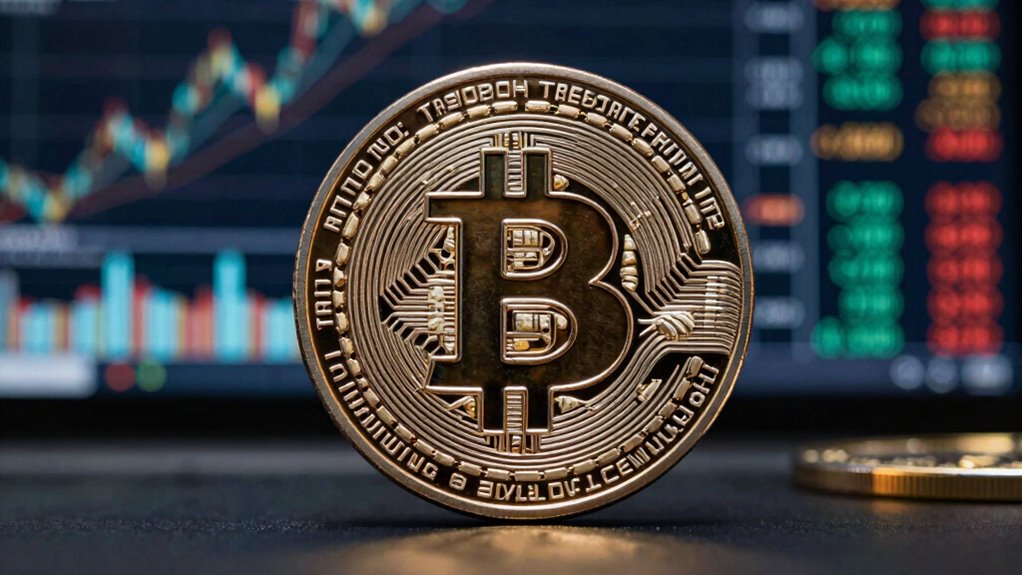
Have you ever wondered why Bitcoin is increasingly viewed as a benchmark for the entire asset class? It’s because Bitcoin’s price movements often reflect broader market trends, making it a useful indicator for investors across industries. Unlike traditional assets, Bitcoin is known for its market volatility, which can be dramatic and sudden. This volatility might seem risky at first glance, but it actually offers valuable insights. When Bitcoin swings wildly, it highlights how markets can react to economic shifts, regulatory news, or investor sentiment. For institutional investors, observing Bitcoin’s price dynamics provides clues about risk appetite and market sentiment on a macro level. Over time, these patterns help shape their broader investment strategies, positioning Bitcoin as a kind of barometer for financial markets. The high refresh rates and real-time nature of Bitcoin trading further enhance its utility as a market indicator, allowing for immediate reactions to global events. Additionally, the regulatory environment surrounding cryptocurrencies influences Bitcoin’s status as a benchmark, as clarity and stability in regulation can bolster its reliability as an indicator. A growing institutional presence in the market also contributes to its credibility, as larger players tend to bring more stability and strategic interest. Their participation often leads to increased market maturity, which can help reduce short-term volatility and foster a more stable environment for investors. This evolving landscape underscores how market dynamics driven by institutional involvement shape Bitcoin’s role as a financial indicator. When big players like hedge funds, asset managers, and corporations start investing in Bitcoin, it signals a shift in how the asset is perceived. Their participation boosts confidence and legitimizes Bitcoin as a serious asset class, not just a speculative tool. As more institutions allocate a portion of their portfolios to Bitcoin, its price movements tend to mirror institutional sentiment, which is often more calculated and strategic than retail-driven. This institutional backing also introduces a level of stability and credibility, gradually reducing some of the market’s volatility. Still, even with increased institutional adoption, Bitcoin remains sensitive to macroeconomic factors, regulatory changes, and technological developments, making it a dynamic gauge of the overall financial environment.
As an affiliate, we earn on qualifying purchases.
Frequently Asked Questions
How Does Bitcoin’s Volatility Compare to Traditional Assets?
You’ll find that Bitcoin’s volatility is much higher than traditional assets, causing significant price fluctuations often daily. Unlike stocks, bonds, or gold, which offer market stability, Bitcoin’s rapid price swings can be unsettling, making it riskier for investors seeking stability. Its unpredictable nature means you should be prepared for sharp changes, so weigh this volatility carefully when considering Bitcoin’s role in your portfolio.
Can Bitcoin Replace Gold as a Safe-Haven Asset?
You might wonder if Bitcoin can replace gold as a safe-haven asset. While Bitcoin’s digital scarcity appeals, market sentiment remains volatile, affecting its reliability during crises. Unlike gold, which has a long-standing history of stability, Bitcoin’s value depends heavily on investor confidence. Although it offers decentralization and limited supply, its current volatility makes it less dependable as a true safe haven, but that could change as adoption grows.
What Are the Main Risks of Using Bitcoin as a Benchmark?
Using Bitcoin as a benchmark is like steering through a stormy sea—you face unpredictable waves. The main risks include market manipulation, which can distort prices easily, and technological risks, like hacking or system failures, that threaten security. These issues make Bitcoin volatile and uncertain, challenging its reliability as a stable benchmark. You should remain cautious, understanding that these risks could impact its effectiveness in setting consistent standards across markets.
How Does Institutional Adoption Impact Bitcoin’s Benchmark Status?
Institutional adoption boosts Bitcoin’s market maturity and strengthens its status as a benchmark. When large institutions enter, they bring credibility, increased liquidity, and stability, making Bitcoin more representative of the broader asset class. Their influence can attract more investors, fostering trust and reducing volatility. However, it also means Bitcoin becomes more intertwined with traditional financial systems, potentially impacting its decentralization and making it susceptible to institutional-driven market shifts.
Are There Regulatory Challenges Affecting Bitcoin’s Role as a Benchmark?
Think of Bitcoin as a lighthouse guiding the crypto market, but legal hurdles and regulatory uncertainty cast shadows over its brightness. These challenges create hurdles for institutions and investors, making them wary of relying solely on Bitcoin as a benchmark. You might find that shifting regulations and unclear rules hinder its stability and acceptance, causing fluctuations that prevent it from serving as a universal standard in the evolving financial landscape.
cryptocurrency market analysis tools
As an affiliate, we earn on qualifying purchases.
As an affiliate, we earn on qualifying purchases.
Conclusion
As you watch Bitcoin carve its path through the financial landscape, it’s clear it’s not just a coin but a compass guiding the entire asset class. Its rise sparks a new dawn, like a lighthouse piercing through fog, illuminating the way forward. Embrace this digital pioneer, for it’s rewriting the rules and setting the rhythm for the markets to follow. In its wake, a new era of investment dawns, vibrant and full of promise.
As an affiliate, we earn on qualifying purchases.
As an affiliate, we earn on qualifying purchases.