
When comparing Bitcoin and digital gold as stores of value, you’ll notice Bitcoin’s high volatility and regulatory uncertainties make it riskier but with high growth potential. Gold remains stable and proven over centuries as a safe haven, especially during economic instability. Your choice depends on whether you prioritize stability or are willing to accept short-term fluctuations for the chance at greater returns. To understand the deeper implications, keep exploring how each aligns with your long-term wealth plans.
Key Takeaways
- Gold has a long-standing reputation as a stable store of value, while Bitcoin’s volatility introduces risks for long-term wealth preservation.
- Regulatory uncertainties and market swings impact Bitcoin’s reliability compared to the more stable, well-established gold.
- Bitcoin is increasingly seen as a digital asset, whereas gold remains the traditional safe-haven asset for centuries.
- Gold offers consistent stability and inflation hedging, while Bitcoin’s value is influenced by market sentiment and evolving perceptions.
- Both serve as stores of value, but gold’s historical stability contrasts with Bitcoin’s rapid price fluctuations and emerging role.
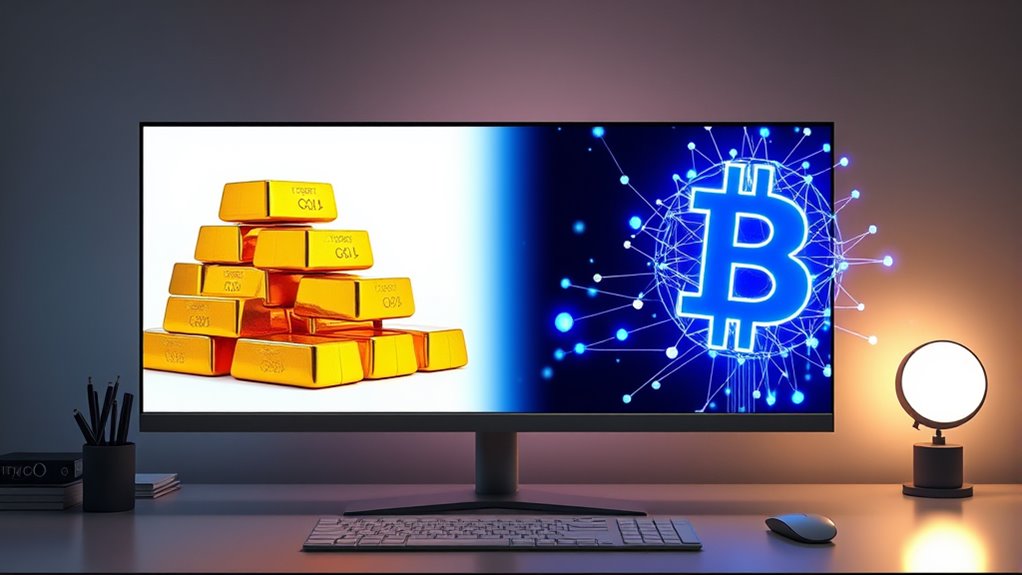
When comparing Bitcoin to digital gold, it’s clear that both serve as stores of value in the digital age, but they differ substantially in purpose and perception. You see, Bitcoin emerged as a decentralized digital currency, designed to operate independently of traditional financial systems. Over time, many investors started viewing it less as a currency and more as a digital asset that can preserve wealth, similar to gold. However, unlike gold, Bitcoin faces ongoing challenges related to cryptocurrency regulation. Governments and regulators worldwide are still figuring out how to classify and control cryptocurrencies, which creates uncertainty. This uncertain regulatory landscape influences how you might perceive Bitcoin’s safety as a store of value. If regulations tighten or become more restrictive, it could impact Bitcoin’s liquidity and ease of access, making it riskier compared to traditional assets like gold.
Market volatility is another critical factor that sets Bitcoin apart from digital gold. Bitcoin’s price swings are well-known for their dramatic nature, with sharp increases followed by steep declines. These fluctuations can be unsettling if you’re contemplating Bitcoin solely as a long-term store of wealth. Unlike gold, which has maintained relatively stable prices over decades, Bitcoin’s value can change drastically over short periods. This volatility stems from various factors: speculative trading, market sentiment, regulatory news, or macroeconomic shifts. While some see this as an opportunity for quick gains, it also means your investment can be exposed to significant risk. Gold, on the other hand, tends to act as a hedge against inflation and economic instability, providing a more stable store of value over time. Additionally, the evolving perception of Bitcoin influences its role as a store of value, with some arguing that its market perception is still in flux, which adds to the uncertainty of its long-term stability.

1986 – Present (Random Year) American Gold Eagle 1/10th oz Bullion Coin with Certificate of Authenticity $5 Seller Uncirculated
✔️Each coin contains 1/10 oz of gold.
As an affiliate, we earn on qualifying purchases.
As an affiliate, we earn on qualifying purchases.
Frequently Asked Questions
How Does Bitcoin’s Volatility Compare to Traditional Gold?
You’ll notice that Bitcoin’s volatility is much higher than traditional gold’s. Its price stability is often affected by market fluctuations, causing rapid swings that can be nerve-wracking. Unlike gold, which remains relatively steady over time, Bitcoin’s value can change drastically in short periods. If you’re looking for a reliable store of value, gold’s stability offers a safer option, whereas Bitcoin’s volatility can be an opportunity or a risk.
Can Bitcoin Replace Gold as a Long-Term Store of Value?
You might see Bitcoin replacing gold as a long-term store of value, thanks to its digital scarcity and increasing market adoption. Its limited supply and decentralized nature make it appealing for those seeking a reliable hedge against inflation. While volatility remains a concern, growing acceptance and institutional interest suggest Bitcoin could become a modern alternative, offering the benefits of digital assets while maintaining the store-of-value qualities traditionally associated with gold.
What Are the Environmental Impacts of Bitcoin Mining Versus Gold Extraction?
They say “you are what you consume,” and when it comes to environmental impact, Bitcoin mining and gold extraction both leave a mark. Bitcoin’s resource consumption, especially energy use, is high but more transparent and potentially more sustainable with greener energy. Gold mining, on the other hand, causes significant environmental damage through land disruption and toxic chemicals. Both impact ecosystems, but Bitcoin’s footprint can be reduced with cleaner technology.
How Do Regulatory Environments Affect Bitcoin and Gold Investments?
You’ll find that regulatory hurdles and tax implications markedly impact your investments in both Bitcoin and gold. Governments may impose stricter rules on cryptocurrencies, affecting liquidity and access, while gold investments face different tax treatments depending on your jurisdiction. Staying informed about changing regulations helps you navigate these challenges, ensuring you comply and optimize your returns. Flexibility and awareness are key to managing risks associated with evolving regulatory environments.
Which Asset Offers Better Liquidity During Market Crises?
During market crises, you’ll find that Bitcoin generally offers better liquidity compared to digital gold. Its liquidity comparison shows that you can buy or sell Bitcoin quickly, even in turbulent times, thanks to its active global market. However, Bitcoin’s crisis resilience can vary based on regulatory environments and market sentiment. Gold tends to be more stable and less volatile, but it might take longer to convert into cash during extreme market upheavals.

Bitkey Bitcoin Hardware Wallet – The Most Secure Way to Buy, Store and Manage Bitcoin
BITCOIN EXCLUSIVE: Bitkey is designed from the ground up exclusively for Bitcoin, offering a dedicated hardware wallet solution…
As an affiliate, we earn on qualifying purchases.
As an affiliate, we earn on qualifying purchases.
Conclusion
Ultimately, whether you see Bitcoin or digital gold as the better store of value depends on your risk appetite and vision for the future. Bitcoin, like a rising tide, promises growth and innovation, while digital gold stands firm as a timeless fortress of stability. Both hold potential, but only you can decide which treasure aligns with your financial voyage. Remember, in this digital age, choosing the right vault can make all the difference.
Bitcoin; The Digital Gold and the Birth of ETFs.
As an affiliate, we earn on qualifying purchases.
As an affiliate, we earn on qualifying purchases.

Cryptocurrency and Digital Asset Regulation: A Practical Guide for Multinational Counsel and Transactional Lawyers
As an affiliate, we earn on qualifying purchases.
As an affiliate, we earn on qualifying purchases.