

Bitcoin’s supply limit of 21 million coins creates inherent scarcity, making it a valuable asset that resist inflation. As the supply approaches its cap, fewer new coins enter circulation, increasing demand from investors who see it as a safe store of value. This scarcity fuels price growth and investor confidence. If you want to understand how this fixed cap continues to influence Bitcoin’s value over time, keep exploring this fascinating dynamic.
Key Takeaways
- Bitcoin’s fixed supply creates scarcity, increasing its perceived value and driving demand among investors.
- The 21-million cap prevents inflation, ensuring Bitcoin remains a deflationary asset.
- Halving events reduce new coin issuance, reinforcing scarcity and supporting price appreciation.
- Supply limitations motivate miners to focus on transaction fees, maintaining network security amidst reward reductions.
- The scarcity-driven model fosters trust and positions Bitcoin as a digital store of value similar to gold.
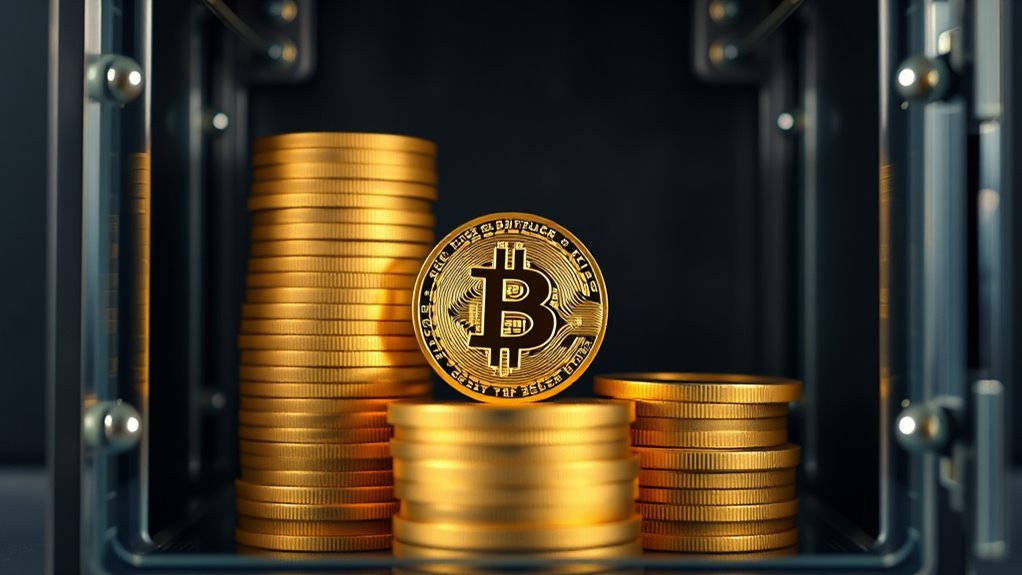
Have you ever wondered why Bitcoin’s supply is capped at 21 million coins? It’s a deliberate design choice that plays a vital role in shaping Bitcoin’s value. This fixed cap creates a unique economic environment where miner incentives and scarcity effects combine to influence the cryptocurrency’s worth. When Bitcoin was first introduced, miners received a reward for verifying transactions – this reward was Bitcoin itself. Over time, that reward halves approximately every four years in an event called the “halving,” steadily reducing new Bitcoin creation. As the supply diminishes, miners’ incentives shift; they rely more on transaction fees rather than block rewards. This gradual reduction encourages miners to optimize their operations, but it also emphasizes the importance of scarcity in maintaining Bitcoin’s value. Because only 21 million coins will ever exist, scarcity effects kick in, making Bitcoin more than just a digital currency—they create a store of value akin to precious metals.
Bitcoin’s fixed supply of 21 million coins creates scarcity that boosts demand and preserves its value over time.
You might notice that scarcity effects drive demand higher as supply becomes limited. Unlike fiat currencies, which governments can print endlessly, Bitcoin’s fixed supply makes it inherently scarce. This scarcity fosters a sense of urgency among investors and users, fueling demand even if the utility is similar to other digital assets. When fewer new coins are produced, and existing coins are held by long-term investors, the available supply in the market shrinks. This scarcity tends to push prices upward, especially during periods of increased interest or economic uncertainty. Hence, the capped supply ensures that Bitcoin’s value isn’t diluted by inflation, unlike traditional currencies.
Miner incentives are intricately tied to this scarcity. Early on, miners had a substantial incentive due to high rewards, but as these rewards halve, their focus shifts to transaction fees, which are driven by network activity. The scarcity effects mean that miners are motivated to keep the network secure and functional, even as the block rewards decrease. Their incentives align with maintaining a limited supply, guaranteeing that Bitcoin remains scarce and valuable. This dynamic creates a self-reinforcing cycle: the capped supply heightens scarcity effects, which in turn sustains demand and price, motivating miners to support the network despite declining rewards.
In essence, Bitcoin’s supply limit isn’t just a technical detail; it fundamentally shapes its value. The interplay of miner incentives and scarcity effects ensures that Bitcoin remains a scarce asset, fostering trust and demand. This scarcity ultimately underpins Bitcoin’s reputation as “digital gold,” providing users with a decentralized store of value that’s immune to inflationary pressures of traditional money.

Bitkey Bitcoin Hardware Wallet – The Most Secure Way to Buy, Store and Manage Bitcoin
BITCOIN EXCLUSIVE: Bitkey is designed from the ground up exclusively for Bitcoin, offering a dedicated hardware wallet solution…
As an affiliate, we earn on qualifying purchases.
As an affiliate, we earn on qualifying purchases.
Frequently Asked Questions
How Does Bitcoin’s Supply Limit Affect Its Scalability?
Bitcoin’s supply limit doesn’t directly affect its scalability, but block size limitations do. These restrictions cap transaction throughput, meaning only a certain number of transactions can fit into each block. When demand rises, this bottleneck causes delays and higher fees. To improve scalability, solutions like increasing block size or implementing second-layer protocols are needed, allowing more transactions per second without compromising the fixed supply.
Can Bitcoin’s Supply Limit Be Increased in the Future?
Bitcoin’s supply limit can’t be increased, as it’s hardcoded into its protocol, regardless of central bank policies or inflation concerns. You can’t simply change the cap; it’s designed to be scarce, making it an effective inflation hedge. This fixed supply helps maintain its value over time, resisting inflationary pressures that might occur if central banks print more money. So, Bitcoin’s supply limit stays constant, preserving its scarcity and appeal.
What Happens to Bitcoin’s Value if Demand Surpasses Supply?
Imagine the scarcity effect in action: when demand for Bitcoin exceeds its limited supply, its value skyrockets. You’ll see this as a natural inflation control, since fewer new coins enter the market. As more people chase the same limited supply, the price rises, making Bitcoin more valuable. This imbalance fuels growth, proving that scarcity truly drives its worth higher, rewarding those who hold onto their coins during surges.
Are There Alternative Cryptocurrencies With Different Supply Models?
Yes, you can explore alternative tokens with different supply models, offering more supply flexibility. These cryptocurrencies often have inflationary or dynamic supply mechanisms, unlike Bitcoin’s fixed limit. By choosing these alternatives, you might benefit from increased supply updates or adjustments, which could influence their value and utility. Keep in mind, though, that supply flexibility can also introduce higher inflation risks, affecting long-term stability and your investment strategies.
How Does Bitcoin’s Fixed Supply Influence Its Adoption in Different Countries?
You’ll find that Bitcoin’s fixed supply encourages adoption in countries with supportive government regulation and cultural acceptance. In places where authorities embrace cryptocurrencies, people see Bitcoin as a secure, scarce asset, boosting trust and use. Conversely, strict regulation or cultural skepticism can hinder adoption. Your willingness to navigate these factors determines how quickly Bitcoin gains popularity locally, especially as its scarcity appeals to those seeking a hedge against inflation or financial instability.

8GPU Mining Rig Complete Crypto Miner with Windows10,Including 8GPU Mining Motherboard 2000W Power Supply,CPU,SSD,4G RAM, 8 GPU Mining Case for ETC/LTC/XHV/Monero/Ravencoin(Without GPU)
Effortless Setup in Minutes: With high-quality mining hardware and Win10 English operating system (not activated), this GPU miner…
As an affiliate, we earn on qualifying purchases.
As an affiliate, we earn on qualifying purchases.
Conclusion
As you watch Bitcoin’s supply cap hold firm, it’s almost as if the universe conspired to set this limit just as interest in digital assets surged. This coincidence deepens your understanding—its scarcity isn’t just a fixed number but a reflection of the unpredictable dance between technology, market demand, and human behavior. In this way, Bitcoin’s supply limit doesn’t just shape its value; it mirrors the intricate, unpredictable patterns of the financial world itself.

Zyntrazy Real-Time Bitcoin & Crypto Stock Ticker with Gold Price Tracking, Digital Clock with Weather, Temperature and Humidity Display, US Market Data, Creative Gift for Husband, Boyfriend or Women
Next-Gen System Upgrade — Backed by CoinGecko, it monitors real-time prices for over 2000 leading cryptocurrencies and the…
As an affiliate, we earn on qualifying purchases.
As an affiliate, we earn on qualifying purchases.

TANGEM Wallet Pack of 2 – Secure Crypto Wallet – Trusted Cold Storage for Bitcoin, Ethereum, NFT's & More Coins – 100% Offline Hardware Wallet
THE HIGHEST LEVEL OF SECURITY: Tangem Wallet generates the private key that never leaves the card. Your crypto…
As an affiliate, we earn on qualifying purchases.
As an affiliate, we earn on qualifying purchases.