TL;DR
Mistral is betting on sovereignty, open weights, and enterprise control as key differentiators. While it appeals to European buyers wary of dependence, critics argue it may be falling behind in reasoning and context performance, raising the question: is it a strategic move or a sign of decline?
When European AI startups talk about sovereignty, they’re not just making political noise. They’re addressing real, concrete needs—data residency, control, compliance—that many US giants overlook. They’re addressing real, concrete needs—data residency, control, compliance—that many US giants overlook. But as Mistral champions this narrative, a nagging question arises: is this a smart, strategic pivot, or are they already slipping behind the front-runners in core AI capabilities?
This article unpacks what Mistral is really doing—its strategy, its strengths, and its weaknesses. We’ll look at how its focus on sovereignty and open weights stacks up against the fierce, fast-moving world of frontier AI. The goal? To see if Mistral’s different game is a winning move or a sign of trouble.
Different game, or already lost?
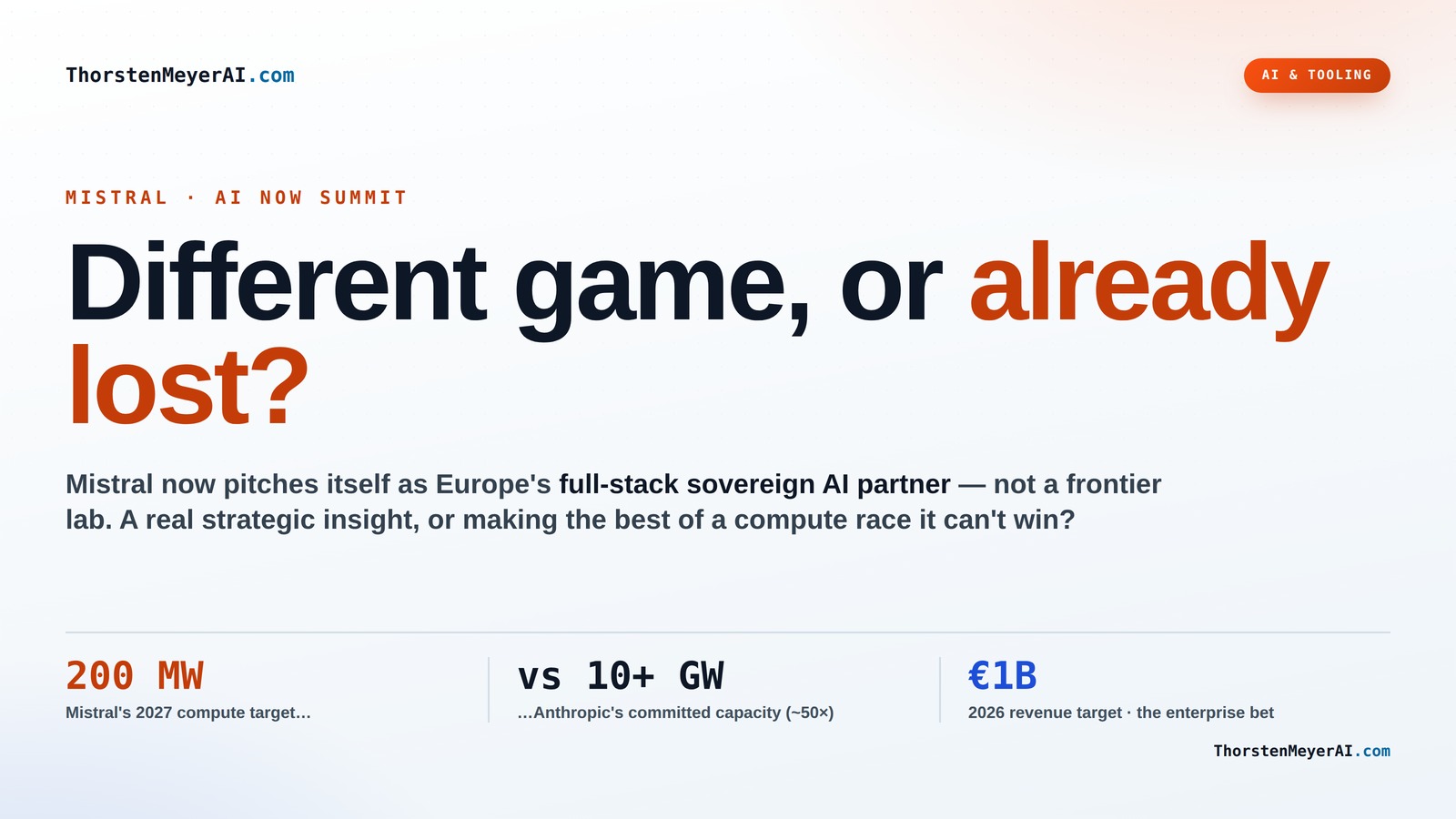
Mistral now pitches itself as Europe’s full-stack AI provider — compute, models, platform, consultancy — not a frontier-model lab. Is that a real strategic insight, or making the best of a race it can’t win? Both readings fit the same facts.
From model lab to full-stack provider
The clearest signal from the summit wasn’t a model — it was a posture. Heavy on enterprise logos and partnerships (ASML, BNP Paribas, Alexa+), light on new-model announcements. That absence is exactly what skeptics seized on.
Compute
40MW Paris DC + Sweden build · 200MW target by 2027
Models
Open & custom · efficient · you own and run them
Platform
Forge for custom models · Vibe for Work agent
Consultancy
Sales teams, integrators, EU provenance & support
enterprise AI model hosting platform
As an affiliate, we earn on qualifying purchases.
As an affiliate, we earn on qualifying purchases.
Small & focused, or large & general?
Mistral bets on specialized small models. The claim isn’t that they win a reasoning leaderboard — they don’t. It’s that on the metrics that matter in production agent systems, a purpose-built small model wins. Flip the metric to see the case reverse.
Small specialized vs large general — by what you measure
In token-heavy agentic apps making hundreds of calls, speed/energy/cost compound. Toggle the metric.

Building AI-Powered Products: The Essential Guide to AI and GenAI Product Management
As an affiliate, we earn on qualifying purchases.
As an affiliate, we earn on qualifying purchases.
Narrow models doing real work
Each is one model doing one thing efficiently — the tangible version of the strategy. Strong on their own terms; the open question is whether the bundle beats a free Chinese open-weight download.
On-prem KYC compliance
Mistral models run inside the bank’s walls for know-your-customer checks. Sensitive financial data never leaves. (BNP was Mistral’s first customer, 2023.)
Voxtral multilingual voice
A focused voice model powering Alexa+ across Europe — speed and efficiency over raw size.
Robostral industrial robotics
Plus a “physics AI” push (via the Emmi acquisition) into aerospace, automotive & semiconductor design and simulation.
Document AI / OCR at scale
Large-scale text extraction — the unglamorous, high-volume enterprise work small models excel at.
data residency compliant AI solutions
As an affiliate, we earn on qualifying purchases.
As an affiliate, we earn on qualifying purchases.
The strategy is downstream of the compute gap
Once you see the raw numbers, “why is Mistral behind?” answers itself — and the specialized-small-model strategy starts looking partly like a smart adaptation to a binding constraint, not a pure philosophical choice.
Compute & capital · Mistral vs a frontier leader, this same week
Not a knock — it’s the constraint that forces the efficiency-first, sovereignty-wedge strategy. Adapting intelligently to your position is what good strategy is.

BXQINLENX Professional 17 PCS Model Tools Kit Modeler Basic Tools Craft Set Hobby Building Tools Kit For Gundam Car Model Building Repairing and Fixing
● FUNCTION—EASY TO USE—The modeler basic tools set is suitable for a beginner and advanced modeler as well.You…
As an affiliate, we earn on qualifying purchases.
As an affiliate, we earn on qualifying purchases.
“I want them to win, but I’m worried”
That ambivalence is the most accurate read of where Mistral sits. The enterprise pivot gets read two opposite ways — and both deserve airing.
On-prem, real sales teams, the Koyeb deployment acquisition, EU provenance — exactly what regulated enterprises want, and stickier than consumer mindshare. Targeting €1B revenue in 2026 with 1,000 staff, up from 15 people and one customer in 2023. US closed-API labs structurally can’t match the sovereignty axis.
“Software consultancy with a data center,” not a foundation-model moat. Enterprise B2B is where European startups go when they can’t win consumer or world-scale SaaS. Why pay Mistral on-prem when you could run Qwen free? One paying Le Chat Pro user said the quality gap with frontier labs is now hard to ignore.
Key Takeaways
- Mistral’s focus on sovereignty and open weights appeals most to regulated European enterprises seeking control and compliance.
- Recent signals suggest Mistral models may lag behind in reasoning and medium-context performance, raising questions about long-term competitiveness.
- The value of open weights is control and customization, but infrastructure and expertise costs can limit appeal for some organizations.
- Sovereignty can be a strong differentiator today, but in AI’s fast race, capability gaps could threaten its durability.
- Buyers need to weigh control and compliance against raw performance—Mistral’s strategy targets a specific niche that values independence.
What Does 'Sovereign' Really Mean for Mistral? It’s More Than Just a Buzzword.
"Sovereign AI" means taking control—over data, hardware, and the model itself. For Mistral, that’s about European independence, hosting models locally, and avoiding the dependency trap of US cloud giants. It’s not just political; it’s a concrete business edge.
Take BNP Paribas, for instance. They run Mistral models on-prem in Belgium, keeping sensitive financial info inside their own walls. That’s sovereignty in action—data stays put, compliance is easier, and control remains tightly in their hands.
So, for many European enterprises, sovereignty translates to security, compliance, and risk reduction. It’s a clear buyer need, especially for regulated sectors like finance and defense. But does that make Mistral inherently better? Depends. It’s a strategic choice—more control often means more costs and potentially less cutting-edge capability. Understanding the importance of strategic control in technology investments can help contextualize this tradeoff.

Open Weights vs. Closed APIs: Why Mistral’s Self-Hosting Push Matters
Mistral’s core differentiation is its open weights—models like Mistral 7B and Mixtral 8x7B are licensed under Apache 2.0, which means you can download, fine-tune, and run them yourself. That’s a game changer for control, customization, and risk management.
Compare this to OpenAI, Anthropic, or Google, where models are only accessible via APIs. For insights on AI control and sovereignty, visit The Liberty Portfolio. For organizations with strict data policies or needing to tweak models for specific workflows, open weights are a lifeline.
However, open weights aren’t a free lunch. They require infrastructure, technical expertise, and ongoing maintenance. For some, this tradeoff is worth it. For others, especially if performance lags, it’s not.

Is Mistral Still Leading in Capabilities? The Growing Skepticism
Here's the tough truth: many experts now question if Mistral can keep pace in reasoning, understanding, and medium-context tasks. Recent discussions highlight that Mistral models, especially the smaller ones, may lag behind GPT-4, Claude, or Gemini in core capabilities. Read more about AI capability comparisons and industry insights.
For example, in recent benchmarks, models like GPT-4 excel at complex reasoning and understanding nuanced prompts. Mistral’s models, while efficient, are often seen as less capable on these fronts, especially in multi-turn conversations or longer contexts.
This creates a dilemma: is the sovereignty story enough to justify a premium, or will performance gaps eventually push buyers towards more capable but less controllable options?

Who Buys Mistral, and Why? Real Enterprise Drivers
Mistral appeals most to European regulators, governments, and large enterprises with strict data needs. Companies like BNP Paribas or Abanca choose Mistral precisely because they want to keep data in-house and control model deployment.
For these buyers, sovereignty, compliance, and risk mitigation outweigh raw performance. They prefer models they can host, audit, and customize—especially when regulations make API reliance risky or impossible.
But that’s a niche. The broader market still leans toward the giants who dominate in reasoning and language understanding. Mistral’s challenge is convincing enterprises that sovereignty and control can also mean cutting-edge AI.

The Big Question: Can Sovereignty Be a Long-Term Moat?
It’s tempting to think sovereignty and open weights create a durable advantage. Explore the implications of sovereignty in AI strategy. But the rapid pace of AI research means today’s edge can be tomorrow’s lag. If Mistral fails to match or surpass the reasoning capabilities of the giants, its strategic positioning might erode.
Recent signals suggest Mistral might be falling behind in the core AI race. If medium-context understanding and reasoning don’t improve, the control and sovereignty story alone won’t be enough to keep clients loyal.
The question isn’t just about today’s capabilities. It’s about whether sovereignty can remain relevant if AI’s most valuable skills—deep reasoning and long context comprehension—keep advancing elsewhere. Learn more about AI industry trends and strategic positioning.
Frequently Asked Questions
What exactly does 'sovereign' mean in Mistral’s case?
It means European companies can host models locally, control updates, and keep sensitive data in-house. Sovereignty covers data residency, open weights, and local deployment—addressing specific legal and security needs.
Is Mistral actually better for enterprises than US AI giants?
For control, compliance, and customizability, yes. But when it comes to raw reasoning and understanding, Mistral’s models may lag behind GPT-4 or Claude, especially in complex tasks.
How does Mistral compare with OpenAI or Anthropic?
Mistral emphasizes open weights and local deployment, while OpenAI and Anthropic focus on API-driven, centrally hosted models. Capabilities are still competitive, but recent signals suggest Mistral may be falling behind in reasoning tasks.
Is Mistral’s sovereignty story sustainable if it can’t match reasoning quality?
Probably not in the long run. If medium-context and reasoning performance don’t improve, clients may switch to more capable models, even if they lose control and sovereignty advantages.
Will sovereignty remain a key differentiator?
It depends on regulatory trends and enterprise needs. For now, sovereignty aligns with European data laws and security priorities, but AI capability growth might eventually overshadow it.
Conclusion
Whether Mistral’s different game is a smart move or a sign of weakness depends on what matters most to buyers today: control or capability. For regulated industries and European governments, sovereignty still shines. But in the race for reasoning mastery, the giants keep pulling ahead.
If Mistral wants to stay relevant, it must improve its core AI skills—fast. Otherwise, sovereignty alone won’t be enough to keep it in the game.