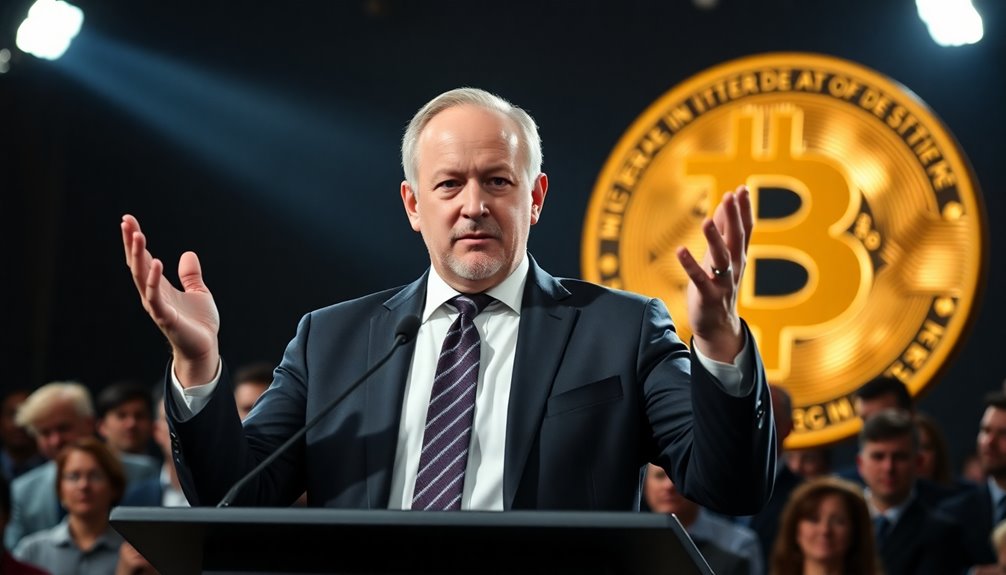

You might find Peter Schiff's take on Bitcoin reserves quite provocative. He argues that the volatility of Bitcoin makes it a poor choice as a reserve asset, calling its promotion "fraudulent." Schiff's preference for traditional assets like gold highlights a larger debate about the legitimacy and stability of cryptocurrencies. But what does this mean for the future of digital currencies and their role in investment strategies?

Get hardware and tech essentials delivered free with Prime
- Fast, free delivery on millions of items
- Prime Video, Amazon Music and more included
- Member-only deals all year

Peter Schiff's recent comments about a Bitcoin reserve have stirred up quite a debate in the crypto community. Initially, some interpreted his words as support for the concept, but Schiff quickly clarified his position, vehemently opposing the idea. He's accused Bitcoin promoters of using fraudulent marketing tactics, arguing that they manipulate the narrative around Bitcoin to inflate its value and legitimacy. Schiff's critiques focus on the volatility of Bitcoin, questioning its role as a reliable reserve asset compared to traditional safe havens like gold.
Peter Schiff's strong opposition to a Bitcoin reserve highlights concerns over its volatility and legitimacy compared to traditional assets like gold.
The concept of a Bitcoin reserve is intriguing. It involves holding Bitcoin as a strategic asset that could theoretically boost market confidence and encourage institutional adoption. However, Schiff warns that Bitcoin's inherent volatility makes it a risky choice for such a purpose. He believes that positive endorsements for a Bitcoin reserve can lead to significant price surges in the short term, but ultimately, it raises more concerns about market stability and liquidity. If Bitcoin can't maintain a steady price, its role as a reserve becomes questionable. Schiff's recent reversal on his support for a Bitcoin reserve further highlights his concerns about the cryptocurrency's reliability.
Schiff's criticisms extend to the broader implications for the crypto market. He argues that fluctuating sentiments triggered by discussions around a Bitcoin reserve can lead to drastic price movements, affecting not just Bitcoin but also other cryptocurrencies. This volatility shakes investor confidence, and when trust wavers, trading activity can spike, leading to further instability. The ripple effects of Schiff's comments have already sparked controversy, illustrating how influential voices can sway market dynamics.
Moreover, when you compare Bitcoin to traditional assets, Schiff's arguments gain traction. He points out that Bitcoin, often dubbed "digital gold," doesn't possess the same reliability as its physical counterpart. His skepticism extends to the inclusion of other cryptocurrencies in reserve discussions, like XRP. He sees XRP as having a different purpose and questions whether altcoins can genuinely serve as stable reserve assets.
In a politically charged environment, discussions about a Bitcoin reserve take on additional layers. Recent plans involving Bitcoin, XRP, Solana, and Cardano have drawn attention, leading to market reactions that suggest potential legitimacy. However, Schiff's stance remains clear: without addressing the volatility and liquidity risks, Bitcoin's role as a dependable reserve asset is fundamentally flawed.
As debates continue, it's essential to consider the implications of Schiff's critiques on both market sentiment and investor behavior.
As an affiliate, we earn on qualifying purchases.
As an affiliate, we earn on qualifying purchases.
As an affiliate, we earn on qualifying purchases.
As an affiliate, we earn on qualifying purchases.
Fall Picks
fall essentials
As an affiliate, we earn on qualifying purchases.