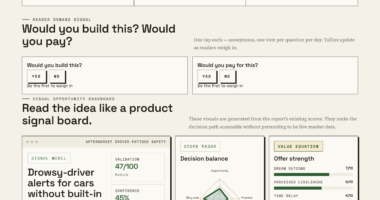

📊 Full opportunity report: The Local-First Agentic Operator on ThorstenMeyerAI.com — validation score, market gap, and execution plan.
TL;DR
A new approach enables a solo operator, using agentic AI, to develop and run multiple complex software products across domains. This challenges traditional organizational models and emphasizes local control and flexibility.
A single operator equipped with agentic AI has demonstrated the ability to build and manage a portfolio of 18 diverse software products, a task that traditionally required multiple teams or an organization. This development suggests a shift in the scale and scope of individual software creation and operation, with significant implications for how software is built and maintained.
The portfolio includes a range of tools, from content engines to satellite-radar ISR platforms, all built with a consistent local-first and provider-agnostic approach. The operator used agentic AI to create these products without prior coding skills, emphasizing a new model where a person, amplified by AI, can perform tasks once reserved for large teams. Each product adheres to four core principles: owning data and compute locally, maintaining flexibility in vendor and model choices, leveraging AI-assisted human editing, and subtracting unnecessary complexity.
This approach challenges the conventional wisdom that building such diverse systems requires extensive organizational resources. Learn more about European agentic commerce. Instead, it posits that a single, well-equipped individual can achieve similar results, provided they adopt these principles and tools. The series serves as evidence that this new model is viable across multiple domains, from regulated industries to defense and open-source projects.
The Local-First Agentic Operator
Eighteen products that looked like a sprawl were never eighteen things. They were one thing, built eighteen times. This is the thesis underneath all of them — named.
- Not “solo beats funded team.” Depth still wins most single contests. The narrower, truer claim: the floor moved — one person can now do what recently took many.
- Breadth is strength and risk. Eighteen products is resilience and a focus problem; several are seeds, not trees.
- The AI part is assisted, not autonomous. Strip away human judgment and subtraction and you get faster mediocrity, not a portfolio.
- A pattern, not a prescription. This fit one operator, one skill set, one moment. The honest version of any manifesto includes “this worked for me.”
A synthesis and a statement of one operator’s working philosophy — independent commentary, produced with AI assistance under human editorial oversight. The views are the author’s own and may change. This is not business, financial, legal, or technical advice, and the four-facet framing is a personal operating pattern, not a prescription or a claim of results. Individual products carry their own terms, disclaimers, and limitations in their respective articles; several are early- or positioning-stage. Product, model, and company names are trademarks of their respective owners; mention does not imply endorsement.
Implications for Software Development and Organizational Structures
This shift could redefine the future of software creation, reducing reliance on large organizations and enabling individuals to innovate and operate at scale. It raises questions about the future of employment in tech, the decentralization of software production, and the resilience of local-first, provider-agnostic systems. The approach also emphasizes control over data and models, which has implications for security, privacy, and long-term sustainability. However, it remains to be seen how broadly applicable and scalable this model is outside controlled demonstrations.

Yahboom K230 AI Development Board 1.6GHz High-performance chip/2.4-inch Display/Open Source Robot Maker Python, Supports AI Visual Recognition CanMV Sensor (with Heightened Bracket)
- High-performance AI Chip: 1.6GHz processor with advanced KPU and CPU power
- Real-time AI Processing: Supports complex AI models for image and voice recognition
- Flexible Expansion: Includes 12-pin GPIO for sensors and modules
As an affiliate, we earn on qualifying purchases.
As an affiliate, we earn on qualifying purchases.
From Organizational to Individual Software Production
Historically, building and managing complex software portfolios required dedicated teams, extensive coordination, and organizational infrastructure. Recent advances in AI, particularly agentic AI, have begun to challenge this paradigm. The series of 18 products, presented by Thorsten Meyer, illustrates a new approach where a single person, guided by AI, can replicate what previously needed multiple specialists and resources. This development aligns with broader trends toward decentralization and democratization of technology, but it is notable for its scope and the explicit principles guiding the process.
Prior to this, individual developers or small teams could create specific tools, but managing a diverse portfolio at this scale was impractical without organizational support. The demonstration shows that with the right principles—local ownership, model flexibility, AI-assisted editing, and subtraction—such feats are now feasible for a lone operator, marking a potential turning point in software engineering.
“The unit isn’t ‘the startup.’ It’s ‘the person, amplified.'”
— Thorsten Meyer

Private AI Engineering with Ollama and Linux: Build Local LLM Servers, Private RAG, GPU Workstations, and Self-Hosted AI Platforms (Production AI Engineering Series Book 4)
As an affiliate, we earn on qualifying purchases.
As an affiliate, we earn on qualifying purchases.
Limitations and Unanswered Questions About the Model
It is not yet clear how scalable or sustainable this approach is outside controlled demonstrations. Questions remain about long-term maintenance, security, and whether such solo operations can handle highly complex or regulated environments at scale. Additionally, the reliance on agentic AI raises concerns about oversight, quality assurance, and potential vendor lock-in for models and tools.

AI Project Power: Reimagining Your Role in the Age of Artificial Intelligence
As an affiliate, we earn on qualifying purchases.
As an affiliate, we earn on qualifying purchases.
Next Steps for Validating Solo Operator Model
Further testing and real-world application are needed to assess the approach’s scalability and robustness. Industry observers will watch for broader adoption, potential limitations, and how this model influences organizational structures in technology. Continued development of agentic AI tools and community sharing of best practices will shape its evolution.

XTOOL AD20 Pro OBD2 Scanner – No Subscription, Full System Car Diagnostic Scan Tool with AI Analysis, Wireless OBD Car Code Reader, Oil Reset, Performance Test, Voltage Test
- No Subscription Needed: Supports unlimited vehicles with free updates
- AI Diagnostic & Repair Guidance: Provides real-time analysis and repair suggestions
- Full System Access: Diagnoses all electronic vehicle systems including ABS, SRS, and more
As an affiliate, we earn on qualifying purchases.
As an affiliate, we earn on qualifying purchases.
Key Questions
Can a solo operator truly replace a team in building complex software?
While the demonstration shows promising results, it remains to be seen whether this can be scaled to highly complex or regulated systems outside controlled settings. The approach relies heavily on agentic AI and human judgment.
What are the risks of relying on agentic AI for critical systems?
Risks include potential model drift, security vulnerabilities, and vendor lock-in, especially if models or tools become less transparent or controllable over time.
Does this approach require technical expertise?
Not necessarily coding expertise, but familiarity with AI tools and principles of local ownership and model flexibility are important. It democratizes software creation but still demands a certain skill set.
Will this change organizational structures in tech companies?
Potentially, as it suggests that individuals could perform roles traditionally filled by teams, leading to more decentralized and flexible models of software development and operation.
Source: ThorstenMeyerAI.com