
📊 Full opportunity report: How Pre-Call Memory Cards Can Improve Your CRM And Customer Trust on IdeaNavigator AI — validation score, market gap, and execution plan.
TL;DR
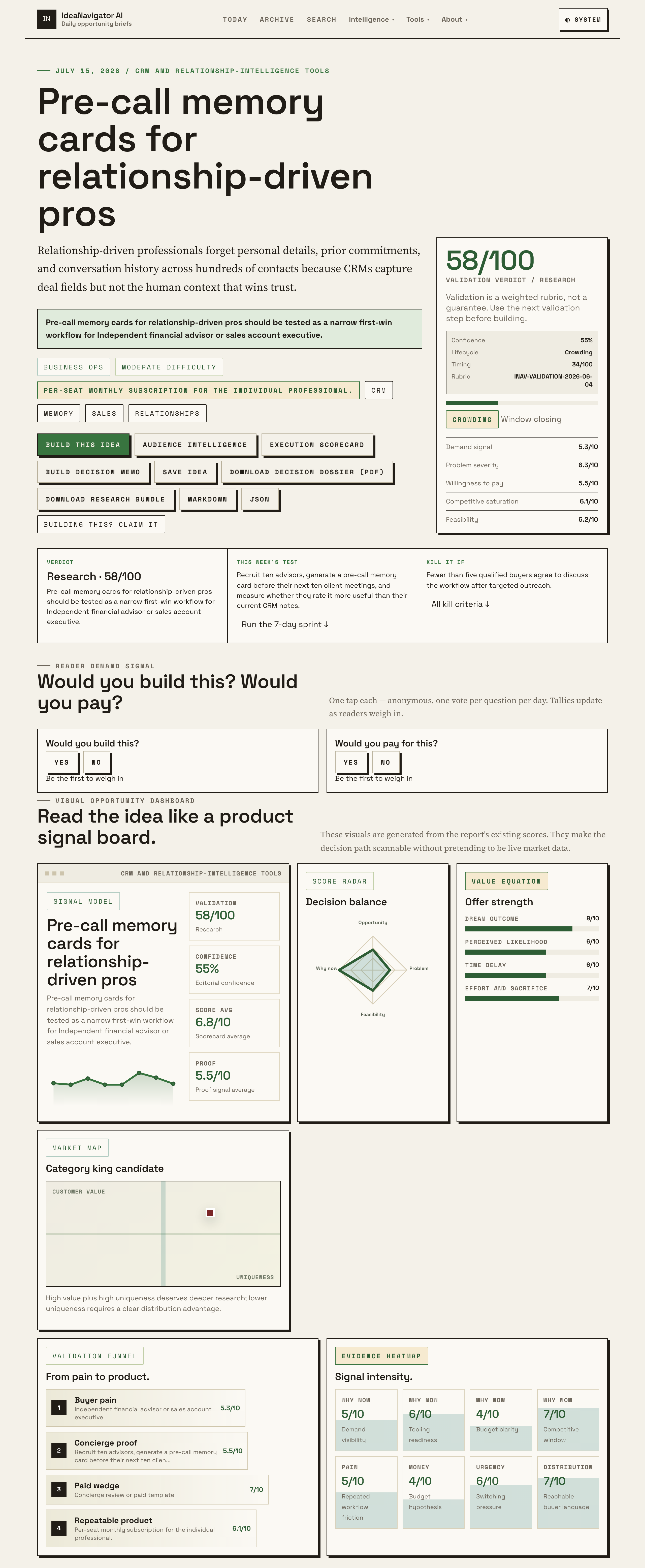
Testing of pre-call memory cards for independent financial advisors suggests they can improve CRM efficiency and customer trust. The approach leverages AI to summarize past interactions, offering a quick, accurate overview before client calls.
Pre-call memory cards for relationship-driven professionals are being tested as a new workflow to enhance client interactions. These cards, generated using AI summaries of past conversations, aim to address gaps in traditional CRM systems that often miss the human context crucial for building trust. This development could significantly improve how independent financial advisors and sales account executives prepare for meetings, potentially transforming relationship management practices.
The concept involves creating a one-page pre-call brief that consolidates a contact’s past emails, notes, and commitments into a concise, searchable memory card. This process leverages large-language-model summarization technology, making it feasible to distill lengthy conversation histories into a quick-reference format. The approach is designed to help professionals recall personal details, prior promises, and ongoing discussion threads, which are often overlooked by standard CRM fields.
According to proponents, the initial testing plan involves recruiting ten advisors to generate pre-call memory cards before their next ten client meetings. The goal is to measure whether these cards are rated as more useful than existing CRM notes, aiming to validate the workflow’s effectiveness. The subscription-based model targets individual professionals, with potential to expand into broader CRM and relationship intelligence markets.
Potential Impact on Client Relationships and CRM Efficiency
This development matters because it addresses a key weakness in current CRM systems: the inability to capture and surface the human context that fosters trust. By providing a quick, accurate summary of past interactions, pre-call memory cards could help professionals personalize conversations, remember commitments, and demonstrate genuine interest. This can lead to stronger client relationships, increased satisfaction, and ultimately, better business outcomes. If validated, the approach could become a standard workflow for relationship-driven roles, leveraging AI to enhance human connection and operational efficiency.

Share a Memory Cards, 50 Cards, Memory Card for Celebration of Life, Graduation, Wedding, Retirement, Going Away Party, 4inch x 6inch, White
Packing Include: 50 Pack share a memory card.
As an affiliate, we earn on qualifying purchases.
As an affiliate, we earn on qualifying purchases.
Limitations of Current CRM Systems in Relationship Management
Many relationship-driven professionals, such as independent financial advisors and sales account executives, struggle to remember personal details and ongoing commitments across hundreds of contacts. Traditional CRMs primarily focus on deal fields and transactional data, often neglecting the nuanced human context that builds trust. Recent advances in large-language-model summarization now make it feasible to automate the creation of memory aids that encapsulate relevant past interactions, offering a practical solution to this longstanding challenge.
This idea builds on the increasing adoption of AI tools to augment relationship management, with some early experiments indicating improved client engagement. The proposed workflow is still in the testing phase, with validation steps planned to assess its usefulness and adoption potential among professionals.
“Leveraging AI to produce concise, searchable memory cards can help professionals recall critical details quickly, making client interactions more personal and effective.”
— an anonymous researcher
pre-call client summary tools
As an affiliate, we earn on qualifying purchases.
As an affiliate, we earn on qualifying purchases.
Unconfirmed Effectiveness and Adoption Challenges
It is not yet clear how well professionals will adopt this workflow or whether the memory cards will significantly outperform their current note-taking methods. The effectiveness of AI-generated summaries in capturing the most relevant details remains to be validated through the planned testing. Additionally, questions remain about integration with existing CRM systems and potential user resistance to new workflows.

The Total Relationship: Four Steps to Breaking the Mold, Transforming the Financial Advisor-Client Partnership and Building True Wealth
As an affiliate, we earn on qualifying purchases.
As an affiliate, we earn on qualifying purchases.
Next Steps in Validation and Broader Implementation
The immediate next step is to execute the planned pilot with ten advisors, measuring the perceived usefulness of the memory cards. If successful, developers will refine the tool and explore broader deployment, including integration with popular CRM platforms. Further research will also examine long-term impacts on relationship quality and business outcomes, potentially establishing a new standard for client engagement workflows.

Executive Function Difficulties in Adults: 100 Ways to Help Your Clients Live Productive and Happy Lives
As an affiliate, we earn on qualifying purchases.
As an affiliate, we earn on qualifying purchases.
Key Questions
How do pre-call memory cards differ from traditional CRM notes?
Pre-call memory cards are concise, AI-generated summaries of past interactions designed to be quickly reviewed before a call, whereas traditional CRM notes are often detailed entries that may be difficult to scan rapidly.
Will this technology replace existing CRM systems?
It is unlikely to replace CRMs entirely; instead, it aims to augment current systems by providing a focused, AI-driven summary that enhances the user’s ability to recall important details quickly.
What are the main benefits of using pre-call memory cards?
The main benefits include improved personalization, better recall of commitments, and increased trust, which can lead to stronger client relationships and more effective meetings.
Are there any risks or drawbacks to this approach?
Potential risks include over-reliance on AI summaries that may omit relevant details or inaccuracies in the generated content. User resistance to adopting new workflows is also possible.
When will this technology be widely available?
The concept is currently in testing, with broader availability dependent on pilot results and further development, likely within the next year or two if proven effective.
Source: IdeaNavigator AI