📊 Full opportunity report: Home AI Deployment: Running Frontier Models On A Mac Studio on ThorstenMeyerAI.com — validation score, market gap, and execution plan.
TL;DR
Apple announced the Mac Studio with up to 512GB of unified memory, enabling local running of frontier-scale AI models. While capacity is confirmed, performance and practical use cases remain nuanced. This marks a notable step toward local AI development for individuals and small teams.
Apple has introduced the Mac Studio with a configuration offering up to 512GB of unified memory, capable of loading frontier-scale AI models locally. This development is confirmed and marks a significant milestone for AI practitioners seeking to run large models on desktop hardware without cloud reliance. The machine’s capacity to hold such models is real, but performance and practical application details are still emerging, making this a noteworthy, but nuanced, advancement in local AI deployment.
The new Mac Studio, announced on August 25, 2026, comes in two main configurations: the M5 Max with up to 128GB of memory, and the M5 Ultra with up to 512GB of unified memory. The ultra model, which is the focus here, features a 36-core CPU and an 80-core GPU, connected via Apple’s UltraFusion interconnect, effectively operating as a single, powerful processor. It is designed for users who need to load large AI models directly into memory, enabling local experimentation and inference without cloud dependence.
Apple claims that the M5 Ultra offers up to 4.3 times faster AI performance than the M3 Ultra and nearly 10 times faster than the M1 Ultra in certain benchmarks, though these are based on Apple’s own tests from July and depend heavily on specific workloads and configurations. The 512GB memory option, which will be available in late October at a price exceeding $10,000, is a key feature that allows loading models that previously required datacenter GPUs. This capacity is seen as a breakthrough for individual researchers or small teams working with large open models, especially in privacy-sensitive contexts.
512GB of unified memory the GPU addresses directly lets you hold frontier-scale models on a desk. How fast they run is a different number — and the marketing steps around it.
Impact of High-Memory Desktop on AI Development
This development signifies a step toward democratizing access to large AI models, enabling individuals and small teams to run frontier-scale models locally. The high memory capacity means that models previously confined to datacenter environments can now be experimented with on a desktop, fostering innovation and privacy. However, the machine’s actual performance for running these models at scale or in production remains limited by bandwidth and compute capabilities, meaning it’s not a replacement for dedicated GPU clusters but a powerful tool for development and experimentation.
As an affiliate, we earn on qualifying purchases.
Evolution of Local AI Hardware and Apple’s Role
Prior to this, running large AI models locally was confined to specialized datacenter hardware, often inaccessible to individual users due to high costs and complexity. Apple’s move to integrate 512GB of unified memory into a desktop machine marks a departure from traditional GPU-centric paradigms, leveraging its silicon architecture to provide substantial capacity for AI workloads. The announcement follows a trend where hardware manufacturers aim to bridge the gap between consumer devices and professional AI hardware, though actual performance and ecosystem maturity are still evolving. Apple’s approach emphasizes control, privacy, and accessibility, contrasting with the more open but complex GPU ecosystems from other vendors.
"This Mac Studio configuration is a real game-changer for small-scale AI experimentation, especially for those prioritizing privacy and local control."
— Thorsten Meyer, AI researcher and writer
As an affiliate, we earn on qualifying purchases.
Performance Limits and Practical Use Cases
While capacity is confirmed, the actual throughput and speed at which these large models can be run are less clear. The bandwidth of 1.2 terabytes per second, though high for a desktop, is still a fraction of what datacenter GPUs deliver, potentially limiting use cases to experimentation and development rather than production-scale deployment. The software ecosystem for running large models locally on Apple silicon is also still maturing, which could impact workflow compatibility and efficiency. Further independent benchmarks and real-world tests are needed to fully assess performance.
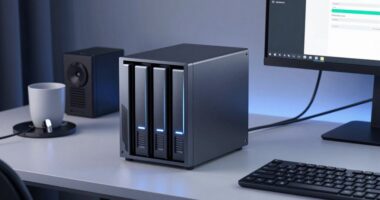
high memory desktop computer for AI
As an affiliate, we earn on qualifying purchases.
As an affiliate, we earn on qualifying purchases.
Upcoming Benchmarks and Ecosystem Maturity
Expect to see independent performance benchmarks on real inference workloads in the coming months, clarifying how well the hardware handles large models in practice. Software ecosystem improvements, including better ML tooling and model support, are likely as developers adapt to Apple’s silicon. The high-memory Mac Studio will likely become a valuable tool for AI researchers and small-scale developers seeking local deployment options, but it will not replace high-end datacenter hardware for large-scale, multi-user applications.
As an affiliate, we earn on qualifying purchases.
Key Questions
Can this Mac Studio run any large AI model?
It can load frontier-scale models up to 512GB in size, but actual performance depends on the model complexity and workload. It is primarily suited for experimentation and development rather than large-scale deployment.
Is this a replacement for cloud-based AI infrastructure?
Not entirely. While it allows local hosting of large models, its bandwidth and compute limits mean it’s best for development and testing rather than serving many users at scale.
When will the high-memory model be available?
The 512GB configuration will be available in late October, with preorders open now and general availability on September 22, 2026.
Does running large models locally compromise privacy?
Running models locally enhances privacy since data does not leave your machine, making it advantageous for sensitive applications.
How does this compare to traditional GPU clusters?
While the Mac Studio offers impressive capacity for a desktop, it cannot match the throughput and multi-user scalability of dedicated GPU clusters used in data centers.
Source: ThorstenMeyerAI.com