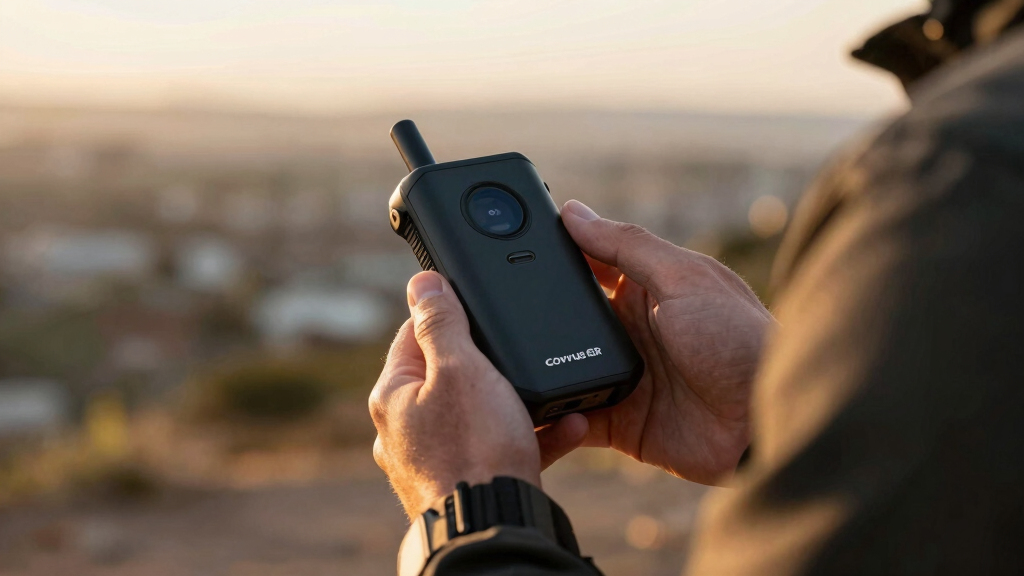

📊 Full opportunity report: How We Launched Corvus ISR In Public: WAMI Exploitation From The Ground Up on ThorstenMeyerAI.com — validation score, market gap, and execution plan.

Get hardware and tech essentials delivered free with Prime
- Fast, free delivery on millions of items
- Prime Video, Amazon Music and more included
- Member-only deals all year
TL;DR
Corvus ISR has publicly launched a synthetic WAMI scene demonstrating live detection and tracking in a browser. This marks the first step in building an open exploitation stack for wide-area motion imagery, focusing on synthetic data for development and benchmarking.
Corvus ISR has publicly launched its first synthetic wide-area motion imagery (WAMI) scene, featuring live detection and tracking capabilities in a browser environment. This marks the initial step in a build-in-public effort to develop an open, customizable WAMI exploitation stack, emphasizing synthetic data as a strategic choice.
The project, initiated by Thorsten Meyer, aims to address the longstanding gap in WAMI exploitation software, which remains largely proprietary and US-controlled. The first artifact is a simplified, synthetic scene generated procedurally, containing hundreds of moving vehicles across a simulated urban environment. It demonstrates real-time motion detection, persistent tracking, and a basic interface accessible via a web browser.
Corvus ISR’s approach relies on synthetic data to bypass legal, privacy, and cost barriers associated with real WAMI datasets. The synthetic scene provides perfect ground truth, enabling accurate benchmarking and detector development. The platform is designed to support two editions: a Sovereign version for air-gapped, fully offline deployment, and a Governed version for cloud use within EU jurisdictions, aligning with regional data sovereignty requirements.
CORVUS ISR · synthetic WAMI scene — live detect & track
BUILD IN PUBLIC · DAY 1 ARTIFACTPotential Impact of Public WAMI Exploitation Development
This launch signifies a shift toward open, customizable WAMI analysis tools, reducing dependency on proprietary US-controlled software. It enables European and other non-US operators to develop and tailor their exploitation pipelines, potentially lowering costs and increasing sovereignty. The use of synthetic data as a development substrate allows for rapid iteration, benchmarking, and testing of detection and tracking algorithms in a controlled environment, laying the groundwork for future real-data integration.
By demonstrating live detection in a browser, Corvus ISR also showcases a move toward accessible, scalable exploitation tools that can be operated by smaller teams or individual operators, challenging traditional market structures dominated by large defense contractors.
As an affiliate, we earn on qualifying purchases.
Background on WAMI and Synthetic Data Use
Wide-area motion imagery (WAMI) is a high-resolution, persistent surveillance sensor class capable of imaging entire cities with gigapixel frames. Despite its technological capabilities, exploitation software remains largely controlled by US entities, with limited open-source or European alternatives. The challenge has been the high cost and legal restrictions surrounding real WAMI data, which hinder development and benchmarking.
Recent trends show proliferation of WAMI platforms on drones, aerostats, and manned aircraft, increasing demand for independent exploitation solutions. Synthetic data has emerged as a strategic tool in AI and computer vision, offering a controlled, legally safe environment for algorithm development, especially when real data is inaccessible or restricted.
Thorsten Meyer’s initiative builds on these trends, aiming to create an open, flexible platform that starts from synthetic scenes, enabling iterative development and eventual transfer to real-world data.
“This is the first public step in building an open WAMI exploitation platform, starting with synthetic data to ensure legal safety, perfect ground truth, and controlled testing.”
— Thorsten Meyer
browser-based motion detection tools
As an affiliate, we earn on qualifying purchases.
As an affiliate, we earn on qualifying purchases.
Unresolved Challenges in Transitioning to Real Data
It remains unclear how well the synthetic-based detection and tracking algorithms will transfer to real WAMI data, which is more complex and noisy. The effectiveness of the synthetic scene as a training and benchmarking platform needs further validation with real-world datasets, which are currently unavailable for public testing.
Additionally, the scalability of the platform for operational use, integration with existing systems, and performance under high-density scenarios are still under development and testing.
As an affiliate, we earn on qualifying purchases.
Next Steps Toward Real-World WAMI Exploitation
Corvus ISR plans to refine its detection and tracking algorithms within the synthetic environment, gradually increasing scene complexity. The next milestones include integrating real WAMI datasets when available, testing the system’s robustness, and expanding the platform’s capabilities.
Further development will also focus on user interface improvements, deployment options, and establishing benchmarks to compare synthetic and real data performance. The project aims to demonstrate a full pipeline capable of operating in operational environments within the next 12-18 months.
open-source WAMI exploitation platform
As an affiliate, we earn on qualifying purchases.
As an affiliate, we earn on qualifying purchases.
Key Questions
Why is synthetic data used for the initial development?
Synthetic data allows for legally safe, perfectly labeled environments, enabling rapid development, benchmarking, and failure case testing without legal or privacy concerns.
Will this platform be available for public or commercial use?
The initial demo is a public prototype; future plans include deploying full versions for commercial or government use, with editions tailored for sovereignty and compliance requirements.
How does this project challenge existing WAMI exploitation software?
It aims to provide an open, customizable alternative to proprietary US-controlled systems, reducing dependency and increasing regional sovereignty in WAMI analysis.
What are the limitations of synthetic data in this context?
While synthetic scenes are useful for development, transferability to real-world data remains uncertain until validated with actual WAMI datasets, which are currently not publicly available.
When can we expect operational deployment?
Full operational deployment is expected within 12 to 18 months, after further testing, algorithm refinement, and real data integration.
Source: ThorstenMeyerAI.com
Fall Picks
fall essentials
As an affiliate, we earn on qualifying purchases.