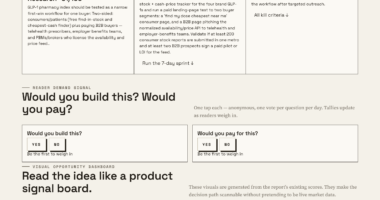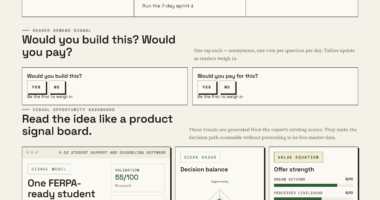
📊 Full opportunity report: Why Governments Are Turning To Benefit Check Bots For Social Program Efficiency on IdeaNavigator AI — validation score, market gap, and execution plan.

Get hardware and tech essentials delivered free with Prime
- Fast, free delivery on millions of items
- Prime Video, Amazon Music and more included
- Member-only deals all year
TL;DR
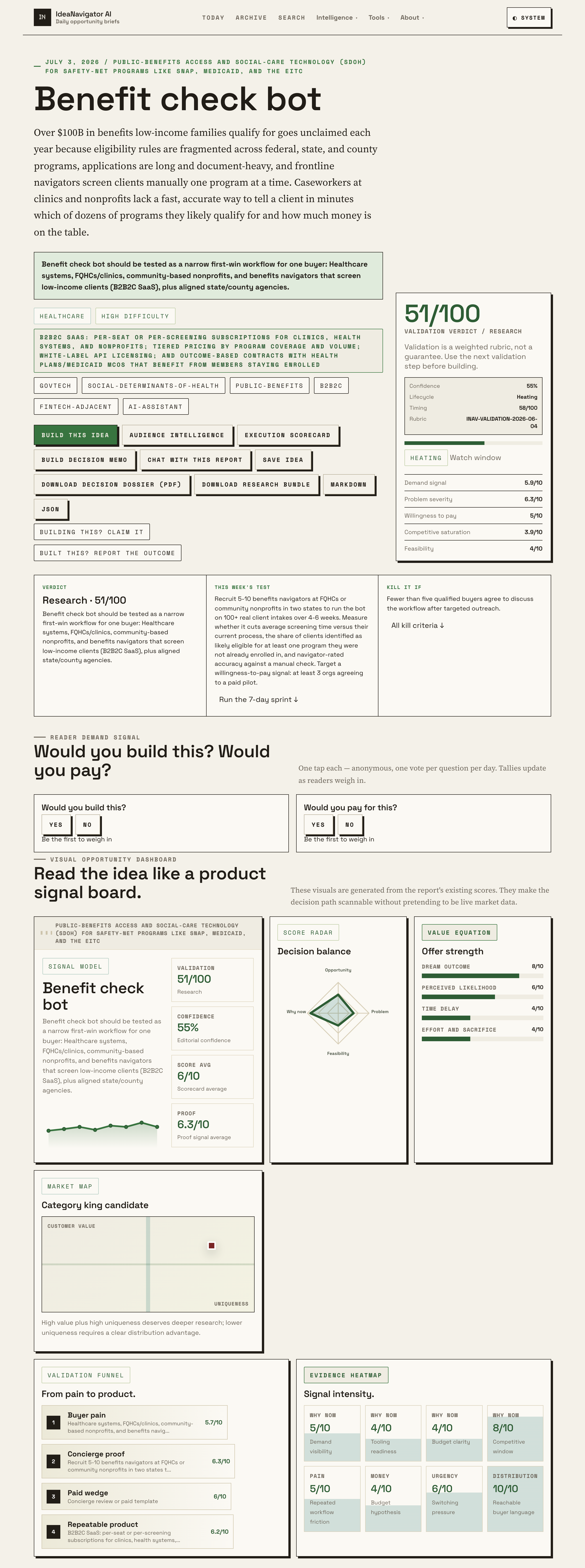
Governments and social service providers are increasingly deploying AI-driven benefit check bots to improve efficiency in screening low-income clients for multiple programs. This shift responds to significant gaps in benefits access and the end of traditional outsourced screening services. The development aims to reduce manual workload and increase program enrollment accuracy.
Governments and community organizations are adopting AI-powered benefit check bots to automate eligibility screening for social programs, aiming to address longstanding gaps in benefits access and reduce manual workload for frontline staff. This shift is driven by recent disruptions in traditional screening services and the need for more efficient, accurate, multilingual tools to serve low-income populations.
Benefit check bots are conversational AI tools designed to quickly assess a client’s likely eligibility for multiple social programs, including SNAP, Medicaid, EITC, and LIHEAP. These bots are being tested as a narrow first-use case within healthcare systems, Federally Qualified Health Centers (FQHCs), community nonprofits, and state agencies, offering a web widget and SMS-based interface that asks simple yes/no and multiple-choice questions. After the screening, the bot provides an estimated benefit amount, next application steps, and required documentation, streamlining what was previously a manual, time-consuming process.
The development of these bots comes in response to over $100 billion in benefits that low-income families leave unclaimed annually, due to fragmented eligibility rules, lengthy applications, and manual screening by caseworkers. The shutdown of Benefits Data Trust, a nonprofit that previously managed benefits enrollment across seven states, in 2024, created a significant capacity gap. Meanwhile, the post-pandemic Medicaid redetermination process has increased the demand for efficient eligibility checks, exposing the limitations of existing manual processes.
These benefit check bots leverage conversational AI technology that can operate at near-zero marginal cost, enabling scalable, multilingual screening without the high expense of call centers. The initial MVP involves embedding a white-label web widget or SMS bot on a clinic or nonprofit’s site, with plans to expand coverage to additional states and programs. Pilot programs aim to assess whether the bots reduce screening times, identify more eligible clients, and improve accuracy compared to manual checks. Early testing involves 5-10 benefits navigators across two states, with success measured by time savings, increased program enrollments, and navigator satisfaction.
Implications for Benefits Access and Frontline Staffing
Adopting benefit check bots could significantly increase the efficiency of social program enrollment, ensuring that more eligible low-income individuals access benefits they qualify for. By reducing manual screening time, these tools can free up caseworkers and navigators to focus on complex cases requiring personalized assistance. Additionally, the scalability and multilingual capabilities of AI bots address longstanding barriers related to language and resource constraints, potentially reducing disparities in benefits access. If successful, this approach could reshape how social safety-net programs operate, making eligibility screening faster, more accurate, and more cost-effective.
As an affiliate, we earn on qualifying purchases.
Recent Disruptions and Opportunities in Benefits Screening
The social services landscape has faced recent disruptions, notably the shutdown of Benefits Data Trust, which previously handled benefits enrollment for multiple states. This created a capacity gap just as the Medicaid ‘unwinding’ process—redetermining eligibility for millions—intensified demand for efficient screening methods. Traditional manual processes are labor-intensive, slow, and prone to errors, especially as eligibility rules are fragmented across federal, state, and local programs. Meanwhile, advances in conversational AI and the need for multilingual, low-cost solutions have made automated benefit screening increasingly feasible. Pilot programs are now underway to test these bots’ effectiveness, with initial focus on healthcare settings and community nonprofits.
social program eligibility screening tools
As an affiliate, we earn on qualifying purchases.
As an affiliate, we earn on qualifying purchases.
Uncertainties Around Deployment and Effectiveness
It remains unclear how widely these benefit check bots will be adopted outside of pilot programs, and whether they will consistently outperform manual screening in accuracy and client satisfaction. Long-term data on enrollment increases and cost savings are still being collected, and questions remain about how these tools will handle complex eligibility scenarios or client mistrust of automated systems. Additionally, the regulatory and privacy implications of deploying AI in sensitive social services settings are still under review, and scalability across diverse jurisdictions is yet to be proven.
AI-powered benefits eligibility checker
As an affiliate, we earn on qualifying purchases.
As an affiliate, we earn on qualifying purchases.
Next Steps for Broader Adoption and Evaluation
Pilot programs involving 5-10 benefits navigators across two states will continue over the next 4-6 weeks, with initial data collection focusing on screening efficiency, eligibility detection rates, and user feedback. If results are positive, plans include expanding to additional states, integrating more programs, and refining the AI’s multilingual capabilities. Stakeholders will also monitor regulatory developments and privacy safeguards. Success in these pilots could lead to broader adoption, with potential integration into existing social service workflows and Medicaid redetermination processes, ultimately aiming for nationwide scalability within the next 1-2 years.
multilingual social benefits screening app
As an affiliate, we earn on qualifying purchases.
As an affiliate, we earn on qualifying purchases.
Key Questions
How do benefit check bots improve the screening process?
They automate eligibility assessments through conversational interfaces, reducing manual work, speeding up processing times, and increasing accuracy in identifying benefits clients qualify for.
Are benefit check bots reliable across different programs and states?
Reliability is currently being tested in pilot programs. Early results are promising, but full validation across diverse jurisdictions and complex cases is still underway.
What are the privacy concerns with using AI for benefits screening?
Ensuring data security, client consent, and compliance with privacy regulations is essential. Developers are working to implement safeguards, but regulatory review continues.
Will benefit check bots replace human navigators entirely?
Most experts see these tools as augmenting, not replacing, human staff, especially for complex cases requiring personalized assistance.
When might these bots be available for widespread use?
If pilot results are positive, broader deployment could occur within the next 1-2 years, with ongoing improvements and scaling plans.
Source: IdeaNavigator AI
Halloween Picks
halloween
As an affiliate, we earn on qualifying purchases.