
📊 Full opportunity report: How To Approach Privacy Compliance And Parental Consent on IdeaNavigator AI — validation score, market gap, and execution plan.

Get hardware and tech essentials delivered free with Prime
- Fast, free delivery on millions of items
- Prime Video, Amazon Music and more included
- Member-only deals all year
TL;DR
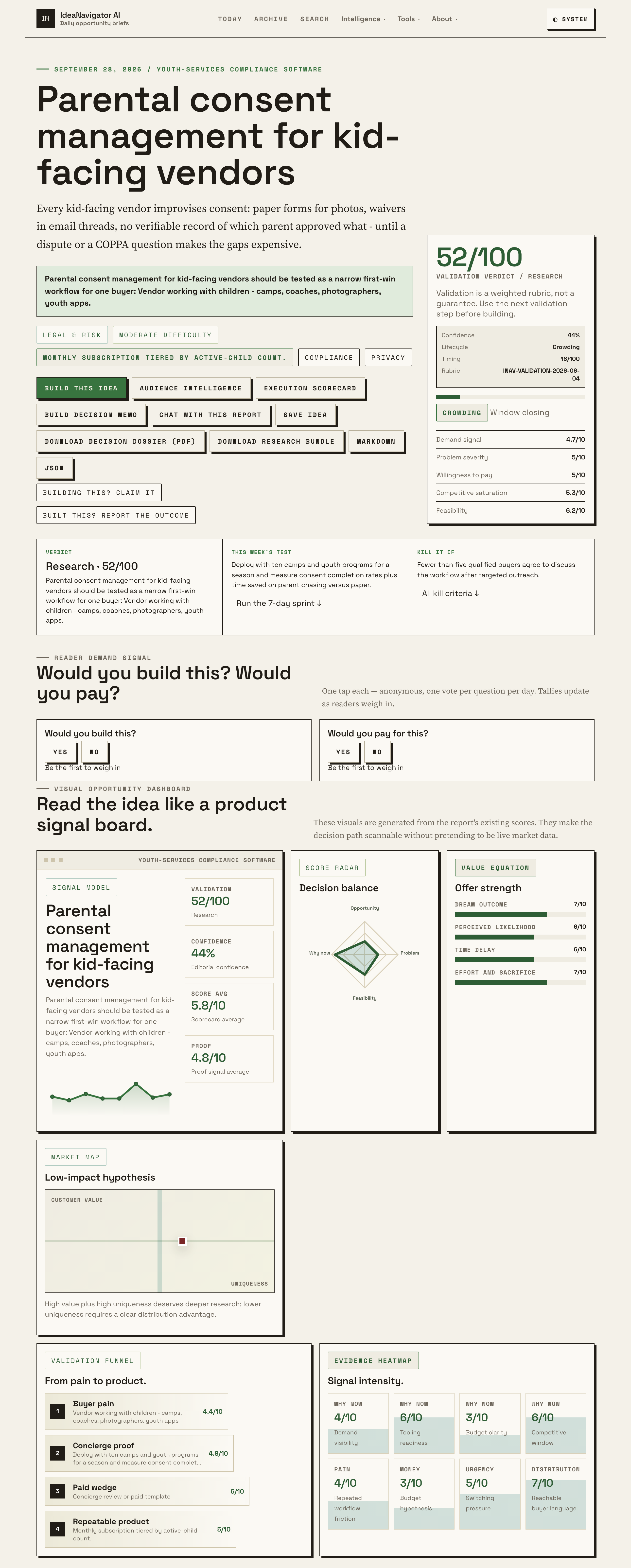
IdeaNavigator AI has published an analysis identifying parental consent management as an underserved compliance niche for businesses serving children. The proposal calls for phone-based consent flows with verifiable records, targeting camps, coaches, photographers and youth apps amid expanding COPPA and state-level privacy enforcement.
IdeaNavigator AI has published an analysis proposing parental consent management software as a targeted opportunity in the youth-services compliance market, arguing that camps, coaches, photographers and youth app operators routinely rely on improvised paper forms and email waivers that leave no verifiable record of which parent approved what. The proposal frames the gap as both a legal exposure and a commercial opening, with enforcement of children’s privacy rules expanding through COPPA updates and new state laws.
According to the analysis, the core problem is structural rather than incidental. Kid-facing vendors today typically collect consent through paper forms for photo use, liability waivers buried in email threads, and ad hoc verbal approvals. None of these produce a durable, auditable record. The result, the analysis argues, is that gaps become visible only when a dispute arises or a regulator asks COPPA-related questions — at which point reconstructing who consented to what becomes expensive or impossible.
The proposed product is a vendor-branded consent flow that parents complete on their phones, covering photo use, data collection, medical authorization and liability. Key features include identity verification scaled to risk tier, a per-child consent ledger, expiry tracking for time-limited approvals, and an instant audit export that a vendor could hand to a regulator or parent on demand. The business model is a monthly subscription priced by active-child count.
On validation, the analysis is specific: deploy the product with ten camps and youth programs for a full season and measure consent completion rates and time saved chasing parents, compared against the paper baseline. That framing positions the idea as a testable workflow rather than a broad platform play, with the narrow first buyer being any vendor working directly with children.
Why Vendors Cannot Keep Improvising Consent
The proposal matters because the enforcement environment around children’s data is tightening at both federal and state level, according to the analysis. The FTC has updated COPPA rulemaking in recent years, and a growing set of state privacy laws include provisions for minors’ data. For small vendors — a summer camp, a freelance sports photographer, a youth sports coach — the cost of building compliant consent processes in-house is high, while the cost of failing to produce records on request is higher.
Parents are also described as increasingly likely to challenge how photos and data about their children are used, which converts consent from a one-time formality into an ongoing record-keeping obligation. A subscription product that offloads that burden is positioned to capture spend from businesses that have no compliance staff and no technical team. The youth-services compliance software market remains thinly served, the analysis suggests, because incumbents focus on enterprise privacy tooling rather than small, seasonal, child-facing operations.
The Paper-to-Digital Consent Shift
Parental consent requirements are long-standing: COPPA, the U.S. children’s online privacy law in force since 2000, requires verifiable parental consent before collecting personal data from children under 13 for online services. Historically, offline businesses such as camps and photographers operated outside that framework, handling photo releases and medical authorizations on paper.
Two developments have blurred that boundary, according to the analysis. First, youth programs increasingly pair physical services with apps and online accounts, pulling more vendors into scope of data-privacy rules. Second, regulators and parents alike now expect defensible digital records, making the paper form and the email waiver look fragile by comparison. The IdeaNavigator AI proposal is one of a broader set of attempts to turn consent from scattered documents into structured, timestamped ledgers.
What the Proposal Has Not Yet Proven
The analysis is a product concept, not a launched company or published research study. Several claims remain unverified. No pilot data exists yet — the ten-camp deployment is proposed as the validation step, so completion rates and time savings are hypotheses, not measured results. The size of the youth-services compliance market is not quantified with figures in the analysis.
It is also unclear whether identity verification appropriate to each risk tier can be delivered cheaply enough for a subscription priced by active-child count, and whether small seasonal vendors will pay recurring software fees for a problem they may still perceive as manageable on paper. The interaction between such a tool and actual COPPA verification standards — which vary by the sensitivity of the data collected — would need legal review before any vendor could treat the records as fully defensible.
The Ten-Camp Season Test
If a builder acts on the proposal, the immediate next step is the stated validation plan: recruit roughly ten camps and youth programs, run the consent flow for a full season, and compare completion rates and administrative time against paper-based processes. Those results would determine whether the subscription model holds at small-vendor price points.
In parallel, the regulatory backdrop will keep moving. Additional COPPA rule updates and new state minors’ privacy laws would either expand the addressable market or raise the compliance bar for what counts as verifiable consent. Vendors and builders watching this space should track FTC rulemaking and state-level children’s privacy legislation, as both directly shape demand for consent record-keeping tools.
Source: IdeaNavigator AI
Key Questions
What is COPPA and does it apply to camps and photographers?
COPPA is the U.S. Children’s Online Privacy Protection Act, requiring verifiable parental consent before collecting personal data from children under 13 through online services. Traditional offline vendors such as camps have generally operated outside it, but the IdeaNavigator AI analysis notes that youth programs increasingly use apps and online accounts, pulling more of them into scope. State privacy laws may add further requirements.
What would the proposed consent product actually do?
Per the proposal, it would give vendors phone-based consent flows for photo use, data collection, medical authorization and liability, with risk-tiered identity verification, a per-child consent ledger, expiry tracking and instant audit export for regulators or parents.
How would the product be validated?
The proposed test is a season-long deployment with ten camps and youth programs, measuring consent completion rates and time saved chasing parents compared with paper-based processes.
Is this an existing company or just an idea?
It is a published product concept from IdeaNavigator AI. No company, pilot data or measured results are described; the validation step has not yet been run.
Would using such a tool guarantee legal compliance for a vendor?
No. The analysis itself describes the records as ‘defensible’ rather than automatically compliant, and the appropriate identity-verification method under COPPA varies with data sensitivity. Vendors would need legal review before treating any tool’s records as sufficient for their specific obligations.
Source: IdeaNavigator AI
Halloween Picks
halloween
As an affiliate, we earn on qualifying purchases.