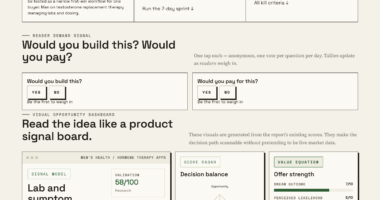

📊 Full opportunity report: IdeaNavigator AI: One Evidence-Mined Idea a Day on ThorstenMeyerAI.com — validation score, market gap, and execution plan.

Get hardware and tech essentials delivered free with Prime
- Fast, free delivery on millions of items
- Prime Video, Amazon Music and more included
- Member-only deals all year
TL;DR
IdeaNavigator AI autonomously generates and publishes one software idea daily based on real user complaints and evidence. It scores ideas to prioritize those with proven demand, aiming to reduce costly product failures.
IdeaNavigator AI has begun publicly releasing one evidence-mined software idea each day, marking a shift in how product ideas are validated before development. Built to autonomously generate, score, and publish ideas based on real user complaints, this system aims to reduce the costly failure rate of software projects by prioritizing demand signals over hunches.
The system, developed by the startup behind IdeaClyst, mines complaints from sources like app reviews, Hacker News, GitHub, and Stack Overflow, to identify genuine user frustrations. It then transforms these pain points into fully scoped software ideas, which are scored from 0 to 100 based on the strength of the evidence.
Each day, the system produces two ideas but publicly shares only one, focusing on the most promising or validated. The entire process—from idea generation to publication—runs autonomously on a single Mac mini, with minimal human intervention, emphasizing low cost and high efficiency.
The scoring system categorizes ideas into four verdicts: Build, Validate, Research, or Rethink. Most ideas are filtered out early, with only the highest-scoring ones recommended for further validation, aiming to avoid building products based on unverified assumptions.
IdeaNavigator AI — one evidence-mined idea a day
Idea generation is cheap; validation is the bottleneck. Mine real complaints, scope an idea, score it 0–100 — and let the verdict tell you when not to build.
Verdict: Validate. Promising — but a high score is a prior, not a proof. The point of the gauge is the verdicts that say not yet.
Independent commentary, produced with AI assistance under human editorial oversight. The views are the author’s own and may change. IdeaNavigator AI generates, mines and scores ideas via automated pipelines; scores and verdicts are programmatic priors that may contain errors or bias and are not validated demand — verify independently before building. As an Amazon Associate the author earns from qualifying purchases; pages may contain affiliate links. Product and company names are trademarks of their respective owners; mention does not imply endorsement.
Why Evidence-Driven Idea Generation Matters
This approach addresses a fundamental problem in software development: building products based on opinions or guesses rather than proven demand. By focusing on real complaints and scoring ideas accordingly, IdeaNavigator AI aims to significantly reduce the risk of product failure, saving time and resources.
For entrepreneurs and companies, this system offers a more efficient way to identify viable opportunities, potentially transforming the product development process from guesswork to evidence-based decision-making. It also introduces a scalable model for continuous, low-cost idea validation.
As an affiliate, we earn on qualifying purchases.
Background of Evidence-Based Product Validation
Traditionally, idea generation has been inexpensive, while validation is costly and time-consuming. Many startups and developers fall into the trap of building products based on assumptions, leading to high failure rates and wasted effort. The concept of mining user complaints and demand signals has gained traction as a way to de-risk product development.
Previous efforts have focused on manual analysis or limited tools, but the launch of an autonomous pipeline that continuously mines, scores, and publishes ideas marks a notable evolution. The system's foundation is rooted in the principles of demand-first development, emphasizing real-world evidence over opinions.
"Our system turns complaints into actionable ideas, scored by real demand signals, to prevent costly missteps in product development."
— Thorsten Meyer, founder of IdeaClyst
As an affiliate, we earn on qualifying purchases.
Unanswered Questions About System Effectiveness
It remains unclear how accurately the scoring system predicts successful products or how often ideas deemed worth building actually lead to market success. Long-term validation of this approach is still pending, and real-world outcomes will be necessary to confirm its effectiveness.
Additionally, the system's reliance on public complaints may miss unvoiced needs or niche markets, and its ability to adapt to different industries or problem types is yet to be tested.
As an affiliate, we earn on qualifying purchases.
Next Steps in Validation and Adoption
The startup plans to monitor the performance of the ideas it publishes, tracking which ones progress to development and market success. It will also refine its scoring algorithms based on real-world outcomes.
Further, the company intends to expand the sources of complaints and incorporate feedback from early users of the ideas to improve the system's accuracy. Widespread adoption by developers and startups could follow if the approach proves effective.
As an affiliate, we earn on qualifying purchases.
Key Questions
How does IdeaNavigator AI find user complaints?
It mines public sources like app store reviews, Hacker News discussions, GitHub issues, and Stack Overflow questions to identify genuine frustrations and unmet needs.
What does the scoring system indicate?
The score from 0 to 100 reflects the strength of the evidence supporting the idea, guiding whether to validate, research, rethink, or build.
Can this system replace traditional product validation?
It aims to complement existing methods by providing a scalable, evidence-based pipeline, but human judgment and market testing remain essential.
Is the process fully automated?
Yes, the entire cycle—from idea generation to publication—runs autonomously on a single Mac mini, minimizing manual effort.
What industries can benefit from this approach?
Any software or tech-driven industry where user complaints and demand signals are available and relevant could potentially benefit.
Source: ThorstenMeyerAI.com
Halloween Picks
halloween
As an affiliate, we earn on qualifying purchases.