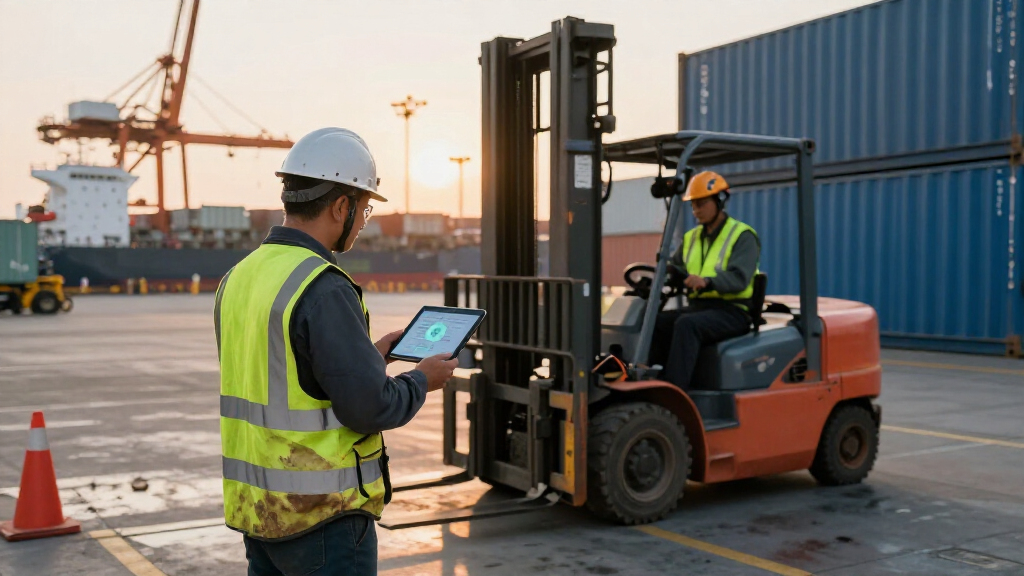

🔍 Read the full analysis: The New Container Dock: AI And Human Labor on ThorstenMeyerAI.com

Get hardware and tech essentials delivered free with Prime
- Fast, free delivery on millions of items
- Prime Video, Amazon Music and more included
- Member-only deals all year
TL;DR
Container shipping replaced the handling of individual sacks, barrels and crates with standardized boxes moved by cranes, sharply reducing the labor and cost required at ports. The shift brought union agreements and protections for some registered workers, but dock employment fell substantially; more recent evidence also cautions that automated terminals are not always faster.
A history article published Nov. 23 examines how container shipping replaced the hand-moving of individual cargo with crane-lifted boxes, cutting handling costs while reshaping dock jobs. The account traces the change from Malcom McLean’s 1956 voyage on the Ideal X to union agreements and more recent labor disputes over automation.
Before containers, ports handled goods as break-bulk cargo: workers moved each sack, barrel, crate or carton between trucks or trains, warehouses and ships. The article cites historian Marc Levinson’s account of a 1954 shipment aboard the freighter Warrior: 194,582 separate items were loaded for Bremerhaven. The crossing took 10 and a half days, while some goods spent more than three months in transit overall.
On April 26, 1956, a crane in Newark lifted 58 truck bodies onto the Ideal X, which had been fitted with a frame to carry them. The ship arrived in Houston five days later, where trucks were ready to haul the containers away. The article notes that McLean did not invent cargo containers; the innovation was a system that moved a box between truck and ship without unloading its contents.
Levinson’s figures, as cited in the article, put the 1956 cost of loading loose cargo at $5.83 a ton, compared with 15.8 cents a ton for the Ideal X. The article calculates that difference as roughly 36 times lower. The comparison concerns loading costs in that account, not the total cost of shipping every kind of cargo.
Infographic 01 · Before the box
Why the port cost more than the ocean
Before the container, every sack and crate was handled one by one. The port, not the sea, was the expensive part of a trip.
One truckload of medicine, Chicago → Nancy (France) · estimate ca. 1960 · total $2,386
Cost of loading one ton · 1956
Roughly 36 times cheaper to load (5.83 ÷ 0.158, our calculation). The loading figures are from Levinson’s own article; other authors cite them to The Box, 1st ed. (2006), p. 52.
Sources: M. Levinson, The Box, 2nd ed. (Princeton UP, 2016), ch. 1, Table 1, p. 12 (American Association of Port Authorities data); M. Levinson, The Box That Shrank the World, Works That Work No. 2.
Powered by Thorsten Meyer AI
The Cost of Replacing Port Labor
Containerization changed more than the speed of moving goods. An estimate for a 1960 shipment of medicine from Chicago to Nancy, France, put port costs at $1,163 of a $2,386 bill, or 48.7% of the total, according to figures reproduced in Levinson’s book. The example shows why shipping companies had a strong financial incentive to reduce time and labor spent at ports.
The employment figures cited in the article indicate the scale of the change: the Port of New York and New Jersey had more than 35,000 longshoremen in the early 1960s and about 3,500 in 2013, according to the Waterfront Commission. Britain’s registered dock workforce fell from a peak of 82,000 to 9,400 in 1989. Those figures describe long-term workforce decline; by themselves, they do not establish that containerization was the sole cause.
The issue remains current because automation debates involve the same tension between productivity and work. East and Gulf Coast dockers struck in 2024 over wages and automation, the article reports. For workers, the questions include job security, pay and control over work. For shipping customers, port performance can affect costs and delays, though automated equipment does not guarantee faster operations.
Products Worth Considering

Apple MacBook Pro 16.3-inch with PROLED XDR Display, Silver

LG UltraGear 27G640A-B 27-Inch QHD IPS Gaming Monitor, 300Hz, 1ms, G-SYNC Compatible, FreeSync Premium, DisplayHDR 400, HDMI 2.1, USB-C, Adj

Ledger Flex Crypto Wallet – Neptune Blue
As an affiliate, we earn on qualifying purchases.
From Break-Bulk Cargo to Boxes
Before standard containers, dock work required large crews and cargo was handled repeatedly. In New York, hiring was often organized through the “shape-up”, where workers gathered and a boss chose who would work that day. The article says the Waterfront Commission, established in 1953 to address corruption in the port, described how surplus labor gave hiring bosses and corrupt union officials power over access to jobs and kickbacks. The 1954 film On the Waterfront made the practice widely known.
McLean was a North Carolina trucker who built a major trucking company. The popular account that he conceived container shipping while waiting at a pier is presented in the source as unverified legend: the author says no contemporary record was found. What is documented in the article is the 1956 Ideal X voyage and McLean’s role in building a system around containers.
Labor negotiations helped determine how the shift unfolded. On Oct. 18, 1960, the International Longshoremen’s and Warehousemen’s Union and the Pacific Maritime Association signed the Mechanization and Modernization Agreement. Employers gained flexibility to mechanize; registered workers received a $29 million fund, income protections if hours fell, retirement benefits and other safeguards. The source says the guarantees applied to fully registered “Class A” workers, not necessarily every person seeking dock work.
““epochal in the annals of industrial relations””
— U.S. Bureau of Labor Statistics, describing the 1960 labor agreement
Automation’s Uneven Results
The history article cites a 2024 U.S. government report that found denser stacking at some automated terminals, but also slower moves and more breakdowns at some sites. The supplied material does not identify the report’s full methodology, the terminals studied or how results varied across facilities. It therefore does not support a blanket conclusion that automation makes ports faster or slower.
The workforce figures also cover different places and time periods, and the source does not quantify how much of the decline resulted from containerization compared with other changes in shipping and employment. Nor does it specify the outcomes of the 2024 East and Gulf Coast strike negotiations over automation. The source describes union protections from the 1960 agreement, but does not provide a full account of how those protections changed or how many workers benefited.
Labor Talks and Terminal Performance
The source article does not identify a specific upcoming negotiation, policy decision or report. The next developments to watch are labor agreements governing automation, how employers and unions address job security and wages, and whether terminal performance data show consistent gains across different ports.
For readers following shipping, two questions remain distinct: whether automation reduces handling costs and whether it improves the pace and reliability of port operations. The figures in the article document major historical cost and workforce changes, but do not settle how current automated terminals will perform or how future productivity gains will be shared with workers.
Key Questions
What changed when container shipping began?
Instead of moving cargo as separate sacks, barrels and crates, ports could transfer standardized boxes between ships and trucks without opening them. The system reduced repeated handling.
How much cheaper was loading on the Ideal X?
The source cites 1956 loading costs of $5.83 a ton for loose cargo and 15.8 cents a ton for the Ideal X. It calculates the difference as roughly 36 times, a comparison of loading costs in the cited account.
Did dockworkers receive protections against mechanization?
A 1960 West Coast agreement provided a $29 million fund and protections including minimum income in some cases, retirement payments, and a no-layoff promise for covered registered workers. The article says the guarantees applied to Class A members.
Does automation always make ports faster?
No such conclusion is established in the source. It cites a 2024 U.S. government report that found denser stacking at some automated terminals, alongside slower moves and more breakdowns at some sites.
Source: ThorstenMeyerAI.com