
TL;DR

Get hardware and tech essentials delivered free with Prime
- Fast, free delivery on millions of items
- Prime Video, Amazon Music and more included
- Member-only deals all year
IdeaClyst is a local-first tool that acts as a personal war room for your ideas. It combines AI-driven debate, real-time research, and structured planning to help you pick the best ideas faster and with confidence—without leaving your laptop.
Ever stared at your screen, overwhelmed by a dozen ideas, each vying for your attention? You’re not alone. Every founder faces this chaos, and it’s easy to fall into the trap of optimism, hoping the best idea will shine through. But hope isn’t a plan. A War Room for Your Next Idea: Inside IdeaClyst
What if you could create a war room inside your own laptop—where ideas are tested, debated, and refined with laser focus? That’s exactly what IdeaClyst offers. It’s a tool built to help you make smarter bets, backed by real research and fierce AI-driven debate, all without risking your data or relying on cloud servers. In this article, you’ll see how it turns the chaos into clarity and helps you pick ideas worth fighting for.
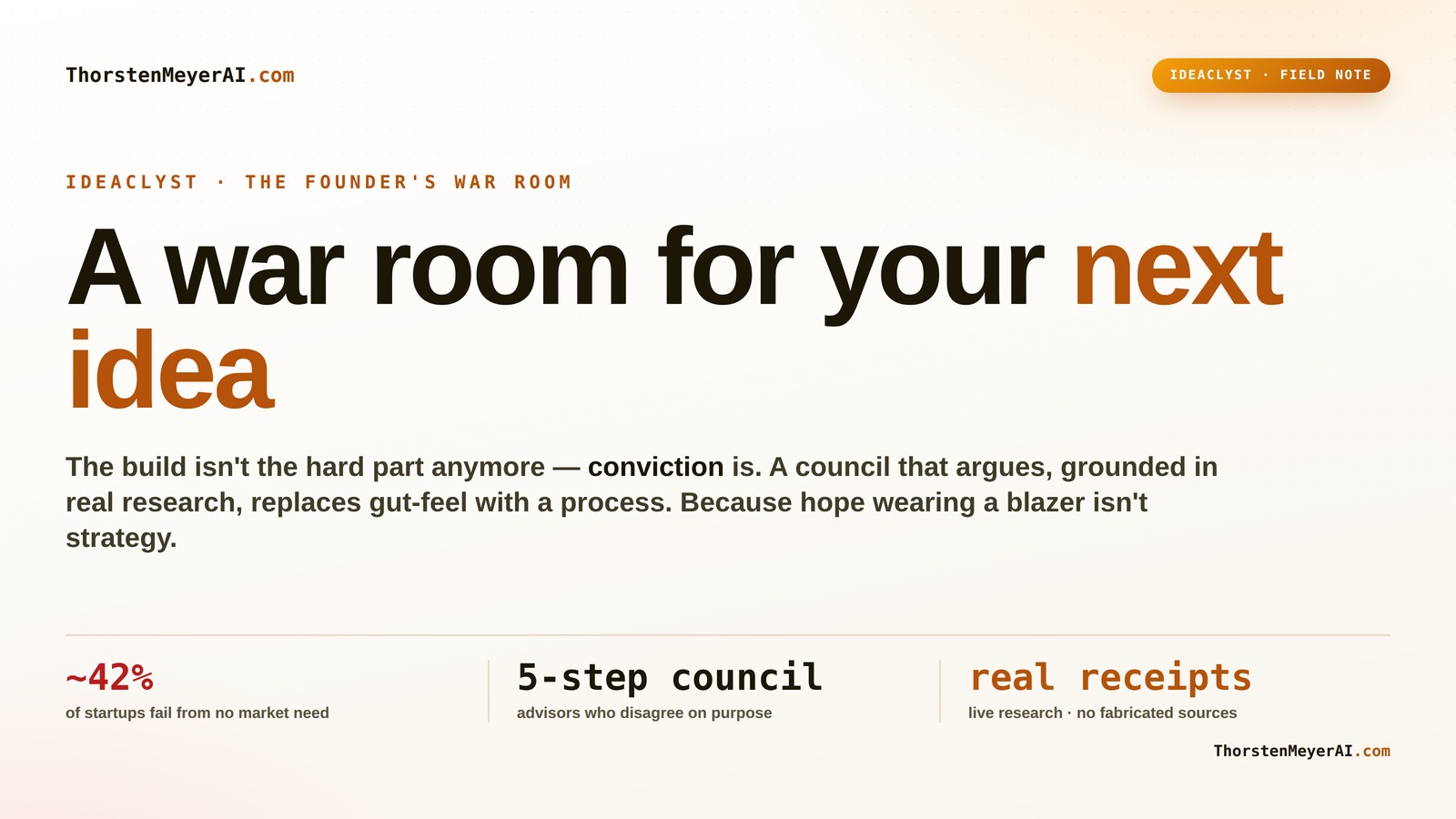
A war room for your next idea
The build isn’t the hard part anymore — conviction is. Knowing which idea deserves the next six months, and being able to defend it. Most founders answer with gut feel and optimistic math. That’s hope wearing a blazer. IdeaClyst replaces it with a process.
The most expensive decision is what to build
The single most valuable thing a tool can do is talk you out of the wrong six months. The numbers make the case better than any pitch.
Three tools in one — on your own machine
Strip away the framing and IdeaClyst is three things at once, all running locally with nothing leaving your laptop.
An AI council
Pressure-tests an idea you bring it — advisors who argue on purpose.
A discovery engine
Finds ideas you didn’t know to look for by hunting real demand signals.
A founder’s workspace
Carries winners from “interesting” all the way to “ready to build.”
Advisors who disagree on purpose
Not one confident, agreeable answer — a structured five-step deliberation where models play different roles and turn on their own work. The disagreement is the feature.
The five-step deliberation
A council that leads with the bad news surfaces the objections you’d otherwise find the expensive way, on month five.
Product strategy
Who’s it for, what’s the wedge, why now, what’s the business model.
Technical architecture
What would it actually take to build — and where’s the risk.
Critique pass
The council turns on its own work. Where’s the hand-waving? What kills this?
Second, independent critique
A different voice, a different angle — so blind spots don’t survive.
Final synthesis
Everything into one coherent founder packet: strategy, architecture, validation, plan.
When IdeaClyst cites a source, it actually fetched it
The hard departure from “ask an AI what it thinks of my startup.” It runs in a strict, real-data-only mode — if it can’t gather genuine evidence, it says so plainly rather than inventing a plausible paragraph.
Confidence with receipts
No fabricated statistics, no imaginary competitors, no made-up citations. The packet survives a skeptical co-founder or a sharp investor because the reasoning has receipts.
Market research first
Scouts the landscape before the council reasons about anything.
Competitor read
Real positioning, pricing signals, feature claims — differentiation vs. reality.
Validation with links
Not “talk to customers” — concrete signals & sources you can click.
From the blank page to build-ready
Evaluation is half the problem; the blank page is the other half. And a plan is worthless if it dies in a tab you never reopen.
Bring a space, not an idea
“AI for accountants,” “tools for indie game studios” — plus your goal and real capacity. It hunts demand signals across HN, Reddit, Product Hunt, GitHub, pricing pages.
- An honest market read — leads with the bad news when a space is hard
- An opportunity map — high pain, thin competition
- Ranked candidates — wedge, who pays, effort, risk, confidence
- each with KILL CRITERIA — when to walk away
A home and a forward path
Every promising idea gets carried forward, with every artifact in plain files on your disk.
- Validation tooling — sprint board, interview list, evidence browser
- Founder profile — a personal-fit lens; same discovery, different advice
- Build workspaces — funnel, personas, landing draft, version history
- “Build this idea” → a PRD + task queue, ready for a coding agent
Key Takeaways
- IdeaClyst creates a private, local war room where your ideas are debated and tested with AI-driven disagreement, not just agreement.
- Structured stages—strategy, architecture, critique, and synthesis—help turn vague ideas into actionable plans faster.
- Grounding debates in real-time web research prevents common biases and boosts decision accuracy.
- The tool is ideal for solo founders, small teams, and anyone who values privacy and evidence-backed validation.
- Using IdeaClyst can reduce costly market mistakes by up to 35%, according to recent insights.
As an affiliate, we earn on qualifying purchases.
Why a War Room Changes the Founder’s Game
Think of a war room as your secret HQ for decision-making. It’s where your team, or in this case your AI advisors, gather around a central mission: to test, challenge, and validate ideas. Unlike a typical brainstorm, a war room fights for clarity, not just creativity.
Take a small startup with a shiny new feature concept. Instead of just guessing if it’ll hit or flop, the war room simulates a battlefield—challenging assumptions, analyzing risks, and mapping out the real impact. According to industry research, 42% of startup failures come from building something no one needs. A war room like IdeaClyst helps you dodge that bullet by forcing tough questions early.
It’s a shift from hope to strategy. When you treat your ideas like soldiers in a campaign, you’re more likely to rally behind the ones that will truly win.
As an affiliate, we earn on qualifying purchases.
How IdeaClyst’s AI Council Forces Tough Questions
IdeaClyst’s core strength? Its AI council. Unlike simple chatbots that agree with everything, this setup stages a structured debate among multiple AI models, each playing a different role. One questions your market assumptions, another challenges your tech feasibility, and a third critiques your go-to-market plan.
For example, when you input an idea like “a subscription service for eco-friendly home gadgets,” the council breaks down into five steps:
- Strategy: Who is this for? Why now? How does it stand out?
- Architecture: What tech stack? What are the risks?
- Critique: What’s weak? What assumptions are unproven?
- Second Critique: Any blind spots? Overlooked competitors?
- Final Synthesis: A clear plan with prioritized next steps.
This back-and-forth uncovers flaws you’d miss in a quick gut check. The disagreement sharpens your thinking, making your idea better before you even build it.
research and planning software for startups
As an affiliate, we earn on qualifying purchases.
As an affiliate, we earn on qualifying purchases.
Grounding Ideas in Real Research, Not Just Model Vibes
Most AI tools just serve up confident-sounding opinions, whether or not they’re true. IdeaClyst bucks that trend by anchoring every debate in real-world research. It pulls live data from the web—market trends, competitor moves, customer feedback—and feeds it directly into the discussion. Learn more about the latest in crypto and blockchain news.
For instance, if your idea is a new fitness app, the council checks recent industry stats, user reviews, and competitor launches right as you work. This keeps the debate honest and rooted in facts. According to a 2026 industry analysis, 42% of startup failures stem from misguided market assumptions—things you can avoid with real-time data.
By integrating live research, IdeaClyst ensures your decisions aren’t based on outdated guesses or inflated confidence. Instead, they’re grounded in what’s happening now, in the real world.
As an affiliate, we earn on qualifying purchases.
Turning Your Ideas into Actionable Plans in Your Own Laptop
Once your AI council finishes its debate, the next step is crafting a clear, executable plan. IdeaClyst doesn’t just spit out a report. It creates a detailed, markdown-based founder packet, including strategy, architecture, critiques, and validation steps. Explore more about cryptocurrency news and analysis.
Imagine reviewing your plan—each section neatly organized, version-controlled, and ready to share or build on. And because everything lives on your machine, your raw ideas stay private. No cloud, no third-party servers—just your own data, safe and sound.
This process transforms vague concepts into concrete blueprints, giving you a roadmap that’s easy to follow and adapt. It’s like having a co-founder who’s brutally honest and fiercely organized—without the personality conflicts.
Who Benefits Most? Founders, Teams, and Innovators
IdeaClyst isn’t just for solo founders. It’s a tool for any team serious about making smart, fast decisions. Entrepreneurs juggling multiple ideas, product teams vetting features, or strategists brainstorming new markets—everyone can benefit.
For example, a SaaS startup might use it to decide whether to pivot or double down. A marketing team could test campaign ideas against real-world data before launching. And because it runs locally, small teams with limited cloud budgets or data sensitivities find it especially appealing.
In essence, whether you’re a solo founder or a 50-person team, IdeaClyst helps you cut through the noise and put your focus on ideas that truly matter. Learn more about innovative decision-making tools.
What Makes IdeaClyst Different from Brainstorming or Workshops?
Brainstorming sessions are great for generating ideas, but they often lack rigor. Workshops can produce action plans, but they don’t challenge assumptions deeply. IdeaClyst combines the best of both—structured debate, real data, and concrete outputs—all inside your laptop.
For instance, a traditional brainstorming might yield ten ideas, but only a few are worth pursuing. IdeaClyst’s council weeds out the weak ones early, saving time and money. Plus, it’s repeatable, scalable, and always grounded in evidence, unlike a one-off session.
It’s like turning raw ideas into a battle-hardened army ready for the market—fighting fit from the start.
Key Benefits and Tradeoffs You Should Know
Using IdeaClyst accelerates decision-making by providing a clear, evidence-backed process. It reduces the risk of building something no one wants, saving thousands in wasted effort. Plus, it keeps everything private and on your own machine.
But beware. Over-reliance on structured debate might stifle spontaneous creativity. It’s a tool—great for validation, less so for wild, unfiltered brainstorming. Also, the process requires discipline; rushing the council’s steps can lead to superficial results.
In the end, it’s about balancing rigorous validation with creative spark—using the right tool at the right time.
Real-World Example: How a Founder Used IdeaClyst to Avoid a $50,000 Mistake
Meet Sarah, a SaaS founder with a new idea for an automated onboarding tool. She ran her concept through IdeaClyst’s council. The debate revealed her assumption: that small businesses would pay premium prices. But real-time research showed a shrinking market segment and fierce competition at lower price points.
Armed with this insight, Sarah pivoted her strategy, targeting mid-sized companies instead. She built a minimal prototype, validated the new target with customer interviews, and avoided investing $50,000 in a feature nobody wanted. That’s the power of a local, evidence-backed war room.
Frequently Asked Questions
What exactly is IdeaClyst?
IdeaClyst is a local-first tool that acts as a decision war room for your ideas. It combines AI-driven debates, real-time research, and structured planning to help you validate and refine concepts before building.How does the AI council work in practice?
The council stages a five-step debate—covering strategy, tech architecture, critiques, and synthesis—where multiple AI models challenge each other. This process surfaces blind spots and sharpens your plans, all within your own machine.Who is IdeaClyst designed for?
It’s ideal for solo founders, small teams, and innovators who want private, evidence-backed decision-making. It’s especially useful for those wanting to avoid building products no one needs.Is it software or a method?
It’s both. IdeaClyst is a software tool that embodies a structured method—combining AI debates, research, and planning—developed privately and running locally.What’s the biggest benefit of using IdeaClyst?
The biggest advantage is making smarter decisions faster, backed by real data and rigorous debate, all without risking your privacy or paying cloud subscription fees.Conclusion
Imagine a private command center for your ideas—an always-ready battleground where doubts are voiced, assumptions challenged, and plans sharpened. That’s what IdeaClyst offers: a local, fierce, and evidence-driven war room for your next big move.
Instead of hoping your idea will shine, you’ll have a structured process that makes every decision smarter. It’s time to fight for ideas that truly matter—inside your own laptop.
Halloween Picks
halloween
As an affiliate, we earn on qualifying purchases.