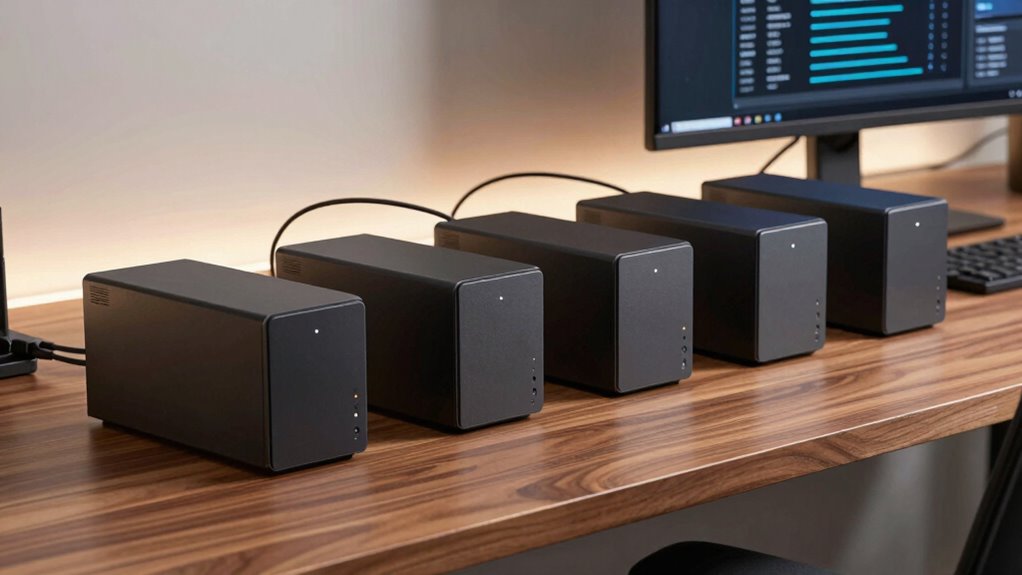

For anyone setting up local nodes, selecting the right mini PC is key to balancing performance, energy efficiency, and cost. The best overall pick, MINISFORUM X1 Lite-255, offers powerful hardware with WiFi 6E and triple 4K output, making it ideal for demanding tasks. The TK Node Mini PC series excels for dedicated home automation, while models like Beelink SER5 MAX provide high-end specs for more intensive workloads. The main tradeoffs involve balancing processing power against size, power consumption, and budget. Keep reading for a detailed breakdown to help you find the perfect fit for your node setup.

Get hardware and tech essentials delivered free with Prime
- Fast, free delivery on millions of items
- Prime Video, Amazon Music and more included
- Member-only deals all year
Key Takeaways
- High-core count and modern processors like AMD Ryzen 7 significantly improve node performance.
- WiFi 6 and high-speed LAN options are essential for reliable network connectivity in node operations.
- Mini PCs with multiple display outputs and expansion support offer flexibility for complex setups.
- Most top-performing options balance power efficiency with processing capability, but premium models come at a higher cost.
- Dedicated models like the TK Node series are optimized for specific home automation and server roles.
| wo-we Mini PC AMD Ryzen 5 3500U, 8GB DDR4 RAM, 256GB NVMe SSD |  | Best for Budget-Friendly Versatility | Processor: AMD Ryzen 5 3500U | RAM: 8GB DDR4 (upgradable to 32GB) | Storage: 256GB NVMe SSD (upgradable to 4TB) | VIEW ON AMAZON | See Our Full Breakdown |
| MINISFORUM X1 Lite-255 Mini PC with AMD Ryzen 7 255, 16GB DDR5, 512GB SSD, WiFi 6E, 2.5GbE LAN, eGPU Support, Triple 4K Output |  | Best for High-Performance Multitasking and Professional Use | Processor: AMD Ryzen 7 255 (8C/16T) | RAM: 16GB DDR5-5600MHz | Storage: 512GB SSD (expandable up to 8TB) | VIEW ON AMAZON | See Our Full Breakdown |
| TK Node Mini PC – Proxmox + Home Assistant, AMD R2514, 16GB RAM, 256GB SSD |  | Best for Self-Hosting and Automation | Processor Options: AMD R2314, AMD R2514, or Intel Core i3-1215U | RAM: 16GB (expandable up to 64GB) | Storage: 256GB SSD (up to 4TB supported) | VIEW ON AMAZON | See Our Full Breakdown |
| Beelink Mini S13 Mini PC, 13th Gen Intel N150, 16GB RAM, 500GB SSD, Dual 4K Display, WiFi 6, Bluetooth 5.2 |  | Best for Compact, Everyday Use | Processor: 13th Intel N150, up to 3.6GHz | RAM: 16GB DDR4 | Storage: 500GB M.2 SSD | VIEW ON AMAZON | See Our Full Breakdown |
| Beelink SER5 MAX Mini PC with AMD Ryzen 7 7735U, 24GB RAM, 500GB SSD, Support for Triple Display, WiFi 6, Bluetooth 5.4 |  | Best for Demanding Multitasking and Heavy Node Workloads | Processor: AMD Ryzen 7 7735U (8C/16T) | Graphics: Radeon 680M (12 cores, 2200MHz) | Memory: 24GB LPDDR5 | VIEW ON AMAZON | See Our Full Breakdown |
| Beelink SER3 Mini PC, AMD Ryzen 3 3200U, 16GB DDR4, 500GB PCIe SSD, 4K Dual Screen Support, WiFi 5, Bluetooth 5 |  | Best Overall for Versatile Local Node Deployment | Processor: AMD Ryzen 3 3200U, up to 3.5GHz | RAM: 16GB DDR4 | Storage: 500GB PCIe SSD (upgradable to 2TB) | VIEW ON AMAZON | See Our Full Breakdown |
| Beelink Mini S12 Mini PC, 12th Gen Intel N95, 8GB RAM, 480GB SSD, Support 4K Dual Display, WiFi 5, BT 4.2, 2.5G LAN |  | Best for Budget-Conscious Node Setups | Processor: 12th Gen Intel N95 (4 cores, up to 3.4GHz) | RAM: 8GB DDR4 (supports up to 16GB) | Storage: 480GB SSD (supports up to 4TB, not included) | VIEW ON AMAZON | See Our Full Breakdown |
| TK Node Mini PC – Home Assistant, AMD R2514, No RAM, 512GB SSD |  | Best for Customizable, Long-Running Home Nodes | Processor: AMD R2514 | Storage: 512GB SSD | RAM: Up to 64GB (dual SO-DIMM slots) | VIEW ON AMAZON | See Our Full Breakdown |
| ACEMAGIC K1 Mini PC AMD Ryzen R2544 (4C/8T, Up to 3.7GHz), 8GB DDR4, 256GB SSD |  | Best for Compact, Cost-Effective Node Solutions | Processor: AMD Ryzen R2544, 4 cores/8 threads, 3.35GHz base | RAM: 8GB DDR4 (expandable up to 32GB) | Storage: 256GB SSD (expandable up to 4TB) | VIEW ON AMAZON | See Our Full Breakdown |
| TK Node Mini PC – Home Assistant, AMD R2514, 8GB RAM, 256GB SSD | | Best for Simple, Reliable Home Automation Nodes | Processor: AMD R2514 | Storage: 256GB SSD | RAM: Up to 64GB | VIEW ON AMAZON | See Our Full Breakdown |
| mini pc for running local node | Storage | Processor | RAM | Graphics |
|---|---|---|---|---|
| wo-we Mini PC AMD Ryzen 5 3500 | 256GB NVMe SSD (upgradable to 4TB) | AMD Ryzen 5 3500U | 8GB DDR4 (upgradable to 32GB) | Radeon Vega 8 |
| MINISFORUM X1 Lite-255 Mini PC | 512GB SSD (expandable up to 8TB) | AMD Ryzen 7 255 (8C/16T) | 16GB DDR5-5600MHz | AMD Radeon 780M, eGPU support |
| TK Node Mini PC | 256GB SSD (up to 4TB supported) | — | 16GB (expandable up to 64GB) | — |
| Beelink Mini S13 Mini PC | 500GB M.2 SSD | 13th Intel N150, up to 3.6GHz | 16GB DDR4 | Intel Integrated Graphics |
| Beelink SER5 MAX Mini PC with | 500GB PCIe NVMe SSD | AMD Ryzen 7 7735U (8C/16T) | — | Radeon 680M (12 cores, 2200MHz) |
| Beelink SER3 Mini PC | 500GB PCIe SSD (upgradable to 2TB) | AMD Ryzen 3 3200U, up to 3.5GHz | 16GB DDR4 | AMD Radeon Vega 3, 1200MHz |
| Beelink Mini S12 Mini PC | 480GB SSD (supports up to 4TB, not included) | 12th Gen Intel N95 (4 cores, up to 3.4GHz) | 8GB DDR4 (supports up to 16GB) | Intel UHD Graphics (1.20GHz, 16EU) |
| TK Node Mini PC | 512GB SSD | AMD R2514 | Up to 64GB (dual SO-DIMM slots) | — |
| ACEMAGIC K1 Mini PC AMD Ryzen | 256GB SSD (expandable up to 4TB) | AMD Ryzen R2544, 4 cores/8 threads, 3.35GHz base | 8GB DDR4 (expandable up to 32GB) | Integrated Radeon Graphics, max 1300MHz |
| TK Node Mini PC | 256GB SSD | AMD R2514 | Up to 64GB | — |
More Details on Our Top Picks
wo-we Mini PC AMD Ryzen 5 3500U, 8GB DDR4 RAM, 256GB NVMe SSD
This mini PC offers a balanced mix of performance and affordability, powered by an AMD Ryzen 5 3500U processor that handles multitasking and basic server duties effectively. Unlike the more powerful MINISFORUM X1 Lite-255, which supports 8K output and eGPU connectivity, the wo-we model is more straightforward and easier to set up, making it ideal for those who don’t need extreme graphics or expansion. Its support for three 4K displays enhances productivity without adding complexity. However, its limited 256GB storage and the need for upgrades—especially RAM—may be a drawback for users planning to run multiple nodes or store large datasets. The lack of a dedicated GPU means it’s less suitable for graphics-intensive tasks. Still, its compact size and upgradeability make it a flexible choice for basic node hosting on a budget.
Pros:- Affordable price point with upgrade potential
- Supports three 4K displays for multitasking
- Compact, lightweight, and quiet design
Cons:- Limited out-of-the-box storage, requiring upgrades
- No dedicated GPU for high-end graphical tasks
- Upgrading RAM and storage needs technical skills
Best for: Home lab enthusiasts or small-scale node operators seeking an affordable, upgradeable mini PC.
Not ideal for: Power users requiring high storage capacity or GPU-accelerated workloads, as the base storage and graphics capabilities are limited.
- Processor:AMD Ryzen 5 3500U
- RAM:8GB DDR4 (upgradable to 32GB)
- Storage:256GB NVMe SSD (upgradable to 4TB)
- Graphics:Radeon Vega 8
- Display Outputs:2x HDMI 2.0, USB-C (4K@60Hz)
- Weight:337g
Our verdict“This mini PC suits users needing a flexible, budget-friendly platform for basic node operations and multitasking.”
MINISFORUM X1 Lite-255 Mini PC with AMD Ryzen 7 255, 16GB DDR5, 512GB SSD, WiFi 6E, 2.5GbE LAN, eGPU Support, Triple 4K Output
The MINISFORUM X1 Lite-255 stands out for its high-end AMD Ryzen 7 255 processor, which outperforms the Ryzen 5 in multitasking and demanding workloads, making it the ideal choice over the wo-we Mini PC for users who prioritize raw power. Its support for dual DDR5 RAM and dual M.2 SSD slots offers extensive upgrade options, and the ability to connect an external eGPU via OCuLink opens the door to high-performance graphics, unlike the other options that rely solely on integrated graphics. While its internal storage starts at 512GB, expanding to 8TB provides ample space for large datasets and multiple nodes. The key tradeoff is setup complexity, especially with external eGPU support, which may be daunting for less technical users. This pick is perfect for professionals or advanced hobbyists who need a powerful, expandable platform for running multiple nodes or virtualization tasks.
Pros:- Powerful AMD Ryzen 7 255 processor with high multi-threaded performance
- Supports dual DDR5 RAM and dual M.2 SSDs for extensive upgrades
- External eGPU support for enhanced graphics performance
- Triple 4K display output for professional multitasking
Cons:- Limited internal storage without upgrades
- Setup complexity for external eGPU connection
- No dedicated GPU included, relying on external solutions
Best for: Tech-savvy users running multiple nodes or requiring intensive multitasking with expandability.
Not ideal for: Beginners or those with limited technical skills, due to the complexity of eGPU setup and upgrades.
- Processor:AMD Ryzen 7 255 (8C/16T)
- RAM:16GB DDR5-5600MHz
- Storage:512GB SSD (expandable up to 8TB)
- Graphics:AMD Radeon 780M, eGPU support
- Networking:WiFi 6E, 2.5GbE LAN
- Ports:HDMI, DisplayPort, USB4, 4xUSB Type-A
Our verdict“This is a top choice for users who need raw performance, expandability, and multiple high-resolution outputs for demanding node management.”
TK Node Mini PC – Proxmox + Home Assistant, AMD R2514, 16GB RAM, 256GB SSD
The TK Node Mini PC is designed for dedicated server roles, especially for running Proxmox and Home Assistant, making it ideal for those focused on self-hosted services. Its compact size and support for multiple 4K displays make it versatile for placement in a home or small office environment. Compared to the Beelink SER5 MAX, which offers more raw processing power, the TK Node emphasizes stability and reliability with professional-grade components. The default 256GB SSD may be limiting for larger node datasets, but its expandability up to 4TB and support for various processor options provide flexibility. The main tradeoff involves needing some technical knowledge to optimize configuration. This mini PC is perfect for automation enthusiasts and small-scale virtualization projects.
Pros:- Preloaded with Proxmox and Home Assistant for easy deployment
- Supports multiple 4K displays and expandable storage
- Compact and reliable with professional-grade components
Cons:- Default 256GB SSD may be insufficient without upgrades
- Processor performance varies depending on selection
- Requires some technical skill for setup
Best for: Automation hobbyists or small-scale virtualization users needing a reliable, space-efficient platform.
Not ideal for: Users requiring large storage out of the box or high-end graphical performance for intensive workloads.
- Processor Options:AMD R2314, AMD R2514, or Intel Core i3-1215U
- RAM:16GB (expandable up to 64GB)
- Storage:256GB SSD (up to 4TB supported)
- Display Support:Up to three 4K via HDMI, DisplayPort, USB-C
- Connectivity:Gigabit Ethernet, WiFi, Bluetooth
- Dimensions:5″ x 5″ x 1.7″
Our verdict“This mini PC is well-suited for automation and virtualization projects where stability and space-efficiency matter most.”
Beelink Mini S13 Mini PC, 13th Gen Intel N150, 16GB RAM, 500GB SSD, Dual 4K Display, WiFi 6, Bluetooth 5.2
The Beelink Mini S13 is designed for those who need a small, efficient system capable of handling typical node operations, with the added benefit of supporting dual 4K displays. Its 13th Gen Intel N150 processor provides decent performance for lightweight server tasks, similar to the Beelink SER3 but with improved connectivity features like WiFi 6 and Bluetooth 5.2. Compared to the more expandable and powerful Beelink SER5 MAX, the S13 is more limited in raw processing power and upgrade options, making it better suited for basic node management and everyday office tasks. Its 16GB RAM is a generous starting point, but without a dedicated GPU, high-performance workloads will be constrained. It fits well in small spaces and can be wall-mounted, ideal for minimalist setups.
Pros:- Compact size with wall-mount capability
- Supports dual 4K displays for multitasking
- Fast WiFi 6 and Bluetooth 5.2 for modern connectivity
Cons:- Limited to 16GB RAM (upgradable to 64GB with additional modules)
- No dedicated GPU for intensive tasks
- Limited internal storage without upgrades
Best for: Lightweight node operators or users in need of a space-saving, low-power computing solution.
Not ideal for: Heavy-duty virtualization or data-heavy nodes, due to limited processing and storage expansion options.
- Processor:13th Intel N150, up to 3.6GHz
- RAM:16GB DDR4
- Storage:500GB M.2 SSD
- Graphics:Intel Integrated Graphics
- Display Support:Dual 4K@60Hz
- Connectivity:WiFi 6, Bluetooth 5.2
Our verdict“This mini PC is a solid choice for small-scale, low-power node setups where space and quiet operation are priorities.”
Beelink SER5 MAX Mini PC with AMD Ryzen 7 7735U, 24GB RAM, 500GB SSD, Support for Triple Display, WiFi 6, Bluetooth 5.4
The Beelink SER5 MAX combines a high-performance AMD Ryzen 7 7735U processor with 24GB of LPDDR5 RAM, making it the most powerful option in this lineup for hosting multiple nodes or handling intensive virtualization tasks. Its support for triple 4K displays allows extensive multitasking, and WiFi 6 along with Bluetooth 5.4 provide robust connectivity. Compared to the MINISFORUM X1 Lite-255, the SER5 MAX offers a more integrated solution with higher base storage and a better cooling system for prolonged operation. The main tradeoff is that, despite its impressive specs, the 500GB SSD may still require expansion for large datasets, and its small form factor limits hardware upgrades. It’s an excellent fit for advanced users needing a reliable, high-performance platform for complex node setups.
Pros:- Powerful AMD Ryzen 7 7735U processor for demanding tasks
- Supports triple 4K monitor setup for extensive multitasking
- Fast WiFi 6 and Bluetooth 5.4 connectivity
- Quiet cooling system for stable long-term operation
Cons:- Default storage of 500GB SSD may require expansion
- Limited upgrade options due to small form factor
- No dedicated GPU for high-end gaming
Best for: Power users or IT professionals managing multiple nodes with high resource demands.
Not ideal for: Casual users or those with limited technical skills, due to configuration needs and upgrade considerations.
- Processor:AMD Ryzen 7 7735U (8C/16T)
- Graphics:Radeon 680M (12 cores, 2200MHz)
- Memory:24GB LPDDR5
- Storage:500GB PCIe NVMe SSD
- Video Output:HDMI, DisplayPort, USB-C
- Network:WiFi 6, Bluetooth 5.4, 2.5G Ethernet
Our verdict“This mini PC excels for users who need substantial processing power and multi-monitor support for complex node operations.”
Beelink SER3 Mini PC, AMD Ryzen 3 3200U, 16GB DDR4, 500GB PCIe SSD, 4K Dual Screen Support, WiFi 5, Bluetooth 5
The Beelink SER3 stands out for its balanced mix of performance and connectivity, making it an excellent choice for running local nodes that require reliable multitasking. Its AMD Ryzen 3 3200U processor combined with 16GB DDR4 RAM ensures smooth operation for most blockchain or server tasks, outperforming lower-spec options like the ACEMAGIC K1, which has only 8GB RAM and a less capable processor. The dual 4K display support enhances monitoring dashboards or node status screens, while the fast PCIe SSD boosts data access speeds. However, the limited 16GB RAM could become a bottleneck for intensive multitasking, and its small form factor restricts future upgradeability. Compared to the Beelink Mini S12, which offers a newer 12th gen CPU but less RAM, this model provides a better balance for multi-tasking and display needs. This pick is ideal for users seeking a dependable, flexible node platform without extensive upgrade plans.
Pros:- Powerful AMD Ryzen 3 3200U processor for multitasking
- Supports dual 4K displays for monitoring and management
- Fast 500GB PCIe SSD with upgrade potential
Cons:- Limited to 16GB RAM, which may restrict heavy multitasking
- No dedicated GPU, unsuitable for graphics-intensive tasks
Best for: Individuals deploying multiple local nodes or running resource-intensive blockchain software in a compact desktop environment.
Not ideal for: Power users needing dedicated graphics or high RAM capacity for heavy data processing, as upgrade options are limited.
- Processor:AMD Ryzen 3 3200U, up to 3.5GHz
- RAM:16GB DDR4
- Storage:500GB PCIe SSD (upgradable to 2TB)
- Graphics:AMD Radeon Vega 3, 1200MHz
- Display Support:Dual 4K @ 60Hz via HDMI2.0
- WiFi:WiFi 5 (802.11ac)
- Bluetooth:5.0
- Ports:2 HDMI2.0, 4 USB 3.2 Gen2, Ethernet 1000M, Audio Jack
- Dimensions:4.96 x 4.44 x 1.65 inches
Our verdict“This model offers a well-rounded mix of performance, display support, and expandability for general local node operations.”
Beelink Mini S12 Mini PC, 12th Gen Intel N95, 8GB RAM, 480GB SSD, Support 4K Dual Display, WiFi 5, BT 4.2, 2.5G LAN
The Beelink Mini S12 offers a compelling blend of modern Intel architecture and affordability, making it a smart choice for users with modest node requirements. Its 12th Gen Intel N95 processor provides solid performance for basic blockchain tasks or small-scale server functions, outperforming the older Ryzen 3-based SER3 in single-threaded efficiency. The dual 4K display support enhances node monitoring without adding complexity. Its 8GB RAM is sufficient for light multitasking but may fall short for heavier workloads, especially compared to the SER3’s 16GB. The included 480GB SSD offers quick data access, though larger storage must be purchased separately. While it features WiFi 5 and Bluetooth 4.2, the 2.5G LAN port ensures faster network connectivity than most competitors like the TK Node, which relies solely on Ethernet. Best suited for users prioritizing cost-effectiveness with room to upgrade storage and RAM later.
Pros:- Modern 12th Gen Intel N95 processor for efficient performance
- Supports dual 4K displays for monitoring multiple nodes
- Includes 2.5G Ethernet for faster network throughput
Cons:- Limited to 8GB RAM out of the box, may require upgrade
- No included storage, additional costs for larger drives
Best for: Budget-conscious operators running small to medium nodes with minimal multitasking needs.
Not ideal for: Heavy multi-node deployments or applications demanding extensive RAM or high-speed networking, as RAM and storage upgrades are needed.
- Processor:12th Gen Intel N95 (4 cores, up to 3.4GHz)
- RAM:8GB DDR4 (supports up to 16GB)
- Storage:480GB SSD (supports up to 4TB, not included)
- Graphics:Intel UHD Graphics (1.20GHz, 16EU)
- Display Output:Dual HDMI, 4K 60Hz
- Connectivity:WiFi 5, BT 4.2, 2.5G LAN
- Dimensions:4.52 x 4.01 x 1.54 inches
Our verdict“This mini PC strikes a balance between performance and affordability, ideal for small-scale node setups with future upgrade plans.”
TK Node Mini PC – Home Assistant, AMD R2514, No RAM, 512GB SSD
The TK Node Mini PC is designed for dedicated home automation or professional node deployments that require flexibility and continuous operation. Its AMD R2514 processor, paired with support for up to 64GB RAM, offers a high-performance foundation, surpassing the other options in raw processing capability. Its support for up to 3x 4K displays makes it suitable for complex dashboards or multiple monitoring screens. Since it ships without RAM, users must purchase and install compatible modules, adding setup complexity. Its 512GB SSD provides ample, fast storage for most applications, but the initial setup involves technical knowledge. Compared to the ACEMAGIC K1, which is more suited for lightweight tasks, the TK Node targets long-term, high-availability environments where customization and expandability are key.
Pros:- Supports up to 64GB RAM for extensive multitasking
- Flexible placement with compact size
- Supports multiple 4K displays for comprehensive monitoring
Cons:- No RAM included, adding setup steps
- Requires technical knowledge for upgrades
- Initial cost can be higher due to extra RAM purchase
Best for: Home automation enthusiasts or professionals deploying reliable, scalable nodes with future expansion in mind.
Not ideal for: Users seeking a simple plug-and-play solution or those uncomfortable with hardware upgrades, as it requires technical setup.
- Processor:AMD R2514
- Storage:512GB SSD
- RAM:Up to 64GB (dual SO-DIMM slots)
- Display Support:Up to 3x 4K displays
- Connectivity:Gigabit Ethernet, WiFi, Bluetooth
- Dimensions:5″ x 5″ x 1.7″
Our verdict“This PC is best suited for users who need a powerful, customizable platform for long-term, high-availability node operations.”
ACEMAGIC K1 Mini PC AMD Ryzen R2544 (4C/8T, Up to 3.7GHz), 8GB DDR4, 256GB SSD
The ACEMAGIC K1 packs a capable AMD Ryzen R2544 processor into a compact chassis, making it suitable for light to moderate node operations where space is limited. Its 8GB DDR4 RAM is enough for basic blockchain or server tasks, though it may struggle with more demanding multitasking, especially compared to the SER3’s 16GB. The 256GB SSD provides speedy data access but could require expansion for larger datasets. Its support for triple 4K display outputs is a plus for monitoring multiple nodes, but the cooling system, while adequate for daily use, may produce some noise under sustained workloads. Compared with the Beelink Mini S12, which offers a more recent CPU, the ACEMAGIC K1 is smaller and more power-efficient, though at the expense of initial storage capacity and future upgrade potential. This makes it ideal for users with limited space and modest node loads.
Pros:- Powerful AMD Ryzen R2544 processor for responsive multitasking
- Supports up to three 4K monitors for extensive oversight
- Compact, space-saving design
Cons:- Limited initial storage of 256GB SSD, requiring expansion
- Cooling system may produce noise during heavy use
Best for: Individuals needing a small, affordable, yet capable platform for basic node management and monitoring.
Not ideal for: Heavy multi-node setups or data-intensive tasks, as RAM and storage are limited and upgrades are necessary.
- Processor:AMD Ryzen R2544, 4 cores/8 threads, 3.35GHz base
- RAM:8GB DDR4 (expandable up to 32GB)
- Storage:256GB SSD (expandable up to 4TB)
- Graphics:Integrated Radeon Graphics, max 1300MHz
- Display Outputs:HDMI 2.0, DisplayPort 1.4, USB-C 3.2
- Connectivity:Gigabit Ethernet, WiFi 5, Bluetooth 4.2
- Dimensions:5 x 2.6 x 2 inches
Our verdict“This mini PC offers a compact, budget-friendly option for light node operations with room for upgrades.”
TK Node Mini PC – Home Assistant, AMD R2514, 8GB RAM, 256GB SSD
The TK Node offers a straightforward, reliable platform optimized for home automation and simple node tasks. Its AMD R2514 processor, combined with 8GB RAM, provides enough power for running Home Assistant or similar software, especially when paired with the 256GB SSD for quick data access. Its support for up to three 4K displays makes it suitable for managing multiple dashboards or security feeds. However, the base configuration lacks RAM, requiring an additional purchase and installation, which adds complexity for less experienced users. Compared to the Beelink SER3, the TK Node emphasizes stability and customization over raw performance, making it a better choice for dedicated, always-on home automation hubs. It’s an ideal pick for users comfortable with hardware upgrades and seeking dependable operation.
Pros:- Supports up to 3x 4K displays for comprehensive monitoring
- Expandable RAM and storage for future needs
- Reliable, designed for 24/7 operation
Cons:- No RAM included, requiring additional purchase
- Requires technical knowledge for upgrades
- Initial setup is more involved
Best for: Home automation enthusiasts or small-scale node operators comfortable with hardware upgrades.
Not ideal for: Users seeking plug-and-play simplicity or high-performance multi-node environments without technical setup.
- Processor:AMD R2514
- Storage:256GB SSD
- RAM:Up to 64GB
- Display Support:Up to 3x 4K
- Connectivity:Gigabit Ethernet, WiFi, Bluetooth
- Dimensions:5″ x 5″ x 1.7″
Our verdict“This PC is best suited for users who want a dependable, expandable home automation hub and are comfortable performing hardware upgrades.”

How We Picked
Our evaluation focused on hardware specifications, performance potential, build quality, and usability for running local nodes. We prioritized processors with multiple cores and high clock speeds, as these directly impact node stability and responsiveness. Connectivity features like WiFi 6E and 2.5GbE LAN were considered essential for maintaining reliable network links. Additionally, we looked at expandability options, noise levels, power consumption, and overall value to ensure these mini PCs are suitable for continuous operation in a home or small office environment. Products were ranked based on their ability to meet these criteria while balancing cost and complexity.| mini pc for running local node | Display Support | Connectivity |
|---|---|---|
| wo-we Mini PC AMD Ryzen 5 3500 | — | — |
| MINISFORUM X1 Lite-255 Mini PC | — | — |
| TK Node Mini PC | Up to three 4K via HDMI, DisplayPort, USB-C | Gigabit Ethernet, WiFi, Bluetooth |
| Beelink Mini S13 Mini PC | Dual 4K@60Hz | WiFi 6, Bluetooth 5.2 |
| Beelink SER5 MAX Mini PC with | — | — |
| Beelink SER3 Mini PC | Dual 4K @ 60Hz via HDMI2.0 | — |
| Beelink Mini S12 Mini PC | — | WiFi 5, BT 4.2, 2.5G LAN |
| TK Node Mini PC | Up to 3x 4K displays | Gigabit Ethernet, WiFi, Bluetooth |
| ACEMAGIC K1 Mini PC AMD Ryzen | — | Gigabit Ethernet, WiFi 5, Bluetooth 4.2 |
| TK Node Mini PC | Up to 3x 4K | Gigabit Ethernet, WiFi, Bluetooth |
Factors to Consider When Choosing Mini Pc For Running Local Nodes
Choosing the right mini PC for running local nodes involves more than just raw specs. You should consider processor performance to handle the computational load, connectivity options for network stability, and expandability for future upgrades. Power efficiency can reduce ongoing costs and heat output, especially important for 24/7 operation. Additionally, size and form factor matter if space is limited or if you plan to integrate the device into an existing setup. Lastly, assess your budget against the features offered to avoid overpaying for unnecessary capabilities or under-speccing for your needs.Processor Power and Core Count
For running local nodes, a processor with multiple cores and high clock speeds provides the stability and responsiveness needed for continuous operation. AMD Ryzen 5 and above, or Intel equivalents, are generally recommended. Overly weak CPUs may struggle under load, leading to slower sync times or potential failures. Conversely, high-end processors increase costs and power consumption, so matching your workload to the CPU is vital to avoid overspending.
Connectivity and Network Support
Reliable network connection is essential for node stability. Look for mini PCs with WiFi 6E support, which offers better range and bandwidth, and Ethernet ports with at least 1GbE, ideally 2.5GbE or higher for future-proofing. If your setup involves multiple devices or high data throughput, prioritize models with multiple LAN ports or support for link aggregation. Poor connectivity can cause data delays or dropped connections, undermining your node’s reliability.
Expandability and Storage Options
Running local nodes can benefit from flexible storage options—preferably NVMe SSDs for speed and reliability. Also, consider whether the mini PC supports additional RAM or storage upgrades, which might be necessary as your node grows or if you run multiple services. Compact designs with limited expansion can be a drawback if your needs evolve, so opt for models that offer accessible upgrade slots whenever possible.
Power Efficiency and Noise Levels
Continuous operation demands energy-efficient components to keep electricity bills manageable and reduce heat output. Look for models with low TDP processors and efficient power supplies. Noise levels matter if the mini PC is placed in a living space or quiet office—models with fanless or semi-fanless designs are preferable. Overly noisy units can become disruptive, especially over long-term use.
Size, Form Factor, and Aesthetics
The physical footprint matters if space is limited or if the mini PC needs to blend into a home environment. Smaller, cube-shaped models are easier to integrate but may sacrifice ports or expandability. Consider how much space you have and whether the device’s design matches your aesthetic preferences. Compact form factors should not compromise on connectivity or performance for the sake of size.
Frequently Asked Questions
Can a mini PC handle multiple nodes or heavier workloads?
Yes, many mini PCs with high-core CPUs like AMD Ryzen 7 or Intel Core i7 can support multiple nodes or heavier workloads. However, it’s important to consider thermal management and power limits, as sustained high loads can cause throttling or overheating in smaller cases. For extensive multi-node setups, choosing a model with good cooling options and room for RAM and storage upgrades will ensure stable performance over time.
Is WiFi 6E necessary for running local nodes?
While not strictly necessary, WiFi 6E offers lower latency, higher bandwidth, and better stability, especially in environments with many connected devices. For critical node functions or when wired Ethernet isn’t feasible, WiFi 6E can improve reliability. However, a high-quality Ethernet connection remains the most consistent choice for uninterrupted, high-speed network performance.
How much RAM do I need for running multiple nodes?
For most small to medium node setups, 8GB of RAM is the minimum, but 16GB or more provides extra headroom for multiple services or heavier workloads. Insufficient RAM can lead to slow response times or crashes, especially if you run several containers or virtual machines. Always consider future growth when selecting RAM capacity.
Should I prioritize SSD storage or HDD for my mini PC?
SSDs, particularly NVMe types, are strongly recommended because they offer faster data access speeds, which reduces sync and startup times for your nodes. HDDs can work but introduce delays and potential reliability issues under continuous use. Investing in SSDs improves overall responsiveness and minimizes bottlenecks, especially important for blockchain or data-intensive nodes.
Is fanless design worth it for a mini PC running nodes?
Fanless designs are excellent for quiet operation and lower power consumption, making them ideal for home environments. However, they may run hotter and sometimes have limited cooling capacity, which could impact performance during prolonged workloads. If noise is a priority and your workload is moderate, fanless models are a good choice, but for heavier tasks, models with active cooling might be more reliable.
Conclusion
For most users seeking a reliable, all-around performer, the MINISFORUM X1 Lite-255 offers a compelling blend of power, expandability, and future-proof connectivity. Those on a tighter budget or with less demanding setups may find the Beelink SER3 or Beelink Mini S12 sufficient. For dedicated home automation or intensive node operations, the TK Node Mini PC series provides optimized performance. Beginners should look for models with straightforward setup and good support, while power users may prioritize high-core CPUs and expandability. Your choice should reflect your specific node workload, space, and budget constraints.
Halloween Picks

Spirit Halloween 4 Ft. 6 In. Scary Sitting Scarecrow Animatronic

Star Wars Yoda and R2-D2 Inflatable Halloween Decor, 6 ft with LEDs, Indoor/Outdoor

9 ft Halloween Inflatable Haunted Castle with Dragon and Ghost
As an affiliate, we earn on qualifying purchases.