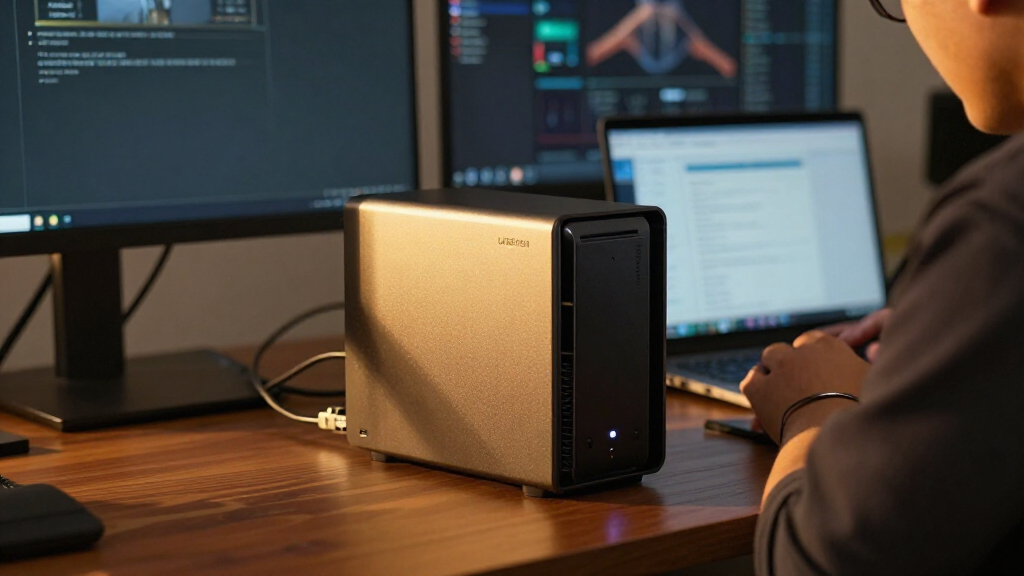

🔍 Read the full analysis: UGREEN NAS DXP4800 Pro For AI: Worth A Look Or Time To Compare? on ThorstenMeyerAI.com

Get hardware and tech essentials delivered free with Prime
- Fast, free delivery on millions of items
- Prime Video, Amazon Music and more included
- Member-only deals all year
TL;DR
The UGREEN NAS DXP4800 Pro combines four drive bays, an Intel Core i3-1315U, expandable DDR5 memory and 10GbE networking for buyers who want a capable home server or small-team storage system. Its advertised capacity depends on drives buyers supply, and its higher-end hardware may be unnecessary for basic backups and shared folders.
A product assessment of the UGREEN NAS DXP4800 Pro says its four drive bays, Intel Core i3-1315U processor and 10GbE networking make it worth considering for home users and small teams running demanding storage or self-hosted services. The same hardware can be excessive for buyers who only need automatic backups and shared folders, and the stated capacity depends on drives purchased separately.
The DXP4800 Pro is a four-bay network-attached storage system with an Intel Core i3-1315U, 8GB of DDR5 memory and a stated memory expansion ceiling of 96GB. Its specifications also include one 10GbE port, one 2.5GbE port and two PCIe 4.0 M.2 slots. The assessment says the processor and memory give the system room to run file services alongside Docker containers or virtual machines, although ordinary backup use is unlikely to need that much processing capacity.
UGREEN lists support for up to 144TB across four hard drives and two M.2 SSDs. That is a possible configuration, not storage included with the NAS: the supplied product details do not state that drives come in the box. The four bays support RAID 0, 1, 5 and 10, while tool-free trays are intended to simplify drive installation. RAID can provide continued access after some drive failures, but it is not a substitute for a separate backup.
The system runs UGOS Pro, which includes media, photo and cloud-sync features. The assessment also describes on-device AI photo organization. These software capabilities may appeal to people who want to manage media on their own system, but the source does not provide independent performance tests or details on how the AI feature works. The listed package includes an aluminum chassis and a two-year warranty; the available information does not establish long-term reliability or operating noise.

UGREEN NAS DXP4800 Pro 4-Bay Network Attached Storage
- ✔ Processor: Intel Core i3-1315U, 6 cores, 8 threads, up to 4.5GHz
- ✔ Memory: 8GB DDR5, expandable to 96GB
- ✔ Graphics: 13th Gen Intel UHD Graphics
The 1 picks
- 1
 UGREEN NAS DXP4800 Pro 4-Bay Desktop NAS with Intel Core i3-1315U, 8GB DDR5,…View on Amazon →
Who Benefits From Its Extra Hardware
The main decision is whether the buyer will use the DXP4800 Pro as more than a network folder. Creators handling large video files, home-lab users running containers, and small teams sharing project storage may benefit from its drive capacity, memory upgrades and faster network ports. For those workloads, combining storage and server tasks in one device could reduce the need for separate equipment.
The faster ports have practical limits. A computer, switch, cabling and storage workload must all support the connection before 10GbE can deliver its potential; the assessment gives a stated maximum transfer speed of 1.25GB/s, not a guarantee for every setup. On a standard gigabit network, the system still works, but the network constrains transfers. Buyers should also include drives and any needed networking upgrades in their budget, since the NAS’s advertised capacity is not a ready-to-use amount of storage.
That makes the product’s appeal conditional rather than universal. A buyer who needs room to expand or intends to run self-hosted services may find the extra hardware useful. Someone who wants compact, straightforward backup storage could pay for capacity and performance that remain unused. The product assessment points to the Synology DS223 and DS223j as simpler two-bay alternatives for those lighter needs, without providing a full price or feature comparison.
How It Compares With Basic NAS
A NAS connects storage to a home or office network so multiple devices can access files and services. Two-bay models can suit basic backups and shared folders; the DXP4800 Pro starts with four 3.5-inch drive bays, giving buyers more room to add drives and configure storage as needs change. It also has two M.2 slots and a higher-end processor, positioning it closer to a flexible home server than a storage-only appliance.
The assessment contrasts the UGREEN system with the Synology DS223 and DS223j, describing those two-bay models as more sensible for straightforward storage. It does not include current prices, independent benchmarks, or a detailed software comparison, so it cannot establish which system offers better value overall. The recommendation is instead based on matching the DXP4800 Pro’s hardware to a buyer’s planned workload.
Setup also involves decisions beyond plugging in a preloaded drive. Buyers need to select disks, choose a storage arrangement, and configure the network and software. Tool-free trays can make the physical part easier, but they do not remove the need to plan capacity and redundancy. The assessment says the system supports RAID 0, 1, 5 and 10; the appropriate setup depends on a buyer’s priorities, and RAID does not protect against every form of data loss.
“The early verdict: worth buying for buyers who will use its speed and flexibility; a simpler two-bay unit is a better fit for straightforward backups and shared folders.”
— ThorstenMeyerAI.com product assessment
Costs, Performance and Setup Questions
The supplied material does not state a price, confirm whether any drives are included, or provide a complete bill of materials. That leaves the total cost of a usable storage setup unclear. The 144TB figure is a listed maximum for a particular drive configuration, not a claim about capacity supplied with the unit.
No independent benchmark results are provided for file transfers, virtual machines, Docker workloads or on-device AI photo organization. Actual speeds depend on the client device, network equipment, cabling, drives and task. The assessment also does not give noise or power measurements, or evidence sufficient to evaluate long-term reliability. Buyers should treat the listed specifications as product details, not proof of real-world performance in every environment.
It is also not clear how much technical experience will be needed for a particular user’s setup, or whether UGOS Pro’s tools will match their preferred workflow. The assessment says new NAS users should expect to spend time learning the configuration. Those unresolved details matter most for people seeking an appliance that is ready to use with minimal setup.
What Buyers Should Check Before Purchase
Before choosing the DXP4800 Pro, buyers should confirm the current price, whether drives are included, which drives are supported and what the warranty covers in their market. They should estimate usable capacity based on the planned drive arrangement rather than treating 144TB as included storage, and keep a separate backup for important files.
For faster file transfers, check whether the computer and network equipment support 10GbE or 2.5GbE and whether cabling and storage can keep up. Buyers planning virtual machines should also weigh whether the included 8GB of memory is enough for their expected workload or whether they will need an upgrade. Those focused only on backups and shared folders can compare simpler two-bay NAS models on price, software and setup requirements.
No later product announcement or review milestone is identified in the source material. The practical next step is a workload-based comparison that includes the NAS, drives and any network upgrades, with independent tests used to check performance claims before purchase.
Key Questions
Does the UGREEN NAS DXP4800 Pro include drives?
The supplied product information does not say that drives are included. Buyers should confirm the box contents and budget for drives before assuming the NAS is ready for storage.
Who is the DXP4800 Pro best suited to?
The assessment identifies home-lab users, creators and small teams as potential fits if they will use the four bays, faster networking, memory expansion or self-hosted services. It may be more machine than needed for basic backup and file sharing.
Will its 10GbE port make every transfer faster?
No. The connected computer, switch, cabling, storage and workload must support the faster path. On an ordinary gigabit network, the NAS will operate, but the network limits the benefit of the 10GbE port.
Does RAID replace a separate backup?
No. The NAS supports several RAID configurations, which can help maintain access after some drive failures, but RAID does not protect against every cause of data loss. Keep a separate backup of important files.
Should basic backup users compare a two-bay NAS?
Yes. The assessment names the Synology DS223 and DS223j as simpler options for straightforward backups and shared folders. A useful comparison should include current pricing, software, drive costs and the features each buyer will actually use.
Source: ThorstenMeyerAI.com