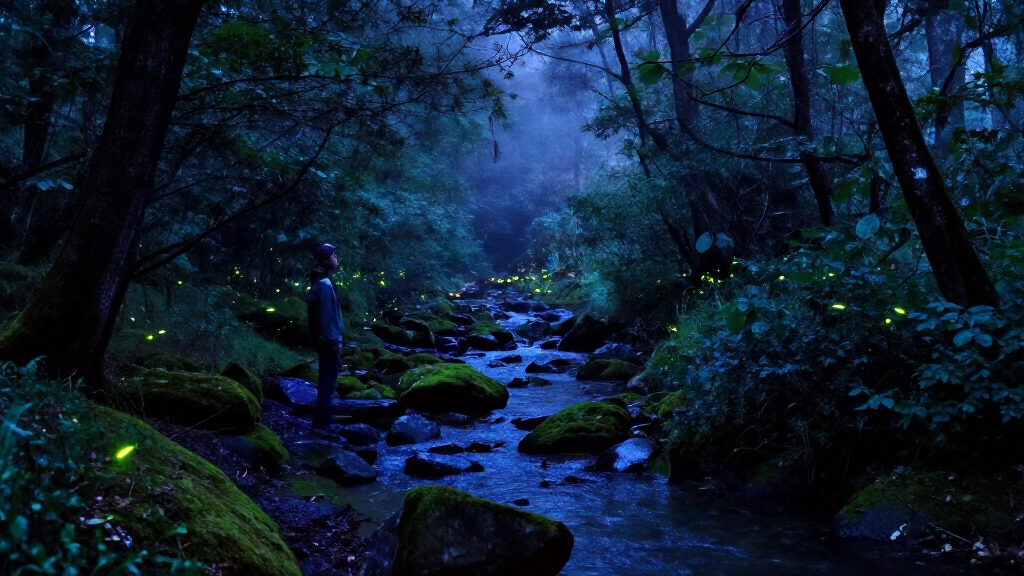

🔍 Read the full analysis: What Inspired “Luciole — The Synchronous Fireflies Of Vallon Creux”? on ThorstenMeyerAI.com

Get hardware and tech essentials delivered free with Prime
- Fast, free delivery on millions of items
- Prime Video, Amazon Music and more included
- Member-only deals all year
TL;DR
“Luciole — The Synchronous Fireflies of Vallon Creux” is Room 155 in an AI-built exhibition of 175 website experiences. Its fictional firefly colony uses a simulation based on the real Kuramoto synchronization model, letting visitors watch flashes align and disrupt the pattern. The source describes the exhibit’s inspiration and design, but does not provide independent reporting or verify claims about its development process.
“Luciole — The Synchronous Fireflies of Vallon Creux”, an interactive website listed as Room 155 in an exhibition of 175 AI-built pieces, was inspired by the idea of making synchronization visible as it happens, as detailed in the original analysis. Its fireflies and setting are fictional, while the underlying simulation draws on the real Kuramoto model, which describes how interacting oscillators can move toward a shared rhythm.
The exhibit’s stated creative brief calls for a forest-dark field notebook in which firefly signals gradually settle into unison. In the version described by ThorstenMeyerAI.com, 96 simulated fireflies begin out of sync. Visitors can change how strongly they influence one another, disturb the pattern through pointer interaction, and watch the simulation respond. A coherence measure, trace and phase diagram display information generated by the model.
The concept is not presented as a real ecological study. Luciole and Vallon Creux are invented, and the fireflies’ behavior is simulated. The source connects the piece’s central interaction—disrupting order and watching it return—to its larger artistic purpose: asking visitors to wait and observe rather than treating synchronization as a finished visual effect.
The supplied account says the website was made with AI and that its creation process forms part of the exhibit’s subject. It describes the visuals as generated with HTML, CSS, SVG and canvas, without downloaded image assets or prerecorded firefly footage. The source also reproduces the project brief, which names a three-pass design process, but does not provide records showing how each pass was carried out.
Room 155 / FABLE 175 · Interactive exhibit
What Inspired “Luciole — The Synchronous Fireflies of Vallon Creux”?
A fictional night field notebook turns a real mathematical idea into something visitors can watch, disturb, and observe settling again: synchronization as a living process.
“Forest-dark patience rewarded.”
The brief imagines a quiet hollow where order emerges gradually. Rather than presenting synchronized flashing as a finished spectacle, the exhibit asks visitors to wait, notice the change, and see how a shared rhythm can form.
A field notebook at night
Near-black green, chartreuse flashes, muted mauve annotations, serif text, and handwritten-style notes frame the experience as patient observation.
Order that can be broken
Visitors adjust coupling and disturb the field with pointer interaction, then watch the simulated pattern respond and recover.
See the process
A coherence measure, trace, and phase diagram make model behavior legible while keeping the focus on change over time.
From separate beats to shared rhythm
Each simulated firefly has an individual phase and tempo. Signals from nearby neighbors nudge those rhythms; the coupling control changes how strongly those nudges matter.
Begin apart
Flashes start out of sync across the field.
Neighbors influence
Local signals affect each oscillator’s timing.
Adjust coupling
Change the strength of those interactions.
Disturb & observe
Interrupt the pattern and watch its response.
What the account says—and leaves open
“Forest-dark patience rewarded.”
The reproduced prompt, credited to “Claude Fable 5,” asks for a fictional hollow, a “wait for it” section, and an interaction that breaks synchrony so visitors can watch it return.
A difference in scale
The brief calls for hundreds of fireflies and proposes invented species, flash patterns, and a two-week season calendar. The account describing the finished room specifies 96 simulated fireflies. It does not explain which proposed features made it into the live experience.
A simulation, not a field study
What is described
The piece is Room 155 in a 175-work exhibition. The account describes a Kuramoto-based simulation, visitor controls, and visuals made with HTML, CSS, SVG, and canvas.
What is invented
Luciole, Vallon Creux, and the colony are fictional. The exhibit models synchronization; it does not document real firefly behavior at a real location.
What remains unconfirmed
The supplied material is a project description and reproduced brief. It offers no development logs, outside confirmation of the AI process, technical documentation, or independent model validation.
A Simulation Visitors Can Disturb
“Luciole” turns an abstract scientific idea into an interaction: visitors can see how individual rhythms may align through local influence, then test what happens when they disrupt that pattern. That makes the exhibit’s central claim experiential rather than documentary. It offers a model to explore, not evidence about a real firefly population.
The distinction matters because the presentation borrows the language of a naturalist’s field notebook. The source describes a restrained palette—near-black green for night, chartreuse for flashes and muted mauve for human annotations—alongside a serif text face and handwritten-style marginal notes. These choices frame the simulation as an observation, but do not turn the fictional location into a real research site.
The work also makes its AI-built production part of the subject. The supplied account presents the site both as an exhibit about synchronization and as a product of a generative development process. Readers can therefore distinguish two things the project puts together: a real mathematical model and a fictional natural-history setting designed around it.
interactive firefly simulation kit
As an affiliate, we earn on qualifying purchases.
As an affiliate, we earn on qualifying purchases.
From Creative Brief to Field Notebook
The account identifies the piece as Room 155 of 175 and links its origins to a prompt credited to “Claude Fable 5,” described as the art director for the FABLE/175 pipeline. The brief specifies a fictional hollow, a firefly simulation and an aesthetic described as “forest-dark patience rewarded.” It also asks for a “wait for it” section that rewards stillness and an interaction that breaks synchronization so visitors can watch it recover.
The brief is more expansive than the exhibit description. It calls for hundreds of fireflies, a roughly 20-second progression from disorder to unison, invented species with different flash patterns and a two-week season calendar. The account’s description of the finished room instead specifies 96 simulated fireflies. The available material does not explain whether the brief changed during development or whether all of its proposed features appear in the live site.
The described simulation assigns each firefly an individual phase and tempo, then nudges it according to signals from nearby neighbors. A coupling control changes the strength of those influences. This mechanism reflects the Kuramoto model named in the brief; it is not a claim that the exhibit reproduces every feature of real firefly communication.
“Forest-dark patience rewarded.”
— The exhibit’s art-direction brief, credited to Claude Fable 5
As an affiliate, we earn on qualifying purchases.
What the Source Does Not Verify
The supplied material is a project description and reproduced creative brief, not an independent evaluation. It does not provide a publication date, development logs, screenshots across devices, performance results or outside confirmation of the AI production process. The account says the site was built by AI, but the available information does not detail which tools or how much human editing were involved.
There is also a difference between the brief’s requested hundreds of fireflies and the description’s 96. It is not clear whether that reflects a revised design, a limit of the implementation or another distinction. The source does not confirm whether every feature listed in the brief—including the season calendar and invented species—is present in the live version.
Finally, the simulation should not be mistaken for field research. The setting and organisms are fictional, and the material does not describe observations of actual fireflies at Vallon Creux. The model’s behavior is described, but no technical documentation or independent validation is supplied.
synchronization science experiment kit
As an affiliate, we earn on qualifying purchases.
As an affiliate, we earn on qualifying purchases.
The Live Exhibit and Its Prompt
The source directs readers to the live Luciole site and says its footer includes a “Prompt” link exposing the brief behind the piece. Visitors can use the simulation and its controls to observe how the modeled flashes respond to changes in coupling and pointer disturbance.
No further release, research study or update is announced in the supplied material. The next step for readers is to compare the live experience with the reproduced brief, while treating the ecological setting as fiction and the synchronization as a computer simulation.
As an affiliate, we earn on qualifying purchases.
Key Questions
What inspired “Luciole — The Synchronous Fireflies of Vallon Creux”?
The project brief called for an interactive, naturalist-style field notebook where visitors watch separate simulated firefly rhythms move toward synchronization. Its stated aesthetic was “forest-dark patience rewarded.”Is Vallon Creux a real place?
No. The source says Vallon Creux and Luciole are fictional, created for the exhibit, not a real location or field study.Does the exhibit use real firefly footage?
The supplied account says the visuals are made with HTML, CSS, SVG and canvas, with no downloaded image assets or prerecorded firefly sequence. The fireflies are simulated.What is the Kuramoto model doing in the exhibit?
The simulation gives each firefly an individual phase and tempo, then lets nearby signals influence those rhythms. The resulting interaction can bring the simulated flashes into closer alignment.How many fireflies are shown?
The account describing the room says 96 simulated fireflies. Its reproduced creative brief asks for hundreds, and the source does not explain the difference.Source: ThorstenMeyerAI.com
Halloween Picks
halloween
As an affiliate, we earn on qualifying purchases.