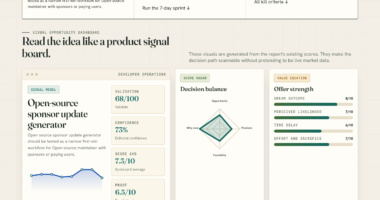

📊 Full opportunity report: Data: The One Thing You Can’t Rent on ThorstenMeyerAI.com — validation score, market gap, and execution plan.
TL;DR
The AI industry is shifting from compute and algorithms to data scarcity. Verified, human-made data is now a scarce resource, leading to fencing, licensing, and a new competitive landscape. This change impacts startups and incumbents alike.
In 2026, the AI industry faces a fundamental shift as access to verified, human-made data becomes increasingly restricted and costly, marking a new chokepoint that no longer can be rented or scraped freely. This change is driven by legal actions, licensing regimes, and strategic fencing by data owners, fundamentally altering the landscape for AI development and competition.
Industry experts estimate that the public internet contains roughly 300 trillion tokens of high-quality text, much of which is already being utilized by frontier AI models. According to Epoch AI, this stockpile is nearing exhaustion, with projections indicating full utilization between 2026 and 2032, and possibly sooner due to efficiency gains. Synthetic data, once a fallback, now faces limitations due to risks of model collapse when training on unverified machine-generated text, increasing reliance on verified human data.
Legal and economic pressures have effectively ended the era of free web scraping. Notably, Anthropic’s $1.5 billion settlement over copyright infringement, and ongoing legal cases like the New York Times against OpenAI, illustrate a shift toward market-based licensing regimes. These developments create high entry barriers, favoring large incumbents with deep pockets and marginalizing smaller players.
Simultaneously, the industry’s focus is shifting from cheap, broad data collection to sourcing rare, expert-verified data. The need for domain-specific expertise—such as legal, medical, or scientific knowledge—has turned data ownership into a strategic asset, with companies like Meta, Surge, and others investing heavily in acquiring and controlling specialized data sources.
Data: The One Thing You Can’t Rent
The free part of “all human knowledge” is running out. As compute and models commoditize, the corpus you can’t replicate becomes the moat — so data is being fenced, priced, and, in places, treated as a national asset.
Data was supposed to be the abundant input. It’s the scarce one. It’s also the chokepoint you can actually own — so guard your proprietary data, and don’t hand it to a provider who can become your competitor (the lesson everyone fled Scale to learn). Nations: license it like Ukraine — keep the model, keep the leverage.
Why Data Scarcity Reshapes AI Industry Power
This shift signifies that access to verified, human-made data will determine competitive advantage in AI development. It consolidates industry power among large firms capable of licensing or owning critical data assets, potentially stifling innovation from startups and smaller labs. The move toward fencing data also raises questions about industry openness, innovation, and the future of AI research driven by proprietary data sources.
verified human-made data sets for AI
As an affiliate, we earn on qualifying purchases.
As an affiliate, we earn on qualifying purchases.
Legal and Market Changes Driving Data Fencing
Historically, AI training relied on freely available web data, with companies scraping and aggregating vast datasets. By early 2026, legal actions such as Anthropic’s $1.5 billion copyright settlement and ongoing litigation like the NYT case against OpenAI have signaled the end of unlicensed scraping. This has led to a market where data is increasingly licensed or fenced, creating barriers for smaller entrants. The industry is also witnessing a shift toward sourcing rare, expert-verified data, which is expensive and limited in supply, further intensifying competition for high-quality data assets.
Meanwhile, the cost of compute and algorithms has decreased, but the value of the underlying data has surged, making data the new chokepoint that determines who can build competitive models.
“The Anthropic settlement sets a precedent that fair use does not cover large-scale piracy, effectively ending free scraping and pushing the industry toward licensing models.”
— Legal expert familiar with industry litigation
domain-specific data collection tools
As an affiliate, we earn on qualifying purchases.
As an affiliate, we earn on qualifying purchases.
Unclear Impact on Smaller Players and Innovation
It remains uncertain how smaller startups will adapt to the rising costs and legal barriers of accessing high-quality data. While large incumbents can afford licensing fees and proprietary data collection, many smaller labs may face insurmountable hurdles, potentially reducing overall innovation and diversity in AI development. The long-term effects of these shifts on global AI progress and open research are still emerging and debated.
As an affiliate, we earn on qualifying purchases.
Future Industry Trends and Regulatory Developments
Industry observers expect further legal rulings and licensing frameworks to solidify, potentially leading to a more segmented AI ecosystem dominated by large firms with proprietary data assets. Companies will likely invest heavily in acquiring and fencing rare, expert-verified data. Additionally, ongoing legal cases and new regulations could reshape data access policies, influencing the pace and direction of AI innovation. Smaller players may seek alternative strategies, such as synthetic data or niche specialization, but their success remains uncertain.

Synthetic Data Generation: A Beginner’s Guide
As an affiliate, we earn on qualifying purchases.
As an affiliate, we earn on qualifying purchases.
Key Questions
Why is data becoming more expensive for AI training?
Legal actions, licensing requirements, and industry fencing have made verified, human-made data costly and less accessible, ending the era of free web scraping.
How does data fencing affect new startups?
Fencing and licensing barriers increase entry costs, favoring large firms with deep financial resources and making it harder for startups to access high-quality data.
What is the significance of the Anthropic settlement?
The $1.5 billion settlement confirms that large-scale piracy of copyrighted material for training is now legally risky and financially costly, pushing the industry toward licensed data sources.
Will synthetic data replace human-made data?
While synthetic data is increasingly used, it carries risks of model collapse and errors, making verified human-made data still essential for high-stakes domains.
What does this mean for AI innovation?
Access to rare, verified data will be a key driver of innovation, but legal and economic barriers may limit the diversity and pace of AI development in the future.
Source: ThorstenMeyerAI.com