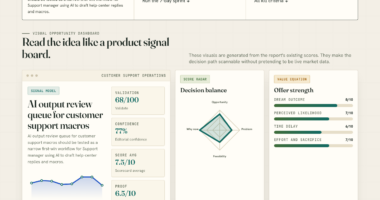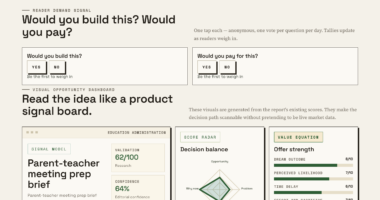
📊 Full opportunity report: AI output review queue for customer support macros on IdeaNavigator AI — validation score, market gap, and execution plan.
TL;DR
Support organizations are piloting a new AI output review queue for customer support macros. The tool scores drafts for policy adherence, tone, and risk, aiming to improve quality control amid rapid AI adoption.
Support teams are piloting a new AI output review queue for customer support macros, designed to automatically evaluate AI-drafted responses for policy compliance, tone, and accuracy before they are published. This development aims to address concerns about the drift of AI-generated support content from established guidelines as organizations adopt AI tools more rapidly than formal approval processes can keep pace.
The review queue is intended as a minimum viable product (MVP) to assist support managers in managing AI-generated help-center replies and macros. According to sources familiar with the initiative, the system scores drafts based on criteria such as adherence to company policies, appropriate tone, source verification, risky promises, and whether the draft has received proper approval.
Support organizations could subscribe to this tool as part of their support operation, with initial validation involving manually reviewing twenty AI-drafted macros to measure how many policy or tone issues are caught before publication. The goal is to improve quality control and reduce the risk of inconsistent or inaccurate responses being sent to customers.
While the concept is in testing, the developers see it as a ‘first-win’ workflow to help support managers oversee AI outputs more efficiently, especially as AI adoption accelerates across customer support teams.
Implications for Customer Support Quality Control
This development is significant because it addresses a key challenge in integrating AI into customer support workflows: maintaining consistent quality and policy compliance. As AI adoption increases, support teams face the risk of AI-generated responses drifting from company policies, tone standards, or providing inaccurate information. The review queue aims to mitigate these risks by providing an automated scoring system that flags potential issues before responses reach customers, potentially reducing errors, legal risks, and customer dissatisfaction.
Implementing such a system could set a new standard for AI oversight in support operations, encouraging organizations to formalize approval workflows and improve overall response quality. It also highlights a shift towards more automated, yet controlled, AI integration in customer service environments.
AI customer support macro review tool
As an affiliate, we earn on qualifying purchases.
As an affiliate, we earn on qualifying purchases.
Rapid AI Adoption in Customer Support
Support teams have increasingly adopted AI tools to draft help-center replies and macros, driven by the need for faster response times and scalability. However, this rapid adoption has outpaced the development of formal approval workflows, raising concerns about the quality and accuracy of AI-generated content.
Currently, many organizations manually review AI drafts, but this process can be time-consuming and inconsistent. The introduction of an automated review queue aims to streamline oversight, ensuring that AI outputs align with policies and tone standards before being published.
Previous efforts to control AI-generated content have focused on manual review, but the new system seeks to embed quality checks directly into the workflow, reducing human error and oversight fatigue.
“The review queue is designed as a first-win workflow, helping support managers catch policy or tone issues early in the process.”
— an anonymous researcher
customer support response quality checker
As an affiliate, we earn on qualifying purchases.
As an affiliate, we earn on qualifying purchases.
Uncertainties About Implementation and Effectiveness
It is not yet clear how well the review queue will perform in live support environments or how organizations will adopt it at scale. Details about its scoring accuracy, integration complexity, and impact on response times remain unconfirmed. Additionally, whether the system can adapt to diverse support contexts and policies is still under evaluation.

The Ethical Business Guide to ChatGPT: 50 Prompt Templates to Boost Productivity and Trust Without Risking Compliance (The AI Mastery Series)
As an affiliate, we earn on qualifying purchases.
As an affiliate, we earn on qualifying purchases.
Next Steps for Testing and Deployment
Support organizations involved in testing will continue to evaluate the system by reviewing the flagged macros and assessing how many issues are caught before publication. Developers plan to refine the scoring algorithms based on initial results and expand testing to larger support teams. Full deployment will depend on validation outcomes and user feedback, with broader rollout possible once the system proves effective at maintaining quality standards.
support macro approval workflow software
As an affiliate, we earn on qualifying purchases.
As an affiliate, we earn on qualifying purchases.
Key Questions
What is the main purpose of the AI output review queue?
The review queue aims to automatically evaluate AI-drafted support macros for policy compliance, tone, and accuracy before they are published, helping support teams maintain quality control.
Is this system currently available for all support teams?
No, it is currently in a testing phase with selected support organizations, and wider availability will depend on validation results.
How will the review queue improve support responses?
It is expected to reduce errors, ensure consistency with policies, and flag risky or inappropriate content before responses are sent to customers.
Will this system slow down the support process?
The goal is to integrate the review queue seamlessly into existing workflows, with the intention of reducing manual review time and improving response quality without significant delays.
What are the potential limitations of this approach?
The system’s effectiveness depends on the accuracy of its scoring algorithms, and it may require ongoing adjustments to handle diverse support scenarios and evolving policies.
Source: IdeaNavigator AI