

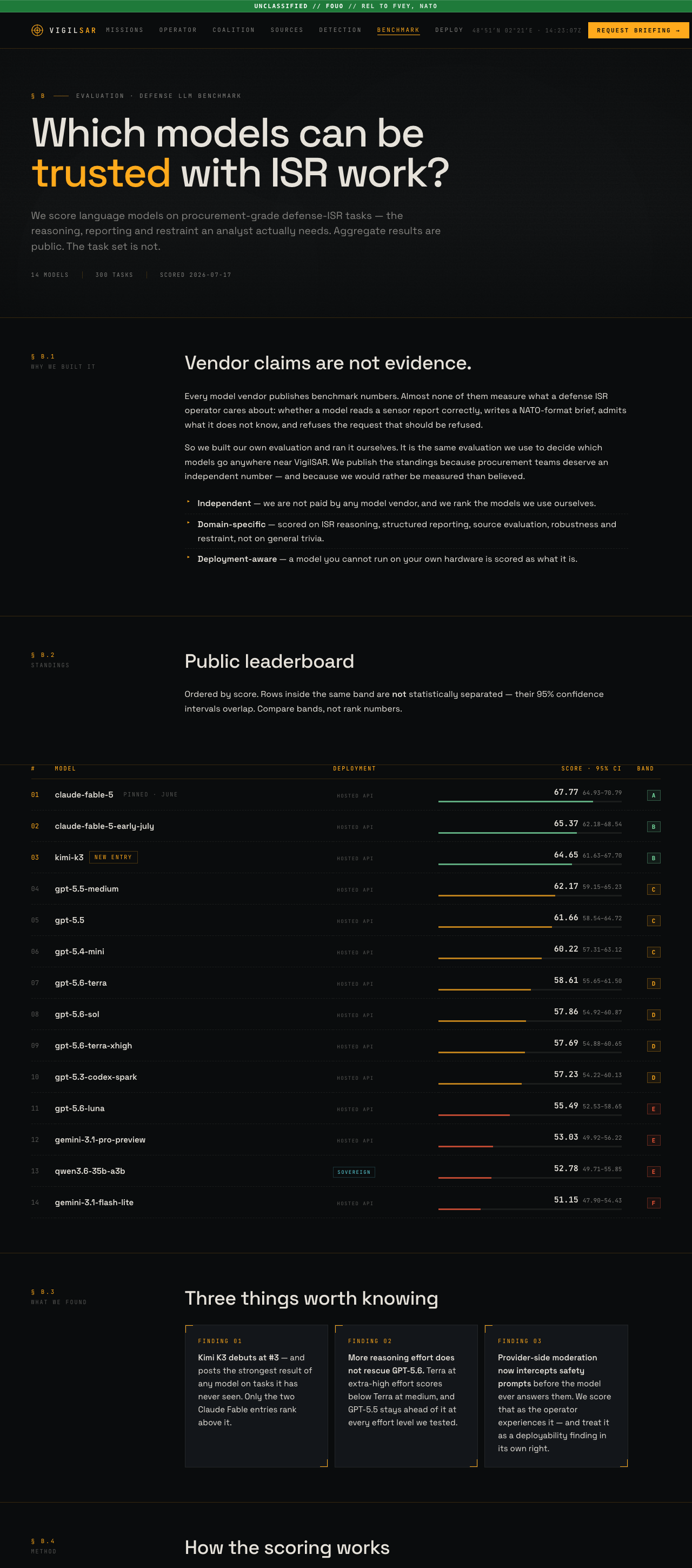
In the realm of defense and intelligence, VigilSAR has established a transparent benchmark for language models tasked with intelligence-surveillance-reconnaissance work. Their public leaderboard scores models based on their ability to perform reasoning, reporting, and restraint—crucial skills for analysts—not just general trivia. The setup involves 14 models evaluated across 300 tasks, with results collected on 2026-07-17.

Get hardware and tech essentials delivered free — and shop member deals
- Fast, free delivery on millions of items
- Access to Prime Big Deal Days deals on October 6–7
- Prime Video, Amazon Music and more included
What sets VigilSAR apart is the deliberate separation between the public test set and a private, held-out set. This design prevents models from simply memorizing answers, as the private set remains undisclosed. The leaderboard displays the scores, along with the gap between public and held-out performance for each model, serving as an indicator of potential overfitting or memorization.
Currently, Claude-fable-5 leads the pack with a score of 67.77, firmly in Band A. A notable newcomer is Moonshot’s Kimi K3, debuting at #3 with 64.65 and positioned in Band B. Impressively, it outperforms all GPT and Gemini models on the leaderboard, which are predominantly in Bands C through F. The inclusion of a locally-runnable model rated as sovereign-deployable indicates that real-world deployment considerations are factored into the score.
The purpose of VigilSAR’s evaluation, as stated on their site, is to counter vendor claims with verifiable data. The operators emphasize that their scoring system is designed for transparency: ranking models, assessing their real performance, and avoiding reliance on vendor-provided claims. The aim is to objectively identify which models can truly meet operational standards, rather than being misled by promotional hype.
To promote honesty, the leaderboard features bands instead of precise ranks, along with confidence intervals and the measured performance gaps between public and private sets. These features help highlight the reliability of each model’s score. Additionally, the leaderboard includes a reference row and cost-per-correct-answer economics, giving a comprehensive view of each model’s value and robustness.
For crypto enthusiasts, the VigilSAR approach echoes the ‘don’t trust, verify’ philosophy. Just as blockchain advocates stress transparent, verifiable data, VigilSAR’s methodology underscores the importance of open, testable evidence in AI evaluation. Their private test set plus held-out set design serves as an anti-gaming measure, ensuring that only models with genuine capabilities earn high marks.
Interested readers can explore the current standings and detailed scores on the public leaderboard. This commitment to transparency exemplifies how verifiable, public data can lead to more trustworthy AI development—an ethos that resonates across sectors, including crypto. For those who value the principle of ‘trust but verify’, VigilSAR’s scoring system offers a compelling model for honest AI benchmarking.
As an affiliate, we earn on qualifying purchases.
intelligence surveillance reconnaissance AI models
As an affiliate, we earn on qualifying purchases.
As an affiliate, we earn on qualifying purchases.
private test set AI evaluation tools
As an affiliate, we earn on qualifying purchases.
As an affiliate, we earn on qualifying purchases.
AI model performance analysis software
As an affiliate, we earn on qualifying purchases.
As an affiliate, we earn on qualifying purchases.
Fall Picks
fall essentials
As an affiliate, we earn on qualifying purchases.