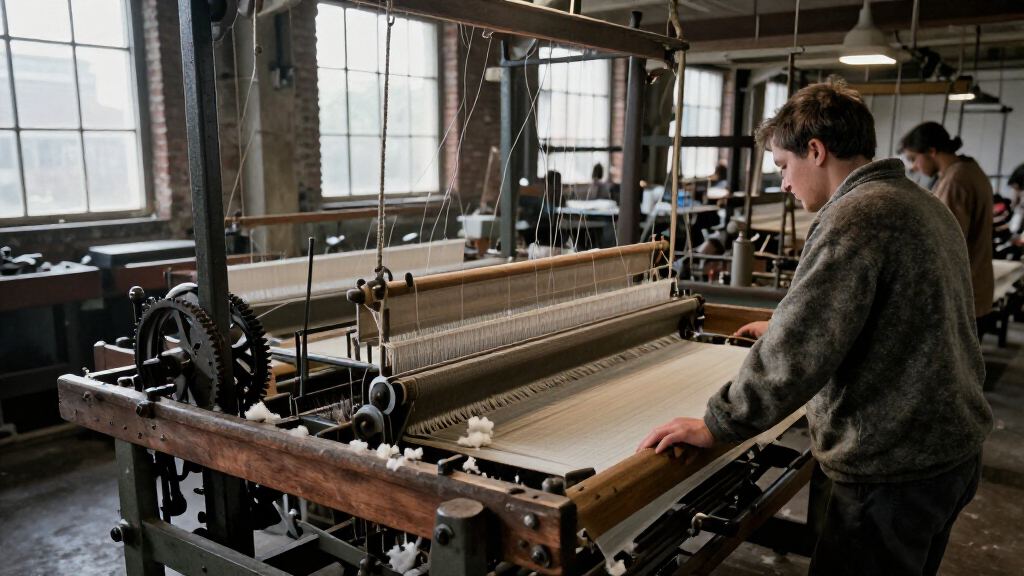
🔍 Read the full analysis: Why Workers Feared The Changes Behind Luddite-Era Machines on ThorstenMeyerAI.com

Get hardware and tech essentials delivered free with Prime
- Fast, free delivery on millions of items
- Prime Video, Amazon Music and more included
- Member-only deals all year
TL;DR
In 1811 and 1812, workers who operated knitting frames began breaking machines in Nottinghamshire, then in other English textile districts. A magistrate’s report linked their targets to employers paying reduced rates and frames producing cheaper stockings; the state responded with troops and a capital law. The episode was about control over pay and working conditions as well as machinery, though the long-term effects on wages remain debated.
Framework knitters in Nottinghamshire began breaking stocking frames in 1811 as work and pay came under pressure, according to contemporary records cited in a new historical account. The workers operated the machines themselves, but a magistrate reported that many attacks focused on frames linked to reduced piece rates and cheaper, lower-quality stockings—making the dispute about the terms of mechanized work, not simply opposition to technology.
In a letter dated February 6, 1812, Nottingham magistrate Robert Baker told the Home Office that in many places a fifth of frame workers had been out of work before the disturbances. He wrote that some hosiers—merchants who supplied work and sold the goods—then offered particular jobs at reduced prices. Baker said the breakers first directed their anger at hosiers paying “the under-price” and also targeted wider frames that enabled cheaper production.
The workers generally did not own the equipment. In a House of Commons speech on February 14, Home Secretary Richard Ryder said frames were hired to workers by employers or by investors who owned them. Knitters paid to use the equipment and were paid by the piece. The account says trade unions were illegal under the Combination Acts of 1799 and 1800, while Parliament had rejected a proposed minimum wage for weavers in 1808. Those limits narrowed workers’ formal options for bargaining over pay.
The unrest spread from Nottinghamshire to Yorkshire and Lancashire in 1812. The source account reports that by December 1811, 900 cavalry and 1,000 infantry had been sent to Nottingham. Parliament’s Frame-Breaking Act, passed on March 20, 1812, made breaking a frame a capital felony; 17 men were executed in 1813. The movement’s letters invoked “General Ned Ludd,” whom the National Archives describes as a mythical figure rather than a verified leader.
Pay and Control on the Frame
The records challenge the modern shorthand that a Luddite is simply someone who rejects technology. These workers made their living operating mechanical frames. The evidence cited by the account suggests they objected to how machinery was being used: who set prices, who owned the equipment, and whether faster or wider frames undercut established rates and product standards.
The consequences reached beyond the workshops. When workers had little legal scope to organize or secure a wage floor, machine-breaking became one form of pressure, while the government answered with military deployment and severe criminal penalties. The episode remains relevant to debates over workplace technology because it highlights questions about distribution of gains and workers’ influence, not just whether a machine can perform a task.
The account connects those questions to modern disputes involving writers’ contracts in Hollywood, works-council rights in Germany and the EU AI Act. The settings and technologies differ, and the comparison does not make them equivalent. It points to recurring concerns over pay, quality and a say in how tools are used.
Products Worth Considering

Logitech MX Mechanical Wireless Illuminated Keyboard, Tactile Quiet, Graphite

Logitech MX Keypad Programmable Macro Pad for Developers, Graphite

Logitech MX Keys S Combo Wireless Keyboard and Mouse, Graphite
As an affiliate, we earn on qualifying purchases.
From Nottingham to Other Districts
The first recorded wave described in the account began in and around Nottingham, where framework knitters made stockings and other goods on hand- and foot-operated machines. Many worked at home or in small workshops. Because workers often rented frames and took jobs from hosiers, a change in the price paid per item could affect their earnings without giving them control over the machinery or the final sale.
Historian Kevin Binfield, editor of a collection of Luddite writings, identifies the attack on wide frames at a workshop in Arnold on March 11, 1811, as the opening of the most intense period of Luddism, which lasted from 1811 to 1813. The National Archives says disturbances spread to the West Riding of Yorkshire and Lancashire in 1812, as well as Leicestershire and Derbyshire. In Yorkshire, some protesters targeted shearing frames used in the wool trade, rather than the stocking frames of the Nottingham knitters.
Baker’s account is evidence from a magistrate seeking to describe and suppress unrest, not a neutral survey of every worker or attack. A reward poster from January 25, 1812, also shows that targeting was not always consistent: it offered £200 for information after five frames were broken at a Lenton knitter’s home, and the workers there said the frames had been operating at “the FULL PRICE.” That episode complicates any claim that all attacks were carefully limited to underpaying employers.
The longer-run wage figures also require care. The source cites economist Robert Allen’s estimate that British real wages rose 12% from 1780 to 1840, while output per worker rose 46% over that same period. It says later research narrows, but does not close, that gap, and that wages grew faster than output after 1840. These are estimates about a broad period; they do not establish what happened to every Luddite household.
““Resentment against the hosiers who paid the under-prices” had been “the leading feature up to the present day.””
— Robert Baker, Nottingham magistrate, in a February 6, 1812, letter to the Home Office
Limits of the Historical Record
The available evidence does not establish that every frame breaker shared the same motives or chose targets according to one consistent rule. Baker’s letter describes what a magistrate understood about the unrest, while the Lenton reward notice records an attack on frames said to be working at the full price. The source account says workers’ threatening letters were intended to frighten, and they do not provide a complete account of the movement’s aims.
The broad wage and productivity estimates also cannot show precisely how mechanization affected individual workers, regions or occupations. The source says later research narrows the gap between wage growth and output growth but does not identify those studies or give revised figures. The degree to which the Nottingham evidence applies to later protests in other textile districts is also not settled by the material cited here.
How the Evidence Is Read
No new legal or historical decision is reported in the account. Its next step is interpretive: it places the magistrate’s letter, parliamentary speeches and the Frame-Breaking Act alongside economic research on wages and productivity. Readers should distinguish those contemporary records from later estimates and from the account’s comparison with present-day workplace technology debates.
For the modern comparison, the relevant developments are the rules and negotiations that set pay, working conditions and worker participation—not a claim that today’s AI disputes repeat the violence of 1811. The historical record supports a focused conclusion: workers feared losing income, standards and influence as machinery reshaped how work was organized, while the precise effects varied and remain difficult to measure.
Key Questions
Were the Luddites against all machinery?
No. The Nottingham framework knitters operated stocking frames for their work. The evidence cited describes attacks on particular frames and employers, with reduced prices and cheaper production among the reported grievances.
Who was General Ned Ludd?
The name appeared on Luddite letters, but the National Archives describes Ned Ludd as a mythical figure. The source material provides no reliable evidence that a real person by that name led the movement.
What happened to people convicted of breaking frames?
The Frame-Breaking Act of March 20, 1812, made frame-breaking a capital felony. The source account says 17 men were executed in 1813.
What do the wage figures show?
Robert Allen’s estimate, as reported in the source, puts British real-wage growth at 12% from 1780 to 1840, compared with a 46% rise in output per worker over the same period. These are broad historical estimates, not a measure of each worker’s experience; the account says later research narrows the gap but does not close it.
How does the episode relate to workplace AI today?
The comparison concerns disputes over pay, work quality and worker input when new tools change how jobs are done. The historical account does not claim that current AI debates are identical to Luddism or that they will follow the same course.
Source: ThorstenMeyerAI.com