📊 Full opportunity report: TRT Care At A Glance: Your Labs And Symptom Tracker on IdeaNavigator AI — validation score, market gap, and execution plan.

Get hardware and tech essentials delivered free with Prime
- Fast, free delivery on millions of items
- Prime Video, Amazon Music and more included
- Member-only deals all year
TL;DR
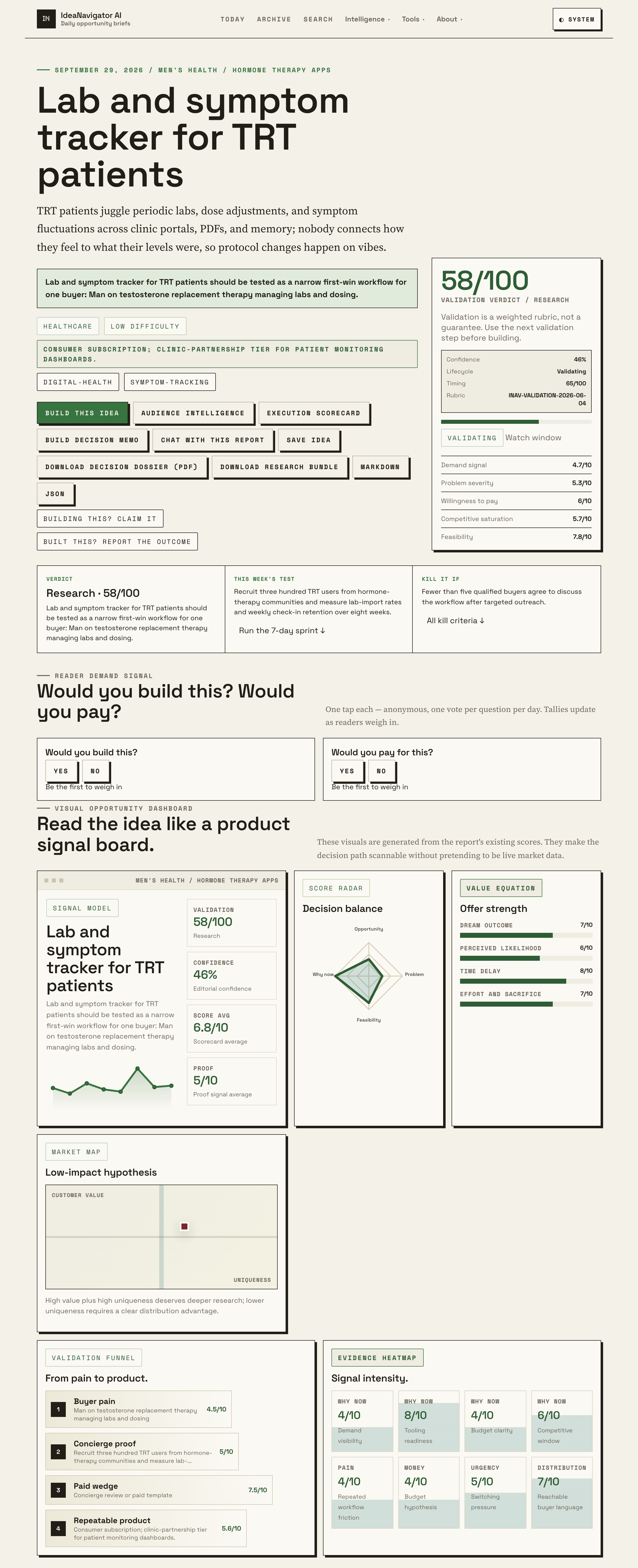
A new product concept from IdeaNavigator AI proposes an app that lets men on testosterone replacement therapy import lab PDFs, chart hormone panels against dose changes and daily symptom check-ins, and generate clinic-visit summaries. The idea targets a fragmented telehealth-driven patient population and proposes a subscription business model with a clinic-partnership tier.
A newly published product concept from IdeaNavigator AI proposes a dedicated tracking app for men on testosterone replacement therapy (TRT), designed to connect periodic lab results, dose changes, and daily symptom fluctuations in one place. The concept, outlined under the working title “TRT Care at a Glance: Your Labs and Symptom Tracker,” argues that TRT patients currently manage their care across clinic portals, PDFs, and memory, with no tool linking how they feel to what their blood levels actually were.
According to the concept document, the minimum viable product would allow users to import lab PDFs and chart hormone panels over time, overlaid against dose changes and daily symptom check-ins. The app would generate trend summaries for clinic visits and flag values drifting outside target ranges — turning scattered data into a single longitudinal record the patient and clinician can review together.
The proposed target user is narrow and specific: a man on testosterone replacement therapy managing labs and dosing. The concept frames this focus as deliberate, recommending the workflow be tested as a “narrow first-win workflow for one buyer” rather than a broad men’s health platform from day one.
On the business side, the concept proposes a consumer subscription as the primary revenue model, supplemented by a clinic-partnership tier that would give hormone-therapy clinics patient-monitoring dashboards. The validation plan calls for recruiting 300 TRT users from hormone-therapy communities and measuring lab-import rates and weekly check-in retention over eight weeks.
Why TRT Patients Need Connected Tracking
The concept addresses a gap created by the recent surge in TRT prescriptions and telehealth clinics. According to IdeaNavigator AI, that growth has produced a large population of self-managing patients whose care is fragmented across multiple providers — often by design, as telehealth models rotate or split clinical responsibility. The document’s central claim is that without a tool connecting symptoms to lab values, protocol changes happen on vibes rather than data.
If validated, the product category could matter beyond TRT. Lab-import and symptom-correlation workflows are a general pattern in chronic hormone care, and a demonstrated first win in the TRT niche — a market with engaged online communities and recurring lab work — could provide a template for adjacent hormone-therapy use cases. The clinic-partnership tier also signals potential B2B demand from telehealth operators seeking patient-monitoring capabilities.
Telehealth Boom Behind the Concept
The concept sits within the broader men’s health and hormone therapy app market, a category that has expanded alongside direct-to-consumer TRT telehealth services. These services typically require patients to complete periodic blood panels, but the results often live in separate clinic portals or arrive as PDFs, with dose adjustments communicated piecemeal.
IdeaNavigator AI frames the timing argument in two parts: rising prescription volume has enlarged the addressable user base, and the multi-provider structure of telehealth care has made fragmentation worse rather than better. The proposed MVP — import, chart, correlate, summarize, flag — is scoped to address exactly that fragmentation without requiring integration with any specific clinic’s systems at launch.
What the Concept Hasn’t Proven Yet
The document is a product concept, not a shipped product. No app has been built, no company or founder has been announced, and no user data exists yet. Key open questions include whether lab-PDF parsing can handle the varied formats produced by different testing labs, whether users will sustain weekly symptom check-ins beyond the initial novelty period, and whether clinicians will accept app-generated trend summaries during visits.
Regulatory positioning is also unaddressed in the concept. An app that flags values outside target ranges may implicate medical-device or clinical-decision-support rules depending on jurisdiction and how the flagging is implemented, and the document does not specify how that would be handled. Whether clinics would pay for the proposed partnership tier is likewise untested.
The Eight-Week Validation Test
The concept’s own next step is its validation plan: recruiting 300 TRT users from hormone-therapy communities and running an eight-week measurement period focused on two metrics — how often users import their lab PDFs, and how many complete weekly symptom check-ins. High retention on both would support building out the full charting and clinic-summary features; weak retention would suggest the workflow is not sticky enough to sustain a subscription model. If validation succeeds, the consumer subscription and clinic-partnership tiers would follow as commercial builds.
Source: IdeaNavigator AI
Key Questions
Is the TRT lab and symptom tracker an available app?
No. As of publication, this is a product concept published by IdeaNavigator AI. No app has been released, and no company behind it has been announced.
What would the app actually do for a TRT patient?
According to the concept, users would import lab PDFs, see hormone panels charted over time against dose changes, log daily symptoms, receive trend summaries for clinic visits, and get flagged when values drift outside target ranges.
How would the product be validated?
The proposed plan is to recruit 300 TRT users from hormone-therapy communities and measure lab-import rates and weekly check-in retention over an eight-week period.
Who is the target user?
The concept deliberately targets one narrow buyer: a man on testosterone replacement therapy who is actively managing his labs and dosing, rather than a general men’s health audience.
How would the business make money?
The concept proposes a consumer subscription as the main revenue source, plus a clinic-partnership tier offering patient-monitoring dashboards to hormone-therapy providers.
Source: IdeaNavigator AI
Halloween Picks
halloween
As an affiliate, we earn on qualifying purchases.