

🔍 Read the full analysis: A Roundup Of 14 AI Workflow Automation Software Tools For 2027 on ThorstenMeyerAI.com

Get hardware and tech essentials delivered free with Prime
- Fast, free delivery on millions of items
- Prime Video, Amazon Music and more included
- Member-only deals all year
TL;DR
According to ThorstenMeyerAI.com’s roundup, the 14 AI workflow automation options for 2027 are organized for business users, developers and enterprise teams. The article favors no-code approaches for quick starts and code-first frameworks for more control, while noting that the entries are largely guides and playbooks rather than a uniform set of software products.
ThorstenMeyerAI.com has published its original roundup of 14 AI workflow automation options for 2027, sorting resources for business users, developers and enterprise teams by technical skill and operational needs. The roundup highlights no-code materials for quick implementation and code-first approaches for greater flexibility, but its entries include guides and playbooks as well as named platforms, rather than 14 directly comparable software products.
ThorstenMeyerAI.com recommends The No-Code AI Automation Playbook as its overall choice for business users who want to automate without writing code. The roundup says the resource connects approaches associated with Zapier, Make and n8n. For developers seeking more control over custom agents, the article points to n8n AI Automation and cites its Python integration as a reason to consider it.
Other named resources in the roundup include Agentic Coding with Claude Code, Agentic AI for DevOps, and AI-Powered Automation for Small Business. ThorstenMeyerAI.com presents these as relevant to different needs: agent-driven development and operations, or starting small with business processes. The article also identifies Microsoft Power Automate as a natural option for organizations already using Microsoft products.
According to the roundup, its selection criteria included practical instructions that can lead to a working workflow and accessibility for the intended user. The supplied material does not present independently reported performance tests, pricing comparisons, or a uniform feature benchmark. ThorstenMeyerAI.com’s main caveat is that simpler no-code workflows can be less adaptable as requirements grow, while comparing AI automation software options can help teams assess what fits their needs, since code-based systems require skills and resources that some teams may not have.
The 14 picks
- 1
 Agentic AI for DevOps Engineers: Building Autonomous CI/CD, Infrastructure, a…View on Amazon →
- 2
 Workflow Automation with Microsoft Power AutomateView on Amazon →
- 3
 Claude AI for Smart Automation: No-Code Strategies to Build Intelligent Workf…View on Amazon →
- 4
 The No-BS Guide to AI Agents & Automation: Build AI Workflows, Automate Your…View on Amazon →
- 5
 AI Agents: From Theory to Operations — A Practical Guide to Business Automati…View on Amazon →
- 6
 50 AI Workflows for Engineers: From Debugging to System Design, Code Review &…View on Amazon →
- 7
 AI-Powered Automation and Workflows for Small Business OwnersView on Amazon →
- 8
 Practical Autonomous Workflow Automation: Build AI Agents and Automate Real-W…View on Amazon →
- 9
 Hands-On AI Workflow Automation: A Beginner-Friendly Roadmap to Eliminating R…View on Amazon →
- 10
 The No-Code AI Automation Playbook: Build Practical AI Workflows with Zapier,…View on Amazon →
- 11
 AI for Everyday Automation: 7 AI Workflows to Save Hours at Work Every WeekView on Amazon →
- 12
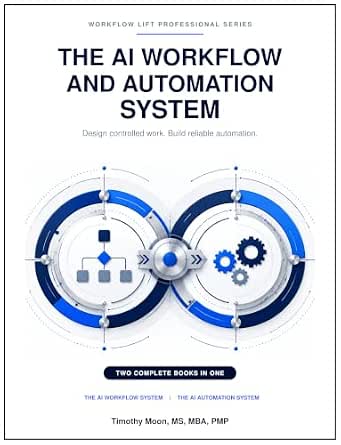 AI Workflow and Automation System – Workflow Lift Professional SeriesView on Amazon →
- 13
 n8n AI Automation: Build Smarter Workflows, Agents, and Intelligent Systems w…View on Amazon →
- 14
 Agentic Coding with Claude Code (5-in-1): A Practical Developer’s Handbook fo…View on Amazon →
Choosing Tools by Team Capability
ThorstenMeyerAI.com’s roundup argues that automation choices depend on more than a platform’s feature list. Technical capacity, integration needs and expected workflow complexity affect whether a team can build and maintain a system. The article suggests a simple tool may help a small team begin quickly, while a developer-led organization may need custom logic and more control.
The roundup says these differences matter as automated workflows connect business applications and move information between services. It advises readers to check API support, connector reliability, projected costs at higher volumes, security controls and error handling. These are selection considerations, not evidence that any one entry is suitable for every organization. The supplied material does not include a comparative test establishing a best product across all use cases.
Products Worth Considering

Logitech MX Keypad Programmable Macro Pad for Developers, Graphite

Ledger Nano X Bluetooth Crypto Wallet

Apple MacBook Air 15-inch with M5 chip, 16GB Memory, 512GB SSD, and Liquid Retina Display
As an affiliate, we earn on qualifying purchases.
How the Roundup Groups Its Picks
ThorstenMeyerAI.com divides the options into no-code playbooks, developer-oriented resources and enterprise guidance. The article describes Zapier and Make as options aimed at accessible workflow building, and n8n as a route for users who want more flexibility and can manage technical setup. It also says workflow design matters: automations with branching logic can be harder to manage than simple sequences.
For larger organizations, the roundup points to integration demands and existing systems as deciding factors. It calls Microsoft Power Automate a default choice for companies already embedded in Microsoft’s ecosystem. That is the source’s recommendation, not a universal ranking; the supplied material gives no comparative adoption figures or independent verification of the products’ current capabilities.
What the List Does Not Establish
The supplied source material does not name all 14 entries, although the roundup’s title promises that number. It also does not provide a publication date, detailed methodology results, current prices, product versions, or evidence from controlled testing. The roundup’s heading refers to software tools, but several entries provided are framed as books, guides or playbooks, so it is unclear whether the complete list is intended to compare products, learning resources or both.
Claims about individual options—including their suitability, flexibility and integrations—are recommendations in ThorstenMeyerAI.com’s roundup, not independently established findings here. Readers should verify current features, supported connectors, security terms and costs with vendors before making decisions. The source’s discussion of GDPR and HIPAA describes checks buyers should make; it does not certify any named tool as compliant.
Verify Fit Before Adoption
ThorstenMeyerAI.com advises readers to compare the complete 14-item list against their own systems and requirements. Before adopting a platform, teams can test a representative workflow, confirm that essential apps and APIs are supported, review data handling and access controls, and estimate costs at higher usage levels. The roundup also stresses that workflows need ongoing maintenance as APIs and business processes change.
The supplied material identifies no product launch, benchmark, regulatory decision or follow-up announcement. The status of individual products and the full set of 14 picks therefore remains subject to verification against the original roundup and current vendor information.
Key Questions
What does the 2027 roundup cover?
ThorstenMeyerAI.com presents 14 AI workflow automation options for business users, developers and enterprise teams. The supplied material names several platforms and learning resources, but does not include all 14 entries.
Which option does the source favor for nontechnical users?
ThorstenMeyerAI.com names The No-Code AI Automation Playbook as its overall choice for users seeking to automate without coding. That is the source’s recommendation, not an independently tested ranking.
What does the source recommend for developers?
The roundup points developers seeking control over custom agents toward n8n AI Automation, citing Python integration. The supplied material does not provide a technical benchmark comparing it with other frameworks.
Are all 14 entries software products?
That is not clear from the supplied material. Several entries named in the roundup are described as guides or playbooks, alongside platforms such as Zapier, Make, n8n and Microsoft Power Automate.
What should teams check before choosing an automation tool?
The roundup advises checking technical skill requirements, integrations, scaling costs, security and maintenance. Teams should confirm current vendor capabilities and terms for their own use case.
Source: ThorstenMeyerAI.com