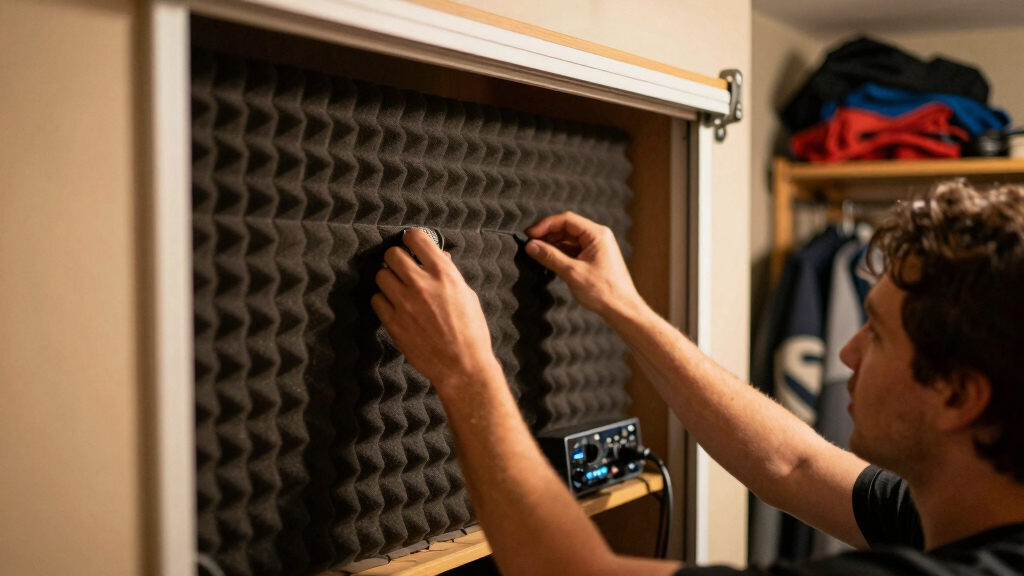

📊 Full opportunity report: Acoustic Dampening, Placement, and the “Rig in the Closet” Setup on ThorstenMeyerAI.com — validation score, market gap, and execution plan.

Get hardware and tech essentials delivered free with Prime
- Fast, free delivery on millions of items
- Prime Video, Amazon Music and more included
- Member-only deals all year
TL;DR
Moving AI workstations out of the workspace into separate rooms or closets significantly reduces noise. Proper ventilation is essential for enclosed setups to prevent overheating. Acoustic foam alone is less effective than strategic placement and isolation.
Placing high-power AI workstations in separate rooms or closets, combined with proper ventilation, is the most effective way to reduce noise levels in a workspace, according to recent expert guidance.
Recent technical advice emphasizes that the primary way to mitigate noise from AI rigs is to move the equipment away from the workspace, such as into a different room or closet. This approach leverages distance and isolation, which are more effective than acoustic foam or sound barriers alone.
The ‘rig in the closet’ setup is gaining popularity, but it requires careful attention to ventilation. Sealing a closet without proper airflow can lead to heat buildup, risking hardware damage. Active or passive ventilation, including exhaust fans and ducting, is necessary to dissipate heat effectively.
Experts highlight that acoustic foam and barriers are less effective at blocking airborne and structure-borne noise compared to strategic placement and decoupling solutions like rubber feet or anti-vibration pads. These measures significantly reduce noise transmission and improve overall quietness.
Acoustic dampening
& the rig in the closet.
The most powerful noise fix isn’t a material — it’s a floor plan. A rig you can’t hear because it’s in another room beats any amount of foam. Tap the approaches in Part 1 to see what actually works.
(another room)
(levers 1–4)
(door / barrier)
(acoustic foam)
Contain the noise, not the heat
Why Moving Rigs to Separate Rooms Is a Game-Changer
Relocating AI workstations to separate rooms or closets drastically reduces noise pollution in work environments, improving productivity and comfort. Proper ventilation ensures hardware longevity, making this approach both practical and sustainable. This method shifts the focus from passive soundproofing to active isolation, which is more effective for high-power equipment.As an affiliate, we earn on qualifying purchases.
Current Best Practices for Noise Reduction in AI Workstations
Traditionally, users relied on acoustic foam, barriers, and decoupling to manage noise at the source. However, these methods have limited effectiveness against airborne and structure-borne noise, especially with high-power GPUs and CPUs generating significant heat and sound.
The emerging consensus emphasizes that physical separation—placing the rig in a different room or closet—is the most effective strategy. This approach aligns with the fact that most AI inference tasks are performed remotely, reducing the need for the workstation to be in the same space as the user.
Recent developments include the use of purpose-built soundproof cabinets that combine acoustic treatment with temperature-controlled airflow systems, offering a balanced solution for quiet and cool operation.
"Moving high-power rigs into separate rooms or closets is the most effective way to eliminate noise in your workspace. Proper ventilation is crucial to prevent overheating and hardware damage."
— Thorsten Meyer, AI workspace expert
AI workstation noise reduction enclosure
As an affiliate, we earn on qualifying purchases.
As an affiliate, we earn on qualifying purchases.
Remaining Questions About Enclosed Setup Effectiveness
While placing rigs in closets or rooms is proven effective, the optimal ventilation solutions and long-term reliability of sealed setups are still under discussion. The precise balance between noise reduction and heat dissipation varies based on hardware specifications and room design.
It is also unclear how different types of enclosures or cabinets perform in various environments, and what specific modifications are necessary for maximum efficiency.
As an affiliate, we earn on qualifying purchases.
Next Steps for Implementing Quiet AI Workstations
Practitioners are advised to focus on creating well-ventilated, dedicated spaces for their AI rigs, ensuring airflow and temperature control. Further research and development are expected to refine soundproof cabinet designs and ventilation systems.
In the near future, more robust, cost-effective solutions combining acoustic treatment with active cooling are likely to become widely available, making the 'rig in the closet' approach more accessible and reliable.
acoustic treatment for computer room
As an affiliate, we earn on qualifying purchases.
As an affiliate, we earn on qualifying purchases.
Key Questions
Is it necessary to use specialized soundproof cabinets for a closet setup?
While not strictly necessary, purpose-built soundproof cabinets improve noise reduction and heat management, especially for high-power GPUs. DIY solutions can work with proper ventilation and decoupling, but commercial cabinets offer more reliable performance.
How can I ensure my enclosed setup stays cool enough?
Implement active ventilation with quiet exhaust fans, ducting, and possibly thermostatic controls. Proper airflow prevents heat buildup, which is critical for hardware longevity.
What are the main benefits of moving the rig to a different room?
The primary benefit is significant noise reduction in your workspace, creating a quieter environment for work and collaboration. It also reduces the need for extensive acoustic treatments inside the workspace itself.
Are there risks associated with sealing a rig in a closet or cabinet?
Yes, without proper ventilation, heat can accumulate, leading to thermal throttling or hardware damage. Ensuring adequate airflow and temperature regulation is essential to mitigate these risks.
Source: ThorstenMeyerAI.com
Halloween Picks
halloween
As an affiliate, we earn on qualifying purchases.