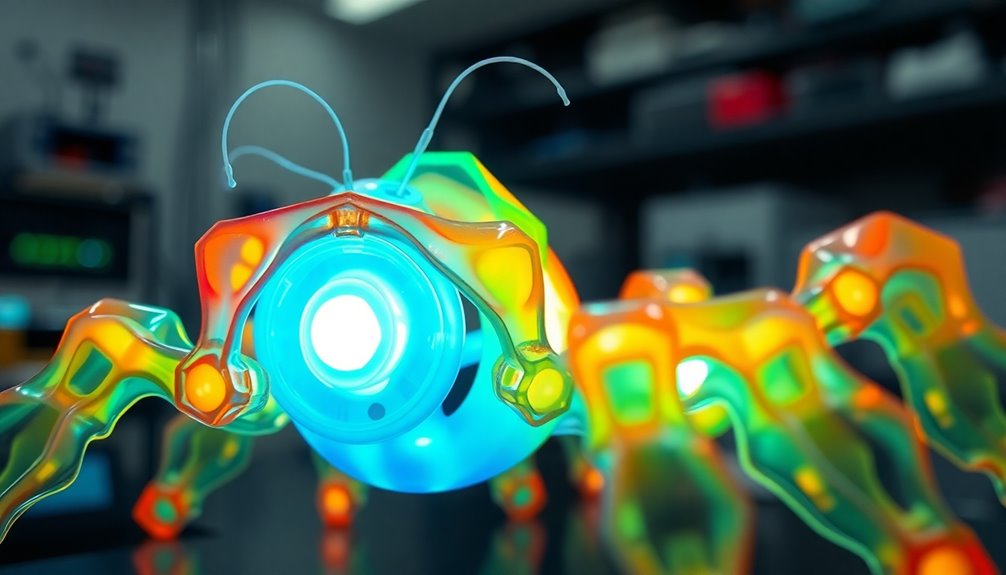

Imagine a world where robots adapt seamlessly to their surroundings, powered by the materials they're made from. Soft robots that utilize 'embodied energy' are making this a reality. These innovations not only enhance energy efficiency but also reduce our reliance on traditional power sources. As you explore this topic, consider how these advancements could reshape industries and the implications for sustainability. What's next in the evolution of robotic technology?

Get hardware and tech essentials delivered free with Prime
- Fast, free delivery on millions of items
- Prime Video, Amazon Music and more included
- Member-only deals all year

In the evolving landscape of robotics, soft robots powered by embodied energy are revolutionizing how we think about energy efficiency and multi-functionality. You'll find that embodied energy integrates energy storage and transduction within the structural materials of robots, enhancing both their efficiency and versatility. This innovative concept is inspired by biological systems, where energy storage and usage are seamlessly intertwined, leading to remarkable adaptability in nature.
Soft robotics is a perfect application for this principle, as flexible materials can serve multiple roles. Imagine a robot whose structure not only moves but also stores energy, reducing the need for separate, bulky battery packs. This means that soft robots can operate longer and more efficiently, a game-changer in various fields like healthcare, manufacturing, and environmental monitoring.
Different methods of energy storage and transduction play crucial roles in these developments. For example, electrical energy is often stored in batteries such as lithium-ion, which can also contribute to the robot's structure. Mechanical energy utilizes elastic components to store energy effectively, as seen in series elastic actuators. Additionally, chemical energy, magnetic energy, and thermal energy storage methods are increasingly integrated into soft robots, providing a holistic approach to energy management.
Embodied intelligence is another fascinating aspect of soft robotics. It integrates sensing, actuation, and control within a robot's body, making it more adaptable to diverse environments. Soft materials not only act as sensors but also enable distributed control, allowing robots to respond passively to changes around them. This adaptability is crucial for interacting with complex environments, and advancements in manufacturing techniques like 3D printing and soft lithography facilitate the creation of intricate soft robotic structures inspired by nature. Embodied intelligence emphasizes the synergy of brain, body, and environment, contributing to more natural robotic behaviors.
However, challenges like achieving energy autonomy still loom large. Efficient energy storage and harvesting are essential for soft robots to thrive. Researchers are also exploring electronic-free logic for simpler tasks, aiming for sustainability by using eco-friendly materials and reducing electronic components.
The complexity of balancing simplicity with performance in fully autonomous systems remains a topic of ongoing investigation.
As you engage with this exciting field, you'll see the potential of combining soft and hard components to enhance functionality. The future of robotics isn't just in hard, rigid machines but in the harmonious integration of soft robots powered by embodied energy.
As an affiliate, we earn on qualifying purchases.
As an affiliate, we earn on qualifying purchases.
flexible energy storage materials
As an affiliate, we earn on qualifying purchases.
As an affiliate, we earn on qualifying purchases.
As an affiliate, we earn on qualifying purchases.
Fall Picks
fall essentials
As an affiliate, we earn on qualifying purchases.