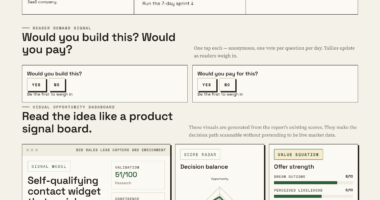

📊 Full opportunity report: A War Room for Your Next Idea: Inside IdeaClyst on ThorstenMeyerAI.com — validation score, market gap, and execution plan.

Get hardware and tech essentials delivered free with Prime
- Fast, free delivery on millions of items
- Prime Video, Amazon Music and more included
- Member-only deals all year
TL;DR
IdeaClyst is a new local-first AI platform that helps founders validate and develop startup ideas through structured council deliberations. It aims to reduce market failure risks and keeps data on the founder’s device.
IdeaClyst, a new local-first AI platform designed for founders, has been launched to facilitate structured validation and critique of startup ideas, aiming to reduce costly market failures.
The platform functions as an AI council that pressure-tests ideas through a five-step deliberation process, including strategy, technical architecture, critique, and synthesis. It operates entirely on the user’s local machine, ensuring data privacy and ownership, and is open source under the MIT license. Founders input their ideas, which are then evaluated by multiple AI models playing different roles, providing a comprehensive, disagreement-driven assessment. The tool aims to cut down research time from months to hours, helping founders make more informed decisions before building or investing in ideas. It also finds new ideas through its discovery engine, complementing the validation process with fresh insights.A war room for your next idea
The build isn’t the hard part anymore — conviction is. Knowing which idea deserves the next six months, and being able to defend it. Most founders answer with gut feel and optimistic math. That’s hope wearing a blazer. IdeaClyst replaces it with a process.
The most expensive decision is what to build
The single most valuable thing a tool can do is talk you out of the wrong six months. The numbers make the case better than any pitch.
Three tools in one — on your own machine
Strip away the framing and IdeaClyst is three things at once, all running locally with nothing leaving your laptop.
An AI council
Pressure-tests an idea you bring it — advisors who argue on purpose.
A discovery engine
Finds ideas you didn’t know to look for by hunting real demand signals.
A founder’s workspace
Carries winners from “interesting” all the way to “ready to build.”
Advisors who disagree on purpose
Not one confident, agreeable answer — a structured five-step deliberation where models play different roles and turn on their own work. The disagreement is the feature.
The five-step deliberation
A council that leads with the bad news surfaces the objections you’d otherwise find the expensive way, on month five.
Product strategy
Who’s it for, what’s the wedge, why now, what’s the business model.
Technical architecture
What would it actually take to build — and where’s the risk.
Critique pass
The council turns on its own work. Where’s the hand-waving? What kills this?
Second, independent critique
A different voice, a different angle — so blind spots don’t survive.
Final synthesis
Everything into one coherent founder packet: strategy, architecture, validation, plan.
When IdeaClyst cites a source, it actually fetched it
The hard departure from “ask an AI what it thinks of my startup.” It runs in a strict, real-data-only mode — if it can’t gather genuine evidence, it says so plainly rather than inventing a plausible paragraph.
Confidence with receipts
No fabricated statistics, no imaginary competitors, no made-up citations. The packet survives a skeptical co-founder or a sharp investor because the reasoning has receipts.
Market research first
Scouts the landscape before the council reasons about anything.
Competitor read
Real positioning, pricing signals, feature claims — differentiation vs. reality.
Validation with links
Not “talk to customers” — concrete signals & sources you can click.
From the blank page to build-ready
Evaluation is half the problem; the blank page is the other half. And a plan is worthless if it dies in a tab you never reopen.
Bring a space, not an idea
“AI for accountants,” “tools for indie game studios” — plus your goal and real capacity. It hunts demand signals across HN, Reddit, Product Hunt, GitHub, pricing pages.
- An honest market read — leads with the bad news when a space is hard
- An opportunity map — high pain, thin competition
- Ranked candidates — wedge, who pays, effort, risk, confidence
- each with KILL CRITERIA — when to walk away
A home and a forward path
Every promising idea gets carried forward, with every artifact in plain files on your disk.
- Validation tooling — sprint board, interview list, evidence browser
- Founder profile — a personal-fit lens; same discovery, different advice
- Build workspaces — funnel, personas, landing draft, version history
- “Build this idea” → a PRD + task queue, ready for a coding agent
Why IdeaClyst Could Transform Startup Decision-Making
By offering a structured, AI-driven process that emphasizes disagreement and thorough critique, IdeaClyst addresses a key failure point in startups: building products no one needs. Its local-first approach ensures data privacy, appealing to founders wary of cloud dependencies. The platform’s ability to compress validation timelines from months to hours could significantly reduce wasted resources and improve success rates, making it a potentially disruptive tool in early-stage startup development.As an affiliate, we earn on qualifying purchases.
The Growing Need for Better Idea Validation Tools
Startups often fail due to lack of market need, with 42% of failures attributed to building the wrong product, according to CB Insights. Traditionally, validation involves costly and time-consuming research, which many founders skip or inadequately perform. AI tools have begun to automate parts of this process, but most rely on cloud services and lack rigorous disagreement frameworks. IdeaClyst emerges as a local-first alternative that emphasizes structured critique and comprehensive evaluation, aligning with the increasing demand for privacy-conscious, efficient validation methods in 2026.“IdeaClyst is designed to help founders make better, faster decisions by providing a structured, disagreement-driven AI council that stays entirely on their own device.”
— Thorsten Meyer, founder of ThorstenMeyerAI.com
AI-driven business idea critique tool
As an affiliate, we earn on qualifying purchases.
As an affiliate, we earn on qualifying purchases.
What Aspects of IdeaClyst Are Still Developing?
Details about user adoption, integration with existing tools, and how well the AI council performs across different industries remain unconfirmed. Learn more about IdeaClyst’s development. The platform’s real-world effectiveness and how it compares to traditional validation methods are still being evaluated.local data privacy startup platform
As an affiliate, we earn on qualifying purchases.
As an affiliate, we earn on qualifying purchases.
Next Steps for IdeaClyst and Its Users
The developers plan to release a beta version for early adopters in the coming months, gather feedback, and refine the AI council’s capabilities. Further integration with popular startup tools and case studies demonstrating its impact are expected. Founders interested in testing the platform can sign up for early access once available.As an affiliate, we earn on qualifying purchases.
Key Questions
How does IdeaClyst ensure data privacy?
All data, including ideas and reports, are stored locally on the user’s machine, with no data leaving the device. The platform is open source under the MIT license, ensuring transparency and control.
Can IdeaClyst replace traditional market research?
It aims to accelerate and enhance early-stage validation by automating research and critique, but it is not a replacement for direct customer engagement and real-world validation.
Is IdeaClyst suitable for all types of startups?
While designed to be flexible, its effectiveness may vary depending on the industry and complexity of the idea. Early feedback from users will help determine its broader applicability.
How does the disagreement framework improve decision-making?
The AI council stages structured debates among models playing different roles, surfacing objections and alternative perspectives that a single AI or human might miss, leading to more balanced and thorough evaluations.
Source: ThorstenMeyerAI.com
Halloween Picks
halloween
As an affiliate, we earn on qualifying purchases.