
🔍 Read the full analysis: Why This AI Artwork Holds The Light: “OORT — Comet Vigil For P/2043 K1 Vesper” on ThorstenMeyerAI.com

Get hardware and tech essentials delivered free with Prime
- Fast, free delivery on millions of items
- Prime Video, Amazon Music and more included
- Member-only deals all year
TL;DR
OORT — Comet Vigil for P/2043 K1 Vesper is an AI-built website and fictional observatory, not a report of a real comet. Its canvas accumulates star trails during a visit, while scrolling and other controls animate an imagined comet and record a simulated act of observation.
OORT — Comet Vigil for P/2043 K1 Vesper, an AI-built exhibition piece presented as room 170 of a 175-room series, turns a fictional observatory into an interactive artwork about waiting, as explored in the original analysis. Its central device is a field of star trails that lengthen with time spent on the page, making a visitor’s duration part of the work rather than a pause before its content.
The site describes P/2043 K1 Vesper as fictional, as is the observatory and the community imagined to have watched it for decades. The visual premise is built with code: a seeded star field draws curved trails on a canvas, and elapsed time extends them. The same local sky can resume when a visitor returns on that device, using local storage to preserve elapsed time.
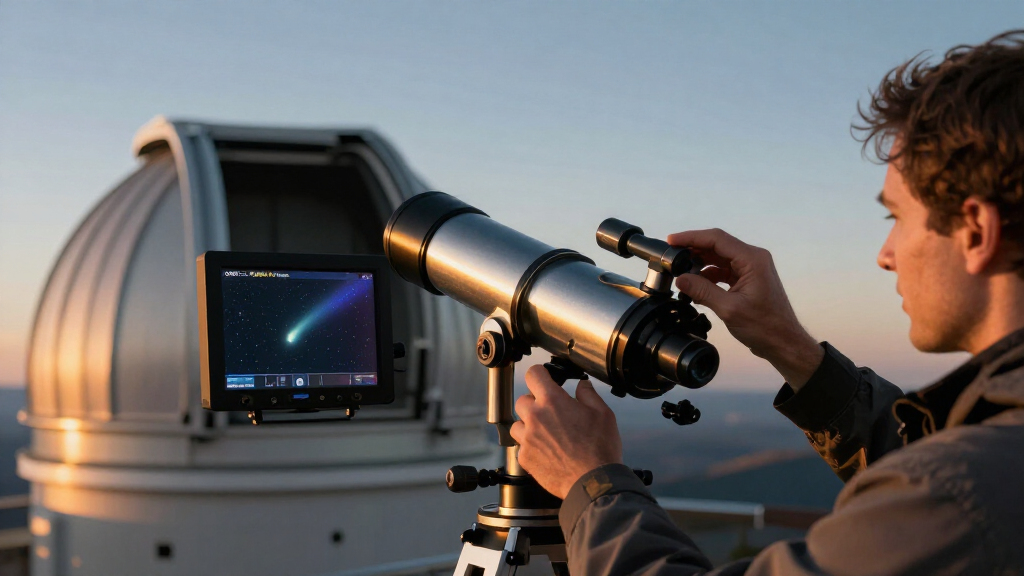
Other controls extend the observatory conceit. Scrolling moves the comet through an inline SVG, with an ion tail directed away from the sun and a dust tail curved along the imagined orbit. A range control changes the defocus view and its associated brightness estimate. Visitors can also hold a control to open a simulated shutter; the site records a timestamp but does not present the moment as a real sighting.
The design uses deep black, cyan, warm red-orange and pale dust-toned text to suggest a dark-adapted observing room. Display lettering gives headings and measurements an instrument-like appearance, while monospaced text presents coordinates and notes in a logbook style. The supplied description says the animation stops when the page is hidden and offers a still version for people using reduced-motion settings.
Room 170 / 175 · AI-Built Exhibition
Why This AI Artwork Holds The Light
OORT — Comet Vigil for P/2043 K1 Vesper is a fictional observatory and interactive artwork. Its star trails build as visitors stay, making time itself part of the viewing experience.
01 / The mechanism
How the Website Makes Waiting Visible
The visit becomes an exposure: elapsed time, movement, and small acts of attention shape what appears on screen.
A sky that accumulates
A seeded star field draws curved trails on a canvas. The trails lengthen while the page remains open, and local storage can preserve the same device’s sky for a return visit.
An orbit controlled by scroll
Scrolling moves the imagined comet through an inline SVG. The ion tail points away from the sun; the dust tail curves along the fictional orbit.
A shutter without a sighting
A range control adjusts defocus and its associated brightness estimate. Holding the shutter control records a timestamp as a simulated observing ritual.
02 / Visitor sequence
From Arrival to Return
The interface links a fictional premise to simple, legible actions in an imagined dark-adapted observing room.
Enter the observatory
Meet a fictional comet and a community imagined to have watched it for decades.
Stay with the sky
Seeded star trails build over time, turning the visit into part of the image.
Move through the orbit
Scroll to animate the comet; use the controls to change focus and brightness.
Leave and return
The described local sky can resume on the same device. “Your visit is the exposure.”
03 / The exhibition
A Technical Study in an Imagined Room
OORT is presented as both an artwork and a study of how code, interaction, and visual direction can support a fictional premise.
The supplied material identifies OORT as room 170 in a 175-room AI-built exhibition, with a live room, a design guide, and a wider exhibition hub. Its art direction specifies an observatory palette, instrument-like display lettering, and monospaced logbook details.
The description also says animation stops when the page is hidden and that a still version is available for visitors using reduced-motion settings. These are details from the supplied brief, not an independent audit of the live implementation.
“The comet remains unseen and in transit.”OORT exhibition description
04 / A clear boundary
What the Fiction Does Not Establish
The artwork does not establish a real comet’s orbit, discovery, brightness, or observation history. The decades-long vigil and “last seen 1608” provenance belong to its invented setting and are not verified astronomy.
The supplied description does not provide an independent technical review, visitor data, or confirmation that every requirement in the prompt was met. It also does not specify when the room first went live or whether the live page has changed since the description was prepared.
05 / Key questions
What Visitors Should Know
The supplied material describes a digital artwork, not an astronomical report.
Is P/2043 K1 Vesper real?
No. The source describes it as fictional, created for an imagined observatory and its long-running vigil.
What changes during a visit?
A seeded canvas draws curved trails that lengthen with elapsed time. The description says local storage can let the same device resume its sky later.
Does the shutter record an observation?
No. It records a timestamp as simulated attention; the artwork does not claim a comet sighting.
How does the animation respond?
Scrolling changes the comet’s SVG position. Its ion tail points away from the sun, while the dust tail curves along the imagined orbit.
Is OORT part of a larger project?
Yes. It is identified as room 170 of 175 in an AI-built exhibition, with a hub linking the wider series.
Where can visitors explore?
The supplied material points to the live OORT room, a design guide, and the exhibition hub. It names no scheduled event or release date.
How the Website Makes Waiting Visible
The work’s main idea is that time spent viewing can change what a viewer sees. Rather than treating a visit as a route through static information, OORT makes duration an input: trails grow while the page remains open, and the record of a shutter press marks attention without inventing a discovery.
That approach also makes the interface part of the subject. The visitor does not observe a real comet, but does encounter a system that links elapsed time, movement and a simulated observing ritual. For readers interested in AI-made digital art, the piece offers a concrete example of how code, interaction and a fictional premise can work together. Its claims should be understood as descriptions of the artwork, not as astronomical observations or evidence about a real object.
Products Worth Considering

Apple MacBook Air 13-inch Laptop with M5 Chip, 16GB Memory, 512GB SSD, Liquid Retina Display, and 12MP Center Stage Camera (2026, Silver)

Apple MacBook Pro 16.3-inch with PROLED XDR Display, Silver

Ledger Flex + Folio Crypto Hardware Wallet
As an affiliate, we earn on qualifying purchases.
Inside the 175-Room Exhibition
The supplied material places OORT in a larger series of 175 AI-built exhibition rooms, identifying it as room 170 and directing visitors to a live site and an exhibition hub. It also links to a design guide explaining the seeded exposure, SVG orbit and visual choices. The page is presented as both an exhibition and a technical study of how those elements are assembled.
The artwork’s prompt, exposed through a footer link according to the source material, describes a fictional comet vigil and specifies the intended observatory palette, typography, motion and interactions. It also calls for accessibility and performance features, including reduced-motion handling, pausing animation when a tab is hidden, and layouts for different screen widths. These details come from the supplied description and brief; they are not an independent audit of the live site.
“The page makes duration part of the artwork instead of treating it as time spent before the content.”
— The OORT exhibition description
What the Fiction Does Not Establish
P/2043 K1 Vesper is fictional, so the site does not establish a real comet’s orbit, discovery, brightness or observation history. The brief includes invented details such as a decades-long vigil and a “last seen 1608” provenance; these belong to the artwork’s fictional setting and should not be read as verified astronomy.
The supplied source describes the site’s behavior and design goals but does not provide an independent technical review, visitor data or evidence that every implementation requirement in the prompt was met. It is also not clear from the material when the room first went live or whether the live page has changed since the description was prepared.
Where Visitors Can Explore OORT
The immediate next step is to visit the live OORT room and see how the sky changes during a session; the source also points to a design guide and the wider 175-room hub. The supplied material does not announce a scheduled event, release date or further development. Any later updates to the room or exhibition are not specified.
Key Questions
Is P/2043 K1 Vesper a real comet?
No. The source describes P/2043 K1 Vesper as fictional, created for an imagined observatory and its long-running vigil.
What changes while someone stays on the page?
A seeded canvas draws curved star trails that lengthen with elapsed time. According to the description, local storage allows the same device’s sky to resume on a later visit.
Does the shutter interaction record a real observation?
No. It records a timestamp as a simulated act of attention. The artwork frames the comet as unseen and still in transit, rather than claiming a sighting.
How does the comet animation work?
Scrolling changes the comet’s position through an inline SVG. Its ion tail points away from the sun, while the dust tail curves along the imagined orbit; both respond to the same progress value.
Is OORT part of a larger project?
Yes. The supplied material identifies it as room 170 of 175 in an AI-built exhibition and links to the other rooms through the exhibition hub.
Source: ThorstenMeyerAI.com